GBP/USD Forecast: Three reasons for the crash and some technical hope for the bulls
- Brexit uncertainty has risen after the EU and UK laid opposing visions to post-Brexit relations.
- The coronavirus outbreak is boosting the safe-haven dollar.
- The greenback is gaining after upbeat US figures.
- Tuesday's four-hour chart is pointing to oversold conditions.

Every party has its hangover – and Brexit is no exception. Fresh tensions between London and Brussels explain part of GBP/USD's downfall – near 300 pips since Friday and hitting the lowest levels since mid-December.
Here are three reasons for the crash:
1) Brexit bites
After the UK officially left the EU on January 31, both sides laid down their visions for post-Brexit relations after the transition period expires at year-end, The differences are stark.
Michel Barnier, the EU's Chief Negotiator, said that to have easy market access, the UK would have to align itself with EU rules, including adhering to the European Court of Justice. On the other hand, UK Prime Minister Boris Johnson rejects taking any rules from the bloc and maintained a combative tone.
Both sides are also at loggerheads over fisheries and other topics. If they fail to strike an agreement, Britain will deal with the EU on World Trade Organization terms (WTO) which would be a shock to the economy. The near simultaneous speeches from both sides of the Channel sparked cable's sell-off.
2) Coronavirus is mostly dollar-positive
The coronavirus outbreak continues raging, claiming the lives of over 400 people and infecting over 20,000. A second death outside China was reported in Hong Kong while Belgium reported its first infection. Economic activity in Asia and elsewhere is under pressure.
While stocks are moving from falls to recoveries, the greenback is one of the currencies of choice. Contrary to last week's dollar dumping – correlated with sliding US bond yields – the world's reserve currency is enjoying higher demand now.
Further headlines are set to impact markets.
3) Upbeat US data
The ISM Manufacturing Purchasing Managers' Index beat expectations by rising to 50.9 – a jump of over three points and reflecting a return to growth. It seems that the US consumer was able to push forward despite industry dragging the economy down 0 and now manufacturing is on its feet again.
The figure also serves as a hint toward Friday's Non-Farm Payrolls. The US publishes Factory Orders for December later on Tuesday, and a bounce is on the cards there as well.
Overall, GBP/USD has many reasons to fall these seem to outweigh initial signs of recovery in the British economy. Markit's Manufacturing PMI for December was upgraded to 50 – exactly the threshold that separates expansion from contraction.
GBP/USD Technical Analysis
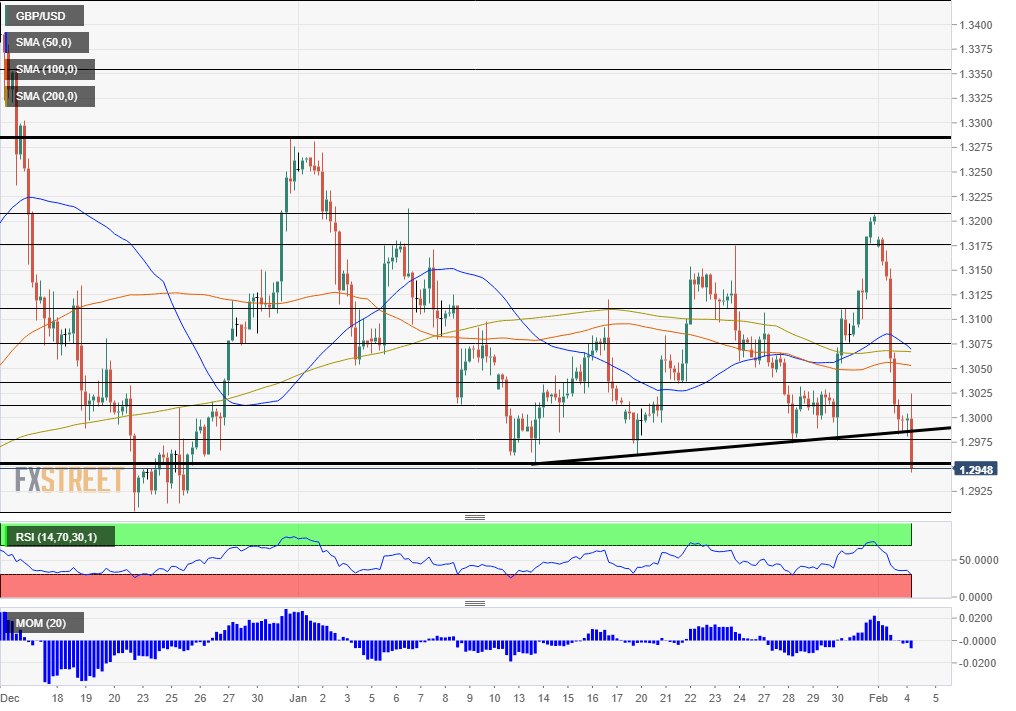
On its way down, pound/dollar fell below the 50, 100, and 200 Simple Moving Averages on the four-hour chart. Moreover, it dropped below the uptrend support line that had accompanied it since mid-January and momentum turned negative.
However, the Relative Strength Index is close to 30 – near oversold conditions. This development implies that an upside correction may be coming soon. A correction could be temporary.
GBP/USD continues battling 1.2955, the low point in January. Further down, 1.29 is a round level and also worked as support in mid-December. It is followed by 1.2875, 1.2820, and 1.2775.
Looking up, resistance awaits at 1.2975, which was a cushion in late January. Next, 1.3010 is a veteran resistance line, and it is followed by 1.3035, which held GBP/US down in late January. 1.3075, 1.3110, and 1.3175 are next.
Author

Yohay Elam
FXStreet
Yohay is in Forex since 2008 when he founded Forex Crunch, a blog crafted in his free time that turned into a fully-fledged currency website later sold to Finixio.
















