|

GBP/USD Forecast: slim chances of breaking below 1.28 mark, UK PMI and NFP in focus

On Thursday, the British Pound was earlier pressured by a slow progress over the Brexit negotiations, with both the UK and the EU remaining far from discussing a future trading relationship. However, the strong US Dollar bullish move seen over the past two-days ran out of steam during NA session, helping the GBP/USD pair to rebound sharply from weekly lows near mid-1.2800s. The main driver behind the greenback's pullback was the US data that showed inflation remains stubbornly below the Fed's 2% target. Adding to this, the US Treasury Secretary Steven Mnuchin's comments that a weaker buck may be good for trade further collaborated to the buck's overnight weakness. 

The pair now seems to have entered a consolidation phase, just below mid-1.2900s as traders now look forward to the release of UK Markit manufacturing PMI, which is expected to come-in at 55.0 for August as compared to previous month's reading of 55.1. The key focus, however, would remain on the keenly watched US monthly jobs report, due for release later during the NA session. Today's NFP print could have implications on the Fed's near-term monetary policy outlook and hence, should act as a big catalyst for the greenback's next leg of directional move.

   •  Nonfarm Payrolls Preview: it will be different this time

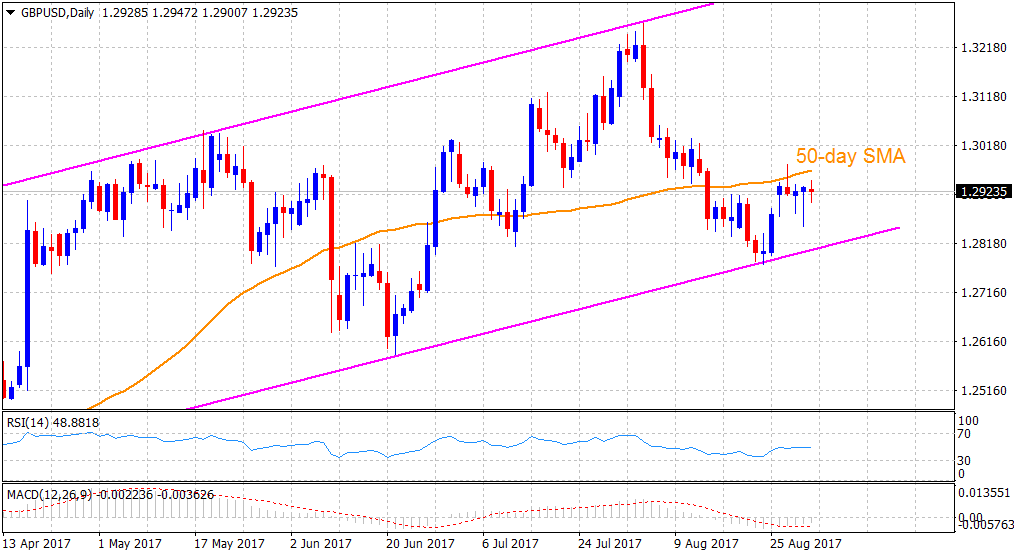
Technically, the pair has held in neutral territory but traders seemed looking for reasons to keep pushing it higher. Any big divergence from today's UK manufacturing PMI and (or) the US employment details would provide the required momentum for a decisive break in either direction.

Bulls would be eyeing for a sustained move beyond 50-day SMA hurdle near the 1.2965-70 region, above which the pair seems set to surpass the key 1.30 psychological mark and head towards testing its next horizontal resistance near 1.3030-35 area. 

On the flip side, weakness back below the 1.2900 handle, leading to a subsequent drop below mid-1.2800s, now seems limited and is more likely to find some strong buying interest near a short-term ascending trend-line support near the 1.2810-1.2800s region. Only a decisive break below the trend-line support would turn the pair vulnerable to slide further in the near-term.
Author

Haresh Menghani

Haresh Menghani is a detail-oriented professional with 10+ years of extensive experience in analysing the global financial markets.


More from Haresh Menghani
Share:

Editor's Picks

AUD/USD keeps range near 0.6950 after Australian trade data

AUD/USD consolidates near a two-month low, trading around mid-0.6900s in the Asian session on Thursday amid a bullish US Dollar. The US PCE data tempered October Fed hike bets, though oil-driven inflation fears remain supportive of elevated US bond yields. Meanwhile, Australia's trade surplus shrank sharply in August to AUD495M, having limited impact on the Aussie Dollar and the pair.


USD/JPY advances to weekly top, around 157.75 as bullish USD counters intervention risks

USD/JPY recovers further from a one-and-a-half-week low, touched the previous day, climbing to the top end of its weekly range during the Asian session on Thursday. Despite the softer US PCE data, oil-driven inflation risks keep US bond yields elevated near multi-year highs. Moreover, the US-Iran standoff benefits the safe-haven US Dollar and supports the currency pair. However, BoJ rate hike bets and intervention fears could limit losses for the Japanese Yen, warranting caution for bulls.

Gold trades below $4,150 as elevated US bond yields and Iran risks support USD

Gold drifts lower for the second straight day on Thursday, looking to extend the previous day's pullback from $4,220. Oil-driven inflation risks counter softer US PCE data and support elevated US bond yields, undermining the non-yielding bullion. Moreover, geopolitical uncertainties allow the safe-haven US Dollar to retain its bullish undertone, further weighing on the commodity.

Why CLARITY Act's failure is beneficial for crypto
Bitwise CIO Matt Hougan stated Wednesday that the crypto market has rallied since the US Senate failed to advance the CLARITY Act, arguing that the legislation’s collapse allowed regulators to move faster on industry rules. Hougan noted that Bitcoin (BTC) has gained 8% and Ethereum (ETH) 7% since the vote, while several altcoins posted larger gains.
The Fed's October hike shrinks with the inflation it was built on

Traders have moved the next Federal Reserve hike from October 28 to December 9, and the inflation report that added to the move said more about July than August. The government's annual rewrite, published alongside the August Personal Consumption Expenditures Price Index, cut July's core reading, which leaves out food and energy, from 3.3% to 3%.

The Euro is near a one-year low: Inflation could trigger its rebound, not its fall

EUR/USD has fallen to its lowest level since May 2025, but a fresh inflation shock in the Eurozone could give the Euro (EUR) an unexpected lifeline. The pair hit 1.1312 on Wednesday and trades well below the January peak of 1.2082.