GBP/USD Forecast: Pound Sterling under heavy pressure as UK gilt selloff continues
- GBP/USD dropped to its weakest level since November 2023 below 1.2250 on Thursday.
- The 10-year UK gilt yield rose to its highest level in over 16 years.
- The pair remains vulnerable despite turning technically oversold in the near term.

After losing nearly 1% on Wednesday, GBP/USD extended its slide and touched its lowest level since November 2023 below 1.2250 in the early European session on Thursday. The pair remains deep in negative territory below 1.2300 despite recovering slightly in the last hour.
British Pound PRICE This week
The table below shows the percentage change of British Pound (GBP) against listed major currencies this week. British Pound was the weakest against the Canadian Dollar.
| USD | EUR | GBP | JPY | CAD | AUD | NZD | CHF | |
|---|---|---|---|---|---|---|---|---|
| USD | 0.08% | 1.11% | 0.63% | -0.45% | 0.42% | 0.51% | 0.24% | |
| EUR | -0.08% | 1.02% | 0.52% | -0.46% | 0.38% | 0.47% | 0.19% | |
| GBP | -1.11% | -1.02% | -0.51% | -1.46% | -0.63% | -0.54% | -0.81% | |
| JPY | -0.63% | -0.52% | 0.51% | -1.06% | -0.17% | -0.08% | -0.16% | |
| CAD | 0.45% | 0.46% | 1.46% | 1.06% | 0.80% | 0.91% | 0.66% | |
| AUD | -0.42% | -0.38% | 0.63% | 0.17% | -0.80% | 0.09% | -0.19% | |
| NZD | -0.51% | -0.47% | 0.54% | 0.08% | -0.91% | -0.09% | -0.27% | |
| CHF | -0.24% | -0.19% | 0.81% | 0.16% | -0.66% | 0.19% | 0.27% |
The heat map shows percentage changes of major currencies against each other. The base currency is picked from the left column, while the quote currency is picked from the top row. For example, if you pick the British Pound from the left column and move along the horizontal line to the US Dollar, the percentage change displayed in the box will represent GBP (base)/USD (quote).
The broad-based US Dollar (USD) strength and a bout of selloff in British government bonds triggered a sharp decline in GBP/USD. The yield on the 10-year UK gilt climbed to its highest level in over 16 years and the yield on the 30-year reached its strongest level since 1998 early Thursday.
Assessing the latest developments in the UK gilt market, "this is a global move but it's being led by the UK," said RBC Capital Markets' fixed income strategist Megum Muhic.
"Potentially, a reason why is the technical break is more significant versus other jurisdictions. The UK is at highs of this cycle whereas in Europe and the US this isn't the case. We're in new uncharted territory," Muhic added, per Reuters.
On the other hand, the US Dollar (USD) benefited from the risk-averse market atmosphere and put additional weight on GBP/USD's shoulders. Citing four sources familiar with the matter, CNN reported on Wednesday that Trump is considering declaring a national economic emergency to allow for a new tariff program, reviving concerns over an aggressive tariff policy stoking inflation.
Stock markets in the US will remain closed and bond markets will close early on Thursday, in observance of a national day of mourning to honor the death of former President Jimmy Carter.
Later in the day, several Federal Reserve (Fed) officials are scheduled to deliver speeches. In case policymakers underline the need for a slowdown in the pace of rate cuts amid the uncertainty surrounding the inflation outlook, the USD is likely to preserve its strength. On Friday, the US Bureau of Labor Statistics will release the December jobs report, which will include Nonfarm Payrolls and Unemployment Rate figures.
GBP/USD Technical Analysis
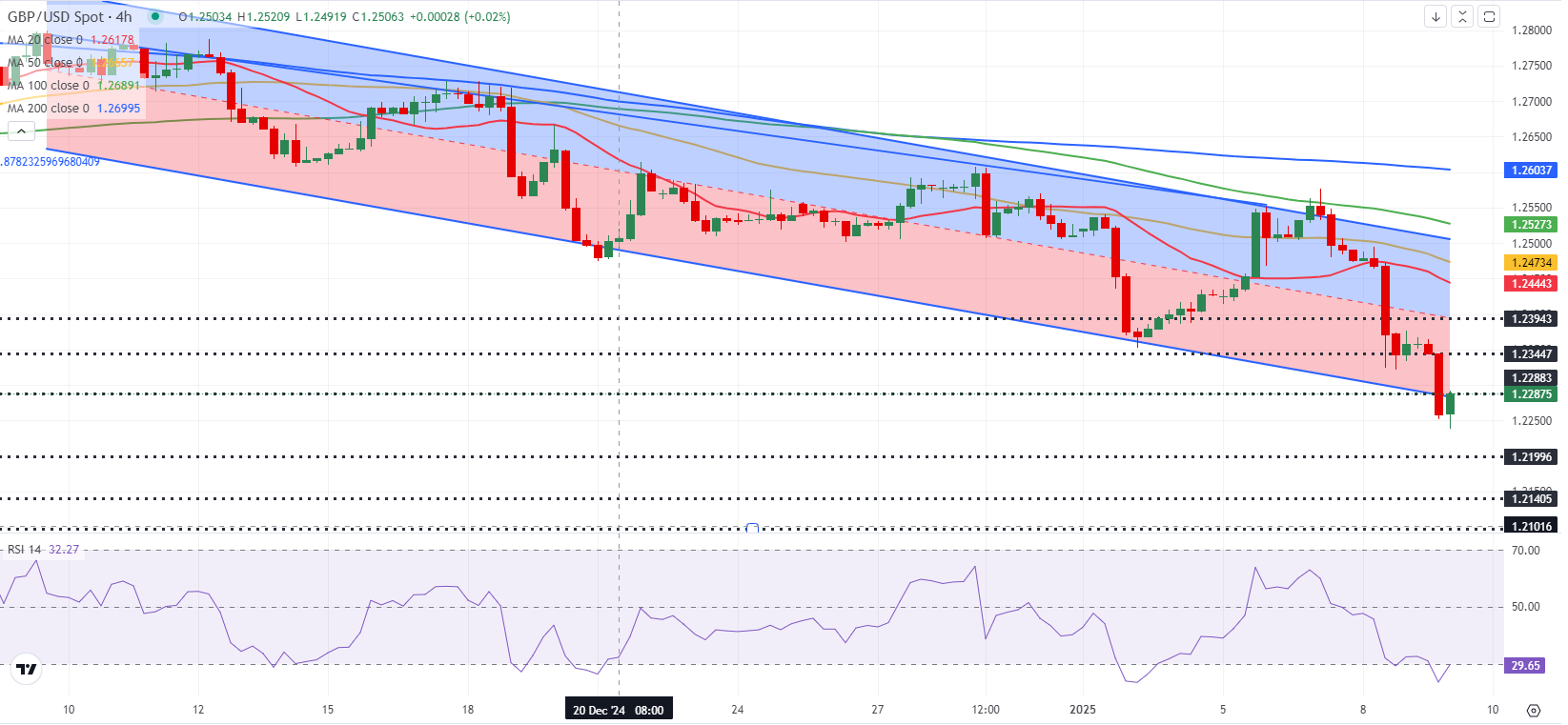
GBP/USD recovered after dipping below the lower limit of the descending regression channel coming from December 9. Meanwhile, the Relative Strength Index (RSI) indicator on the 4-hour chart rose slightly above 30, suggesting that the pair's bearish bias remains intact after staging a technical correction from oversold levels.
On the downside, static support seems to have formed at 1.2250 ahead of 1.2200 (static level, round level) and 1.2140 (static level from November 2023). Looking north, first resistance could be spotted at 1.2350 (former support, static level) before 1.2400 (round level, mid-point of the descending channel).
UK gilt yields FAQs
UK Gilt Yields measure the annual return an investor can expect from holding UK government bonds, or Gilts. Like other bonds, Gilts pay interest to holders at regular intervals, the ‘coupon’, followed by the full value of the bond at maturity. The coupon is fixed but the Yield varies as it takes into account changes in the bond's price. For example, a Gilt worth 100 Pounds Sterling might have a coupon of 5.0%. If the Gilt's price were to fall to 98 Pounds, the coupon would still be 5.0%, but the Gilt Yield would rise to 5.102% to reflect the decline in price.
Many factors influence Gilt yields, but the main ones are interest rates, the strength of the British economy, the liquidity of the bond market and the value of the Pound Sterling. Rising inflation will generally weaken Gilt prices and lead to higher Gilt yields because Gilts are long-term investments susceptible to inflation, which erodes their value. Higher interest rates impact existing Gilt yields because newly-issued Gilts will carry a higher, more attractive coupon. Liquidity can be a risk when there is a lack of buyers or sellers due to panic or preference for riskier assets.
Probably the most important factor influencing the level of Gilt yields is interest rates. These are set by the Bank of England (BoE) to ensure price stability. Higher interest rates will raise yields and lower the price of Gilts because new Gilts issued will bear a higher, more attractive coupon, reducing demand for older Gilts, which will see a corresponding decline in price.
Inflation is a key factor affecting Gilt yields as it impacts the value of the principal received by the holder at the end of the term, as well as the relative value of the repayments. Higher inflation deteriorates the value of Gilts over time, reflected in a higher yield (lower price). The opposite is true of lower inflation. In rare cases of deflation, a Gilt may rise in price – represented by a negative yield.
Foreign holders of Gilts are exposed to exchange-rate risk since Gilts are denominated in Pound Sterling. If the currency strengthens investors will realize a higher return and vice versa if it weakens. In addition, Gilt yields are highly correlated to the Pound Sterling. This is because yields are a reflection of interest rates and interest rate expectations, a key driver of Pound Sterling. Higher interest rates, raise the coupon on newly-issued Gilts, attracting more global investors. Since they are priced in Pounds, this increases demand for Pound Sterling.
Author

Eren Sengezer
FXStreet
As an economist at heart, Eren Sengezer specializes in the assessment of the short-term and long-term impacts of macroeconomic data, central bank policies and political developments on financial assets.
















