GBP/USD Forecast: Pound Sterling poised for further downside
- GBP/USD edges lower toward 1.3100 in the European session on Tuesday.
- The technical picture points to a buildup of bearish momentum.
- Investors await US ISM Manufacturing PMI data from the US.

GBP/USD stays under modest bearish pressure in the European session on Tuesday and retreats toward 1.3100. The technical outlook suggests that sellers retain control as focus shifts to August ISM Manufacturing PMI data from the US.
British Pound PRICE Last 7 days
The table below shows the percentage change of British Pound (GBP) against listed major currencies last 7 days. British Pound was the weakest against the US Dollar.
| USD | EUR | GBP | JPY | CAD | AUD | NZD | CHF | |
|---|---|---|---|---|---|---|---|---|
| USD | 1.09% | 0.53% | 0.90% | 0.28% | 0.45% | 0.24% | 0.53% | |
| EUR | -1.09% | -0.54% | -0.18% | -0.82% | -0.63% | -0.87% | -0.56% | |
| GBP | -0.53% | 0.54% | 0.36% | -0.25% | -0.09% | -0.30% | -0.00% | |
| JPY | -0.90% | 0.18% | -0.36% | -0.63% | -0.46% | -0.69% | -0.38% | |
| CAD | -0.28% | 0.82% | 0.25% | 0.63% | 0.17% | -0.05% | 0.26% | |
| AUD | -0.45% | 0.63% | 0.09% | 0.46% | -0.17% | -0.23% | 0.10% | |
| NZD | -0.24% | 0.87% | 0.30% | 0.69% | 0.05% | 0.23% | 0.29% | |
| CHF | -0.53% | 0.56% | 0.00% | 0.38% | -0.26% | -0.10% | -0.29% |
The heat map shows percentage changes of major currencies against each other. The base currency is picked from the left column, while the quote currency is picked from the top row. For example, if you pick the British Pound from the left column and move along the horizontal line to the US Dollar, the percentage change displayed in the box will represent GBP (base)/USD (quote).
GBP/USD closed the first day of the week virtually unchanged as trading volumes remained thin amid the Labor Day holiday in the US.
With trading conditions starting to normalize on Tuesday, the US Dollar (USD) benefits from the souring risk mood, causing GBP/USD to stretch lower. At the time of press, US stock index futures were down between 0.5% and 0.8%, pointing to a bearish opening in Wall Street.
In the second half of the day, the ISM will release August Manufacturing PMI data. The market expectation is for the headline PMI to improve modestly to 47.5 from 46.8 in July. A better-than-forecast print could support the USD and force GBP/USD to stay on the back foot.
Investors will also pay close attention to the employment component of the PMI survey. The Employment Index dropped to its lowest level since July 2020 at 43.4 in July. Another drop in this data could feed into concerns over worsening conditions in the labor market and make it difficult for the USD to preserve its strength. On the flip side, a noticeable rebound, with a reading close to 50, could provide an additional boost to the currency.
GBP/USD Technical Analysis
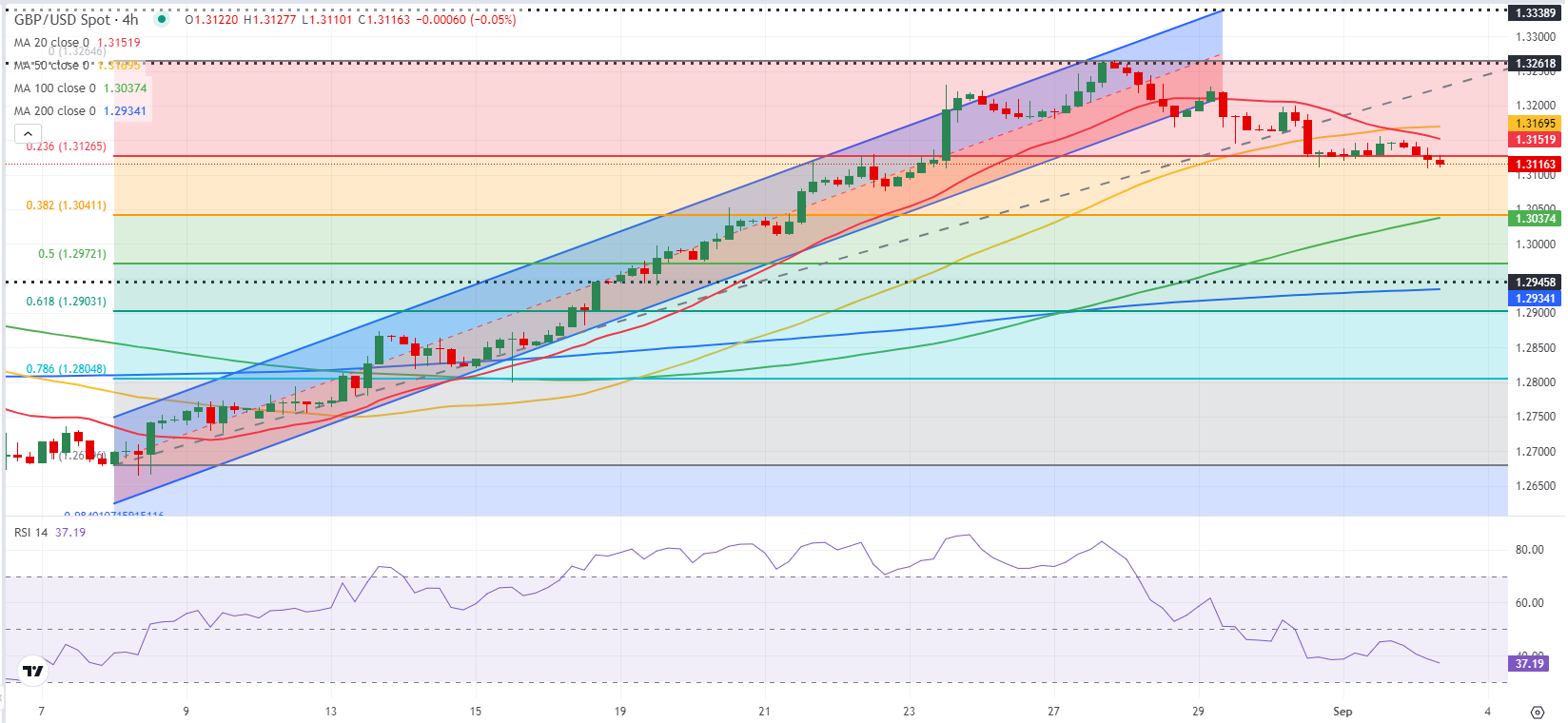
GBP/USD broke below 1.3130 (Fibonacci 23.6% retracement level of the latest uptrend) after spending the first day of the week near this level. Meanwhile, the Relative Strength Index (RSI) indicator on the 4-hour chart retreated below 40, suggesting that sellers retain control of the pair's action.
Immediate support is located at 1.3100 (psychological level, static level) ahead of 1.3040 (100-period Simple Moving Average (SMA), Fibonacci 38.2% retracement) and 1.3000 (psychological level, static level).
On the upside, technical sellers could be discouraged if GBP/USD flips 1.3130 into support. Above this level, 1.3170 (50-period SMA) could be seen as next resistance before 1.3200 (psychological level, static level).
Pound Sterling FAQs
The Pound Sterling (GBP) is the oldest currency in the world (886 AD) and the official currency of the United Kingdom. It is the fourth most traded unit for foreign exchange (FX) in the world, accounting for 12% of all transactions, averaging $630 billion a day, according to 2022 data. Its key trading pairs are GBP/USD, aka ‘Cable’, which accounts for 11% of FX, GBP/JPY, or the ‘Dragon’ as it is known by traders (3%), and EUR/GBP (2%). The Pound Sterling is issued by the Bank of England (BoE).
The single most important factor influencing the value of the Pound Sterling is monetary policy decided by the Bank of England. The BoE bases its decisions on whether it has achieved its primary goal of “price stability” – a steady inflation rate of around 2%. Its primary tool for achieving this is the adjustment of interest rates. When inflation is too high, the BoE will try to rein it in by raising interest rates, making it more expensive for people and businesses to access credit. This is generally positive for GBP, as higher interest rates make the UK a more attractive place for global investors to park their money. When inflation falls too low it is a sign economic growth is slowing. In this scenario, the BoE will consider lowering interest rates to cheapen credit so businesses will borrow more to invest in growth-generating projects.
Data releases gauge the health of the economy and can impact the value of the Pound Sterling. Indicators such as GDP, Manufacturing and Services PMIs, and employment can all influence the direction of the GBP. A strong economy is good for Sterling. Not only does it attract more foreign investment but it may encourage the BoE to put up interest rates, which will directly strengthen GBP. Otherwise, if economic data is weak, the Pound Sterling is likely to fall.
Another significant data release for the Pound Sterling is the Trade Balance. This indicator measures the difference between what a country earns from its exports and what it spends on imports over a given period. If a country produces highly sought-after exports, its currency will benefit purely from the extra demand created from foreign buyers seeking to purchase these goods. Therefore, a positive net Trade Balance strengthens a currency and vice versa for a negative balance.
Premium
You have reached your limit of 3 free articles for this month.
Start your subscription and get access to all our original articles.
Author

Eren Sengezer
FXStreet
As an economist at heart, Eren Sengezer specializes in the assessment of the short-term and long-term impacts of macroeconomic data, central bank policies and political developments on financial assets.