GBP/USD Forecast: Pound Sterling looks to clear 1.3000 after UK inflation data
- GBP/USD touched a new 2024-high above 1.3000 in the European morning.
- Annual inflation in the UK held steady at 2% as expected in June.
- Markets see a diminishing chance of a Bank of England rate cut in August.

Following Tuesday's indecisive action, GBP/USD gained traction in the European morning and touched its highest level in a year above 1.3000. The pair could extend its uptrend once it confirms this level as support.
The data published by the UK's Office for National Statistics showed early Wednesday that annual inflation, as measured by the change in the Consumer Price Index (CPI), remained unchanged at 2% in June as expected. In the same period, the core CPI rose 3.5%, matching analysts' estimate and May's increase. Services prices, which have been the sticky part of inflation, rose 5.7% on a yearly basis following the 5.6% increase recorded in May.
British Pound PRICE This week
The table below shows the percentage change of British Pound (GBP) against listed major currencies this week. British Pound was the strongest against the Australian Dollar.
| USD | EUR | GBP | JPY | CAD | AUD | NZD | CHF | |
|---|---|---|---|---|---|---|---|---|
| USD | 0.02% | -0.14% | -0.66% | 0.26% | 0.76% | 0.54% | -0.28% | |
| EUR | -0.02% | -0.12% | -0.48% | 0.43% | 0.77% | 0.72% | -0.11% | |
| GBP | 0.14% | 0.12% | -0.27% | 0.55% | 0.89% | 0.79% | 0.01% | |
| JPY | 0.66% | 0.48% | 0.27% | 0.90% | 1.19% | 1.15% | 0.18% | |
| CAD | -0.26% | -0.43% | -0.55% | -0.90% | 0.43% | 0.29% | -0.54% | |
| AUD | -0.76% | -0.77% | -0.89% | -1.19% | -0.43% | -0.05% | -0.89% | |
| NZD | -0.54% | -0.72% | -0.79% | -1.15% | -0.29% | 0.05% | -0.83% | |
| CHF | 0.28% | 0.11% | -0.01% | -0.18% | 0.54% | 0.89% | 0.83% |
The heat map shows percentage changes of major currencies against each other. The base currency is picked from the left column, while the quote currency is picked from the top row. For example, if you pick the British Pound from the left column and move along the horizontal line to the US Dollar, the percentage change displayed in the box will represent GBP (base)/USD (quote).
According to Reuters, UK interest rate futures are now pricing a roughly 33% probability of the Bank of England (BoE) lowering the policy rate by 25 basis points in August, down from nearly 50% before the data release. This change in market positioning supports Pound Sterling.
In the second half of the day, the US economic docket will feature Housing Starts, Building Permits and Industrial Production data for June. With markets already fully pricing in a September Federal Reserve rate cut, these data releases are unlikely to have a noticeable impact on the US Dollar's (USD) valuation.
GBP/USD Technical Analysis
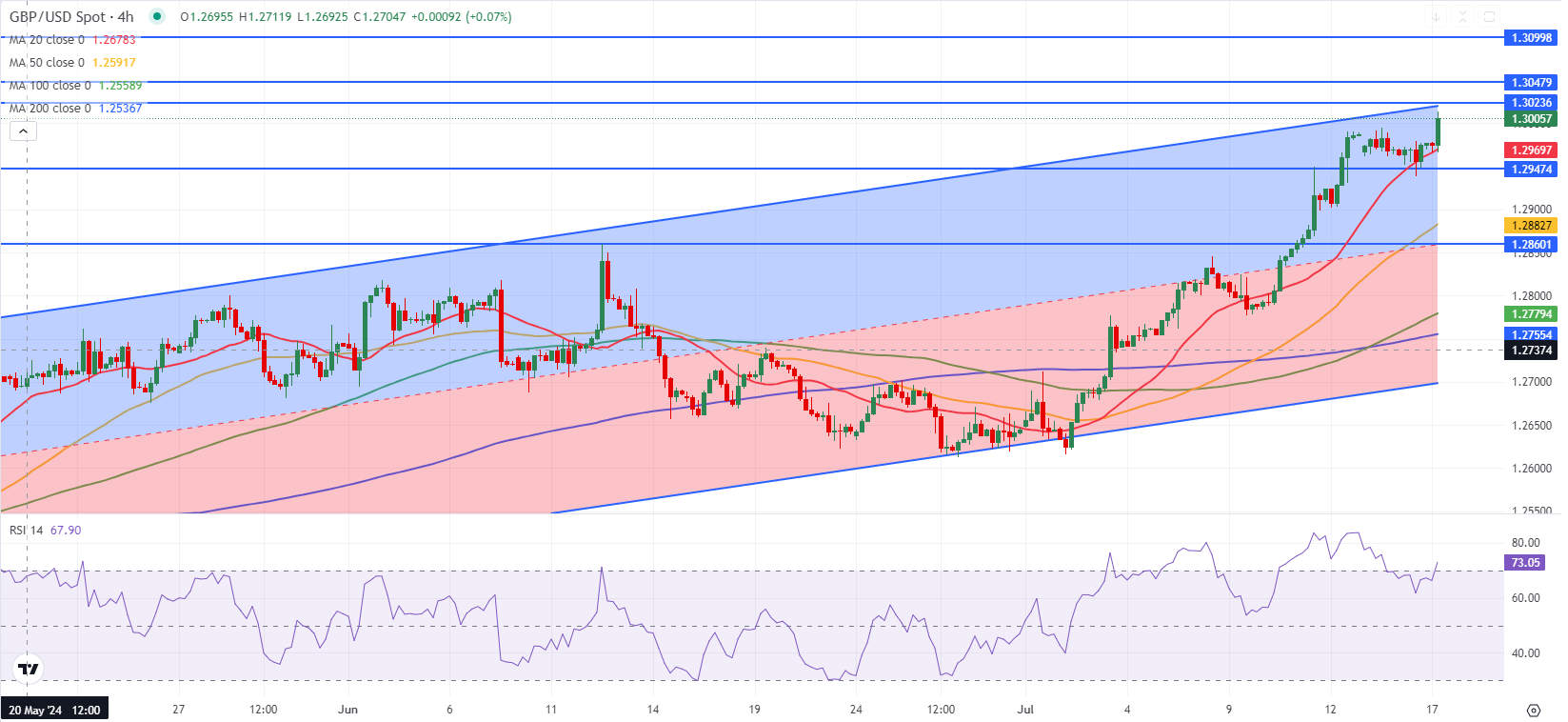
The Relative Strength Index (RSI) indicator on the 4-hour chart climbed back above 70 in the European morning on Wednesday, suggesting GBP/USD is technically overbought. In case the pair goes into a consolidation phase and starts using 1.3000 as support, the upper limit of the channel could act as next resistance at 1.3020 ahead of 1.3040 (static level from July 2023) and 1.3100 (psychological level, static level).
On the downside, supports could be seen at 1.2950 (static level) and 1.2900 (psychological level, static level), if 1.3000 fails to hold as support.
Inflation FAQs
Inflation measures the rise in the price of a representative basket of goods and services. Headline inflation is usually expressed as a percentage change on a month-on-month (MoM) and year-on-year (YoY) basis. Core inflation excludes more volatile elements such as food and fuel which can fluctuate because of geopolitical and seasonal factors. Core inflation is the figure economists focus on and is the level targeted by central banks, which are mandated to keep inflation at a manageable level, usually around 2%.
The Consumer Price Index (CPI) measures the change in prices of a basket of goods and services over a period of time. It is usually expressed as a percentage change on a month-on-month (MoM) and year-on-year (YoY) basis. Core CPI is the figure targeted by central banks as it excludes volatile food and fuel inputs. When Core CPI rises above 2% it usually results in higher interest rates and vice versa when it falls below 2%. Since higher interest rates are positive for a currency, higher inflation usually results in a stronger currency. The opposite is true when inflation falls.
Although it may seem counter-intuitive, high inflation in a country pushes up the value of its currency and vice versa for lower inflation. This is because the central bank will normally raise interest rates to combat the higher inflation, which attract more global capital inflows from investors looking for a lucrative place to park their money.
Formerly, Gold was the asset investors turned to in times of high inflation because it preserved its value, and whilst investors will often still buy Gold for its safe-haven properties in times of extreme market turmoil, this is not the case most of the time. This is because when inflation is high, central banks will put up interest rates to combat it. Higher interest rates are negative for Gold because they increase the opportunity-cost of holding Gold vis-a-vis an interest-bearing asset or placing the money in a cash deposit account. On the flipside, lower inflation tends to be positive for Gold as it brings interest rates down, making the bright metal a more viable investment alternative.
Author

Eren Sengezer
FXStreet
As an economist at heart, Eren Sengezer specializes in the assessment of the short-term and long-term impacts of macroeconomic data, central bank policies and political developments on financial assets.