GBP/USD Forecast: Pound Sterling holds steady on UK election day
- GBP/USD fluctuates in a tight range at around 1.2750.
- British voters head to polls for general election.
- The pair could struggle to find direction with US markets remaining closed on Independence Day.

GBP/USD advanced toward 1.2800 and reached its highest level since June 13 on Wednesday. With the market action turning subdued on Thursday, the pair entered a consolidation phase at around 1.2750.
The renewed selling pressure surrounding the US Dollar (USD) fuelled a leg higher in GBP/USD as markets reacted to dismal macroeconomic data releases.
British Pound PRICE This week
The table below shows the percentage change of British Pound (GBP) against listed major currencies this week. British Pound was the strongest against the Japanese Yen.
| USD | EUR | GBP | JPY | CAD | AUD | NZD | CHF | |
|---|---|---|---|---|---|---|---|---|
| USD | -0.78% | -0.83% | 0.34% | -0.34% | -0.77% | -0.32% | 0.27% | |
| EUR | 0.78% | -0.28% | 0.84% | 0.14% | -0.11% | 0.15% | 0.75% | |
| GBP | 0.83% | 0.28% | 1.07% | 0.41% | 0.17% | 0.43% | 1.02% | |
| JPY | -0.34% | -0.84% | -1.07% | -0.69% | -1.04% | -0.67% | -0.05% | |
| CAD | 0.34% | -0.14% | -0.41% | 0.69% | -0.38% | 0.02% | 0.61% | |
| AUD | 0.77% | 0.11% | -0.17% | 1.04% | 0.38% | 0.25% | 0.92% | |
| NZD | 0.32% | -0.15% | -0.43% | 0.67% | -0.02% | -0.25% | 0.62% | |
| CHF | -0.27% | -0.75% | -1.02% | 0.05% | -0.61% | -0.92% | -0.62% |
The heat map shows percentage changes of major currencies against each other. The base currency is picked from the left column, while the quote currency is picked from the top row. For example, if you pick the British Pound from the left column and move along the horizontal line to the US Dollar, the percentage change displayed in the box will represent GBP (base)/USD (quote).
The ADP's monthly publication showed that payrolls in private sector increased 150,000 in June, missing the market expectation of 160,000, and the Department of Labor announced that there were 238,000 first-time applications for unemployment benefits in the week ending June 29, up from 233,000 in the previous week.
Additionally, the ISM Services PMI came in at 48.8 in June, down from 53.8 in May and pointing to a contraction in the service sector's business activity. Details of the survey showed that the Employment Index and the Prices Paid Index dropped to 46.1 and 56.3, respectively.
The US economic calendar will not feature any macroeconomic data releases on Thursday, stock and bond markets will remain closed in observance of the Independence Day holiday.
Meanwhile, British voters will cast ballots in a snap general election called by Prime Minister Rishi Sunak. Opinion polls suggest that there is a very strong likelihood the main opposition Labor Party will win a landslide, with Sir Keir Starmer becoming the next Prime Minister of the UK. Exit polls are expected to be announced shortly after voting ends at 22:00 local time (21:00 GMT). The final outcome is likely to be confirmed in the early morning hours on Friday.
On Friday, the US Bureau of Labor Statistics will release labor market data for June. Ahead of this key data release, investors could refrain from taking large positions, especially with the ongoing UK election and the US holiday.
GBP/USD Technical Analysis
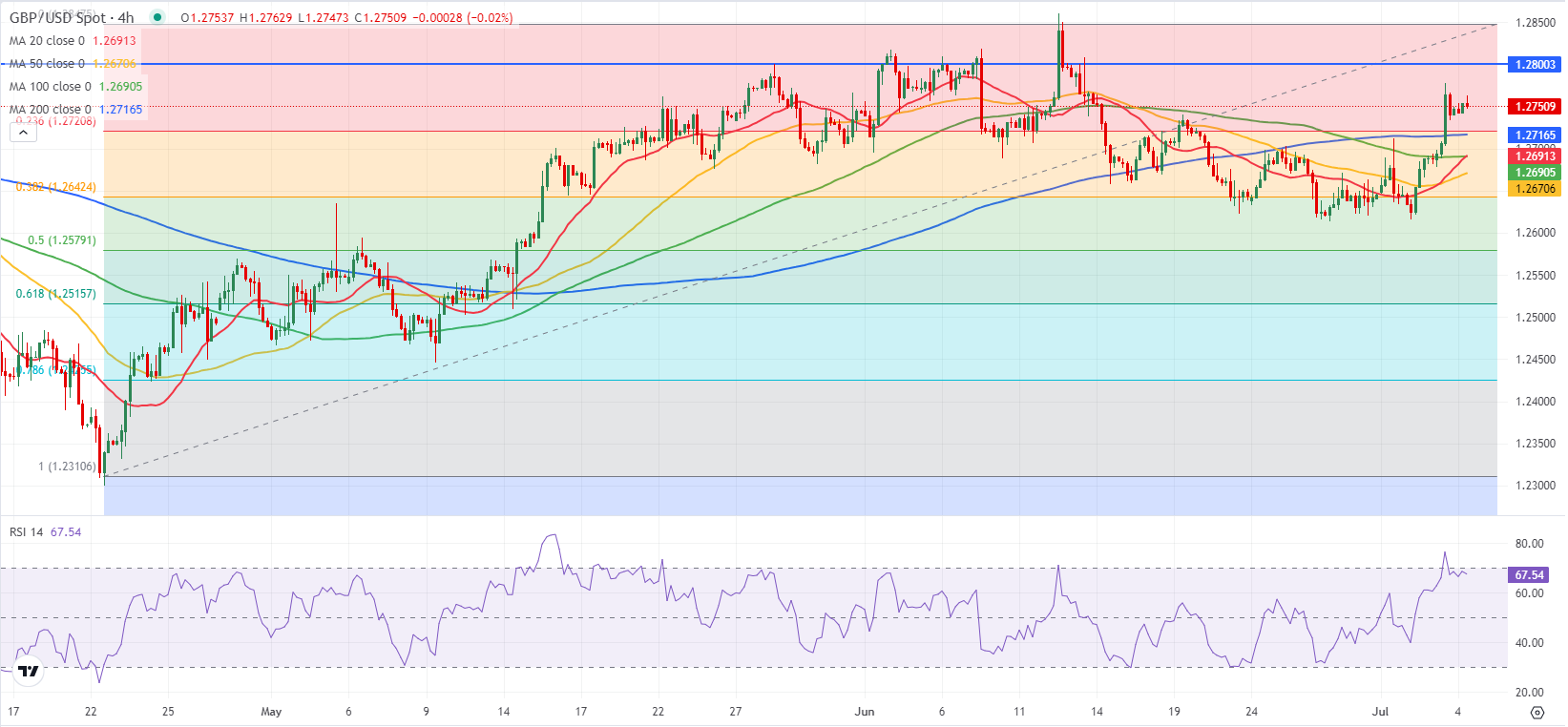
GBP/USD currently trades near 1.2750 (static level). Once that level is confirmed as support, 1.2800 (psychological level, static level) could be seen as next resistance before 1.2860 (Jun 12 high).
On the downside, the 20-day Simple Moving Average aligns as support at 1.2700 before 1.2670 (50-day SMA) and 1.2650 (100-day SMA).
Economic Indicator
Parliamentary Election
The U.K. Parliamentary Election released by the United Kingdom Parliament elects 650 members to the United Kingdom's Lower House of Parliament. It is a significant event to determine the appropriate stance of monetary policy and assesses the risks to its long-run goals of price stability and sustainable economic growth in the u.K. The election might affect the GBP volatility.
Read more.Premium
You have reached your limit of 3 free articles for this month.
Start your subscription and get access to all our original articles.
Author

Eren Sengezer
FXStreet
As an economist at heart, Eren Sengezer specializes in the assessment of the short-term and long-term impacts of macroeconomic data, central bank policies and political developments on financial assets.