GBP/USD Forecast: Pound Sterling could surpass 1.2800 on weak US jobs data
- GBP/USD trades at three-week highs above 1.2750 on Friday.
- Labour Party won parliamentary majority in general election as expected.
- Nonfarm Payrolls in the US are forecast to rise 190,000 in June.

Following Thursday's subdued action, GBP/USD regained its traction and reached its highest level in three weeks near 1.2780 on Friday. 1.2800 aligns as next immediate resistance for the pair as investors gear up for the key data releases from the US.
British Pound PRICE This week
The table below shows the percentage change of British Pound (GBP) against listed major currencies this week. British Pound was the strongest against the US Dollar.
| USD | EUR | GBP | JPY | CAD | AUD | NZD | CHF | |
|---|---|---|---|---|---|---|---|---|
| USD | -1.04% | -1.12% | -0.03% | -0.48% | -0.99% | -0.45% | -0.03% | |
| EUR | 1.04% | -0.30% | 0.73% | 0.26% | -0.06% | 0.29% | 0.72% | |
| GBP | 1.12% | 0.30% | 1.01% | 0.56% | 0.24% | 0.59% | 1.02% | |
| JPY | 0.03% | -0.73% | -1.01% | -0.44% | -0.89% | -0.42% | 0.04% | |
| CAD | 0.48% | -0.26% | -0.56% | 0.44% | -0.47% | 0.03% | 0.46% | |
| AUD | 0.99% | 0.06% | -0.24% | 0.89% | 0.47% | 0.35% | 0.87% | |
| NZD | 0.45% | -0.29% | -0.59% | 0.42% | -0.03% | -0.35% | 0.45% | |
| CHF | 0.03% | -0.72% | -1.02% | -0.04% | -0.46% | -0.87% | -0.45% |
The heat map shows percentage changes of major currencies against each other. The base currency is picked from the left column, while the quote currency is picked from the top row. For example, if you pick the British Pound from the left column and move along the horizontal line to the US Dollar, the percentage change displayed in the box will represent GBP (base)/USD (quote).
The Labour Party won a parliamentary majority in the UK general election, securing 411 seats in the 650-seat House of Commons and paving the way for Labour leader Keir Starmer to become the next prime minister. As this outcome was largely expected, it had little to no impact on Pound Sterling's valuation.
In the second half of the day, the US Bureau of Labor Statistics will release the June jobs report. Following the impressive 272,000 increase recorded in May, Nonfarm Payrolls are forecast to rise 190,000 in June. The Unemployment Rate is seen holding steady at 4% and the annual wage inflation, as measured by the change in the Average Hourly Earnings, is expected to decline to 3.9% from 4.1%.
Earlier in the week, the Manufacturing and the Services PMI reports published by the ISM pointed to a decline in these sectors' payrolls. Additionally, ADP Employment Change came in at 150,000 to miss the market expectation of 160,000, while the weekly Initial Jobless Claims edged higher to 238,000 in the week ending June 29, up from 234,000 in the previous week.
The selling pressure surrounding the US Dollar (USD) seen this week suggests that markets might have already priced in a disappointing NFP reading. The market positioning, however, shows that there is more room for further USD weakness in case the jobs report feed into expectations for a Federal Reserve (Fed) rate cut in September. According to the CME FedWatch Tool, there is still a 25% probability that the Fed leave the policy rate unchanged in September.
Hence, the immediate reaction to an NFP reading of 150,000, or lower, could fuel another leg higher in GBP/USD. On the flip side, a positive surprise could support the USD and limit the pair's upside heading into the weekend.
GBP/USD Technical Analysis
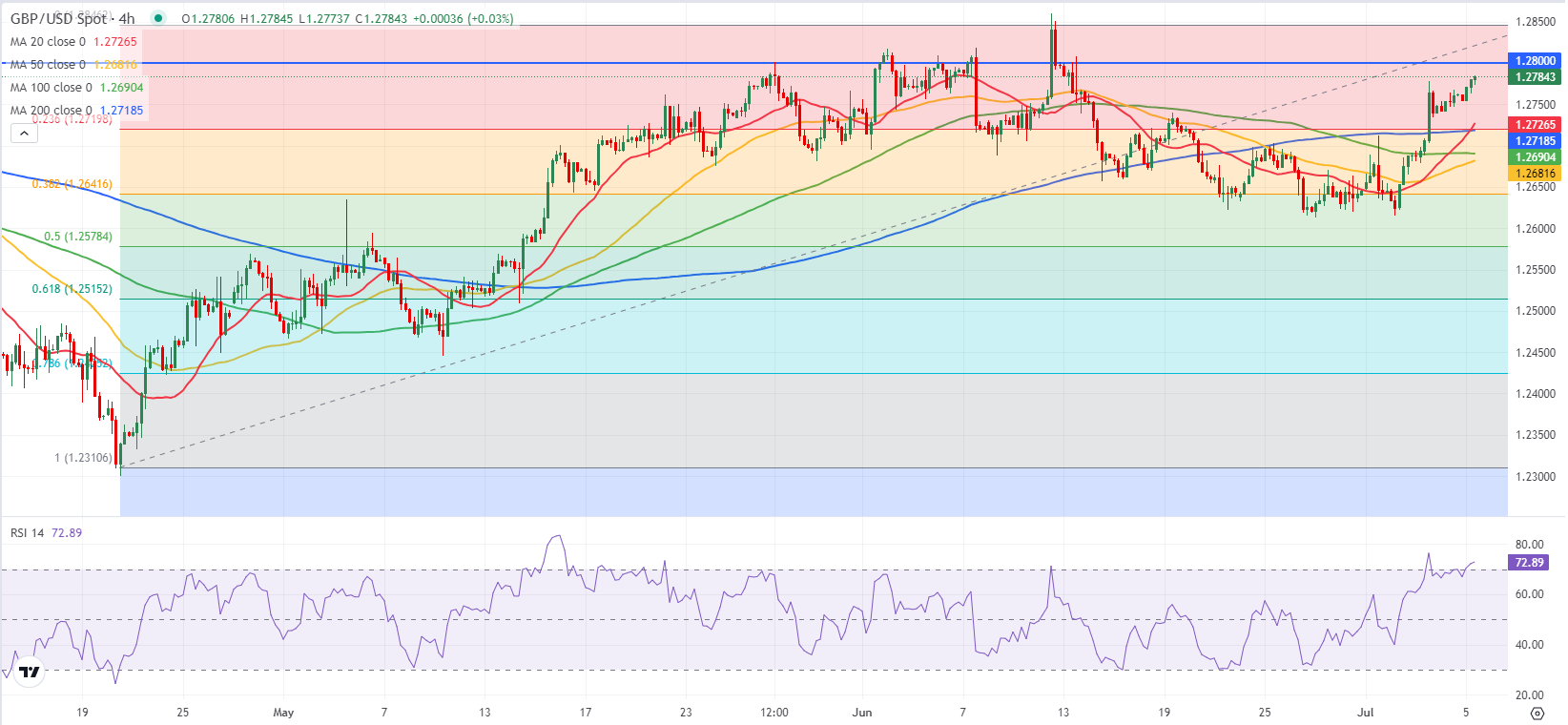
The Relative Strength Index (RSI) indicator on the 4-hour chart stays above 70 and points to overbought conditions. Nevertheless, investors are likely to ignore this technical development in case the US data triggers a USD selloff. 1.2800 (psychological level, static level) could be seen as next resistance before 1.2860 (Jun 12 high) and 1.2900 (psychological level, static level).
On the downside, supports could be seen at 1.2700 (20-day Simple Moving Average (SMA)), 1.2670 (50-day SMA) and 1.2650 (100-day SMA).
Economic Indicator
Nonfarm Payrolls
The Nonfarm Payrolls release presents the number of new jobs created in the US during the previous month in all non-agricultural businesses; it is released by the US Bureau of Labor Statistics (BLS). The monthly changes in payrolls can be extremely volatile. The number is also subject to strong reviews, which can also trigger volatility in the Forex board. Generally speaking, a high reading is seen as bullish for the US Dollar (USD), while a low reading is seen as bearish, although previous months' reviews and the Unemployment Rate are as relevant as the headline figure. The market's reaction, therefore, depends on how the market assesses all the data contained in the BLS report as a whole.
Read more.Next release: Fri Jul 05, 2024 12:30
Frequency: Monthly
Consensus: 190K
Previous: 272K
Source: US Bureau of Labor Statistics
America’s monthly jobs report is considered the most important economic indicator for forex traders. Released on the first Friday following the reported month, the change in the number of positions is closely correlated with the overall performance of the economy and is monitored by policymakers. Full employment is one of the Federal Reserve’s mandates and it considers developments in the labor market when setting its policies, thus impacting currencies. Despite several leading indicators shaping estimates, Nonfarm Payrolls tend to surprise markets and trigger substantial volatility. Actual figures beating the consensus tend to be USD bullish.
Author

Eren Sengezer
FXStreet
As an economist at heart, Eren Sengezer specializes in the assessment of the short-term and long-term impacts of macroeconomic data, central bank policies and political developments on financial assets.