GBP/USD Forecast: Pound Sterling could struggle to gain traction ahead of key UK data
- GBP/USD fluctuates above 1.2950 after posting small losses on Monday.
- Inflation data from the UK on Wednesday could trigger the next big action in the pair.
- US Retail Sales in June are expected to remain unchanged.

GBP/USD lost its traction after coming in within a touching distance of 1.3000 on Monday and closed the day modestly lower. The pair holds steady slightly above 1.2950 in the European session on Tuesday.
British Pound PRICE Last 7 days
The table below shows the percentage change of British Pound (GBP) against listed major currencies last 7 days. British Pound was the strongest against the New Zealand Dollar.
| USD | EUR | GBP | JPY | CAD | AUD | NZD | CHF | |
|---|---|---|---|---|---|---|---|---|
| USD | -0.66% | -1.20% | -1.47% | 0.35% | -0.10% | 1.08% | -0.20% | |
| EUR | 0.66% | -0.56% | -0.83% | 1.00% | 0.56% | 1.76% | 0.47% | |
| GBP | 1.20% | 0.56% | -0.29% | 1.57% | 1.14% | 2.33% | 1.02% | |
| JPY | 1.47% | 0.83% | 0.29% | 1.84% | 1.38% | 2.58% | 1.28% | |
| CAD | -0.35% | -1.00% | -1.57% | -1.84% | -0.46% | 0.75% | -0.55% | |
| AUD | 0.10% | -0.56% | -1.14% | -1.38% | 0.46% | 1.17% | -0.13% | |
| NZD | -1.08% | -1.76% | -2.33% | -2.58% | -0.75% | -1.17% | -1.27% | |
| CHF | 0.20% | -0.47% | -1.02% | -1.28% | 0.55% | 0.13% | 1.27% |
The heat map shows percentage changes of major currencies against each other. The base currency is picked from the left column, while the quote currency is picked from the top row. For example, if you pick the British Pound from the left column and move along the horizontal line to the US Dollar, the percentage change displayed in the box will represent GBP (base)/USD (quote).
The cautious market mood helped the US Dollar (USD) find a foothold at the beginning of the week, causing GBP/USD to correct lower from the highest level it touched in nearly a year.
During the American trading hours, Federal Reserve (Fed) Chairman Jerome Powell said that inflation readings in the second quarter represented further progress but repeated that he is not going to send any signals on any particular meeting. With markets already fully pricing in a Fed rate cut in September, according to the CME FedWatch Tool, these comments had little to no impact on the USD's performance against its rivals.
The US Census Bureau will release Retail Sales data for June later in the day. Markets expect a no change following the marginal 0.1% increase recorded in May. Although a positive surprise could support the USD, investors are unlikely to take large positions, or change their minds about the Fed rate outlook, based on this data alone. Hence, the market reaction could remain short-lived.
On Wednesday, the UK's Office for National Statistics will publish Consumer Price Index (CPI) figures for June, which could influence the market expectations regarding the timing of the Bank of England's (BoE) rate reduction. Ahead of this data, GBP/USD's action could remain subdued.
GBP/USD Technical Analysis
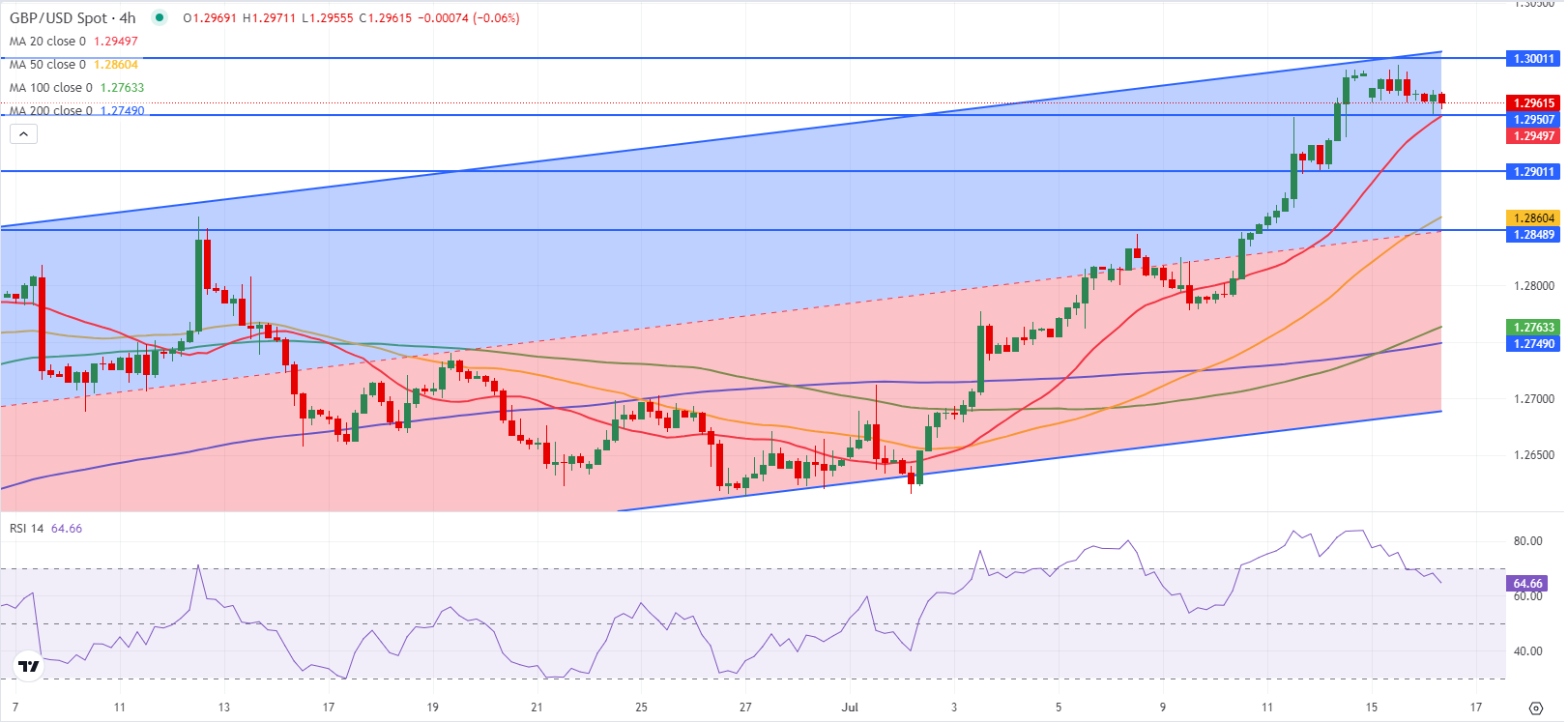
GBP/USD was last seen trading slightly above 1.2950 (20-period Simple Moving Average (SMA), static level). If the pair falls below that level and fails to reclaim it, 1.2900 (psychological level, static level) could be seen as next support before 1.2850 (mid-point of the ascending regression channel coming from late April).
On the upside, 1.3000 (upper limit of the ascending channel, psychological level) aligns as strong resistance ahead of 1.3040 (static level from July 2023) and 1.3100 (psychological level, static level).
Economic Indicator
Consumer Price Index (YoY)
The United Kingdom (UK) Consumer Price Index (CPI), released by the Office for National Statistics on a monthly basis, is a measure of consumer price inflation – the rate at which the prices of goods and services bought by households rise or fall – produced to international standards. It is the inflation measure used in the government’s target. The YoY reading compares prices in the reference month to a year earlier. Generally, a high reading is seen as bullish for the Pound Sterling (GBP), while a low reading is seen as bearish.
Read more.Next release: Wed Jul 17, 2024 06:00
Frequency: Monthly
Consensus: 2%
Previous: 2%
Source: Office for National Statistics
The Bank of England is tasked with keeping inflation, as measured by the headline Consumer Price Index (CPI) at around 2%, giving the monthly release its importance. An increase in inflation implies a quicker and sooner increase of interest rates or the reduction of bond-buying by the BOE, which means squeezing the supply of pounds. Conversely, a drop in the pace of price rises indicates looser monetary policy. A higher-than-expected result tends to be GBP bullish.
Author

Eren Sengezer
FXStreet
As an economist at heart, Eren Sengezer specializes in the assessment of the short-term and long-term impacts of macroeconomic data, central bank policies and political developments on financial assets.















