Federal Reserve takes out massive emergency insurance policy
- US central bank cuts fed funds target range 1% to 0% to 0.25%.
- Begins $700 billion quantitative easing program.
- Fed to buy Treasuries and mortgage backed securities.
- Dow futures down +1000 points in pre-market.
- Powell does not see negative rates as appropriate for the US.

In a bid to prevent financial market instability and to blunt economic damage from the global spread of the Coronavirus the US central bank dropped the fed funds target range 100 basis points to 0%-0.25%.
Saying the outbreak “has harmed communities and disrupted economic activity in many countries, including the United States,” the FOMC announced a $700 billion asset purchase program that will buy $500 billion in Treasuries and $200 billion in mortgage-backed securities over the coming months.
Market reaction
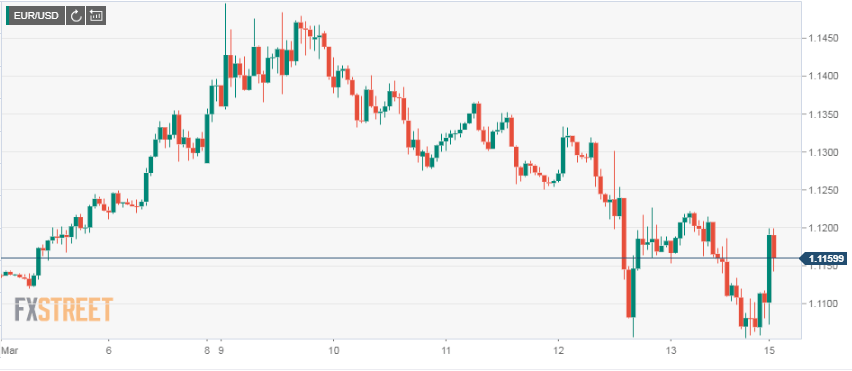
Market were clearly spooked by the emergency weekend move, reminiscent of the height of the financial crisis. Dow futures were limit down at 7:00 pm in New York and the euro had jumped over 100 points to 1.1156 from its open at 1.1101 in Asian trading. The USD/JPY was at 106.42 down from 107.95.
The Fed also lowered the rate at the discount window by 1.25% to 0.25% and lengthened the loan term to 90 days. This facility is used by banks for emergency liquidity and “supports the smooth flow of credit to households and businesses,” said the bank in a separate note.
The discount window is known as the ‘lender of last resort’ to the banking industry. Its use is public and many institutions have in the past been reluctant to access it as it suggests that borrowers may be having trouble finding loans in the interbank money market.
The Fed also cut reserve requirements, the funds that banks must keep on deposit at the central bank, to zero for many thousands of banks.
In a further effort to sustain global financial liquidity the Fed, in concert with the Bank of Japan, the ECB, the Bank of Canada, and the Swiss National Bank, lowered the interest rates on swap line loans to promote dollar liquidity around the world.
“The Committee expects to maintain this target range until it is confident that the economy has weathered recent events and is on track to achieve its maximum employment and price stability goals,” promised the FOMC statement.
It appears from the format of the FOMC statement that the weekend meeting will replace that scheduled for this Wednesday and Thursday, though this was not stated.
Monday morning
While the Fed's surprise Sunday move excited fears of the unknown more considered thought is likely to conclude that the safety factors that ordered currency markets last week will remain true. One key metric will be the extent of the Treasury market response. With the Fed set to buy $500 billion in Treasuries over the next month rates will be forced lower.
Chairman Powell said that the bank will "go in strong" on asset purchases and that there would be no weekly or monthly cap on purchases, implying a major effort by the New York Fed which executes the central bank's market directives, on Monday morning.
As of this writing (8:40 pm EDT) the 10-year Treasury yield is 0.707%, down from the Friday close at 0.983%.
T
Author

Joseph Trevisani
FXStreet
Joseph Trevisani began his thirty-year career in the financial markets at Credit Suisse in New York and Singapore where he worked for 12 years as an interbank currency trader and trading desk manager.