Fed dot plot expected to signal fewer rate cuts as inflation pressures linger
- The Federal Reserve's dot plot reflects interest rate expectations from the world's most important central bank.
- June's Fed dot plot will likely show fewer rate cuts, given the strength of the economy and the persistence of inflation.
- Fed Chair Jerome Powell decision to focus on inflation or employment may add context to the dot plot.

A dovish decision – that was the verdict in March, when the Federal Reserve's (Fed) dot plot still pointed to three interest rate cuts in 2024, despite higher inflation. Markets seemed to ignore the fact there were fewer dots pointing to three cuts, and that the median was close to tipping down to two cuts.
Fed dot plot recent developments
The dot plot is officially called the Summary of Economic Projections (SEP) and consists of projections for growth, inflation and employment, in addition to rates. Markets care about borrowing costs – even to the point of cheering weak economic data as it implies lower rates.
After that March decision, the bank acknowledged inflation was higher and pointed to a longer delay in cutting rates. Some hawkish Fed members, such as Minneapolis Fed President Neel Kashkari, opened the door to refraining from reducing borrowing costs in 2024. That would mean higher points on the dot plot.
However, it was followed by a much-needed retreat in inflation in the report for April, which showed that the "bump on the road" might have been long but that price rises were moderating. It emboldened the doves, which could still opt for three rate cuts on the dot plot.
Underlying inflation is falling slowly:
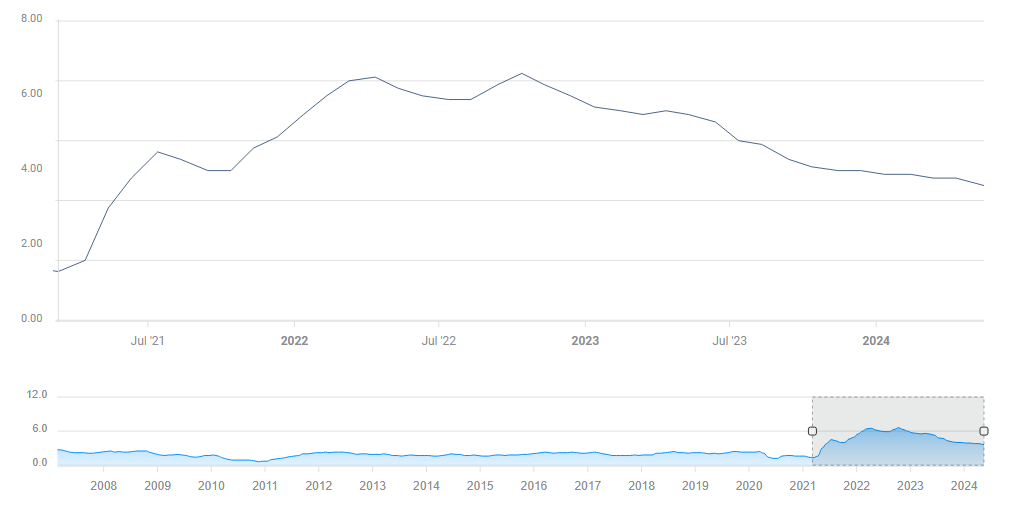
Will the Federal Open Market Committee (FOMC) opt for one or two interest rate cuts as the median in the dot plot? That is the question for markets. Apart from inflation, the labor market is also of high importance as full employment is the Fed's second mandate.
Fed Chair Jerome Powell said that "unexpected weakness" in jobs would push the Fed toward cutting rates. The last Nonfarm Payrolls resulted in 272,000 new positions in May, well above expectations and reflecting strength rather than weakness.
However, the Unemployment Rate rose to the round 4% level. That strengthens the doves.
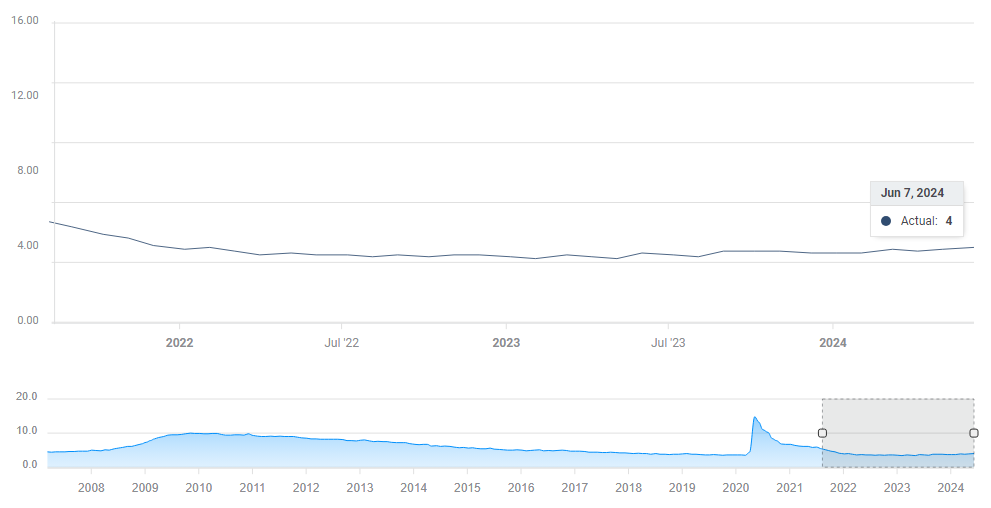
US Unemployment Rate. Source: FXStreet
Fed dot plot has the first and last word in moving markets
FOMC members – including those who do not vote on interest rates – participate in creating the dot plot, and the eyes of markets are on them. A median of one rate cut in 2024 would boost the US Dollar (USD), but send Gold price and stocks down. A dot plot pointing to two cuts would cheer investors in stocks and Gold, while downing the US Dollar.
It is essential to note that the accompanying statement and Fed Chair Jerome Powell's press conference also move markets. And Powell will stress that the FOMC makes decisions on a meeting-by-meeting basis and is data-dependent. Nevertheless, the dot plot has the first word in moving markets – and the last word.
The dots are what investors remember, and the next ones come only in September. That means Gold, the US Dollar and stocks will be impacted by this factor for many months.
Interest rates FAQs
Interest rates are charged by financial institutions on loans to borrowers and are paid as interest to savers and depositors. They are influenced by base lending rates, which are set by central banks in response to changes in the economy. Central banks normally have a mandate to ensure price stability, which in most cases means targeting a core inflation rate of around 2%. If inflation falls below target the central bank may cut base lending rates, with a view to stimulating lending and boosting the economy. If inflation rises substantially above 2% it normally results in the central bank raising base lending rates in an attempt to lower inflation.
Higher interest rates generally help strengthen a country’s currency as they make it a more attractive place for global investors to park their money.
Higher interest rates overall weigh on the price of Gold because they increase the opportunity cost of holding Gold instead of investing in an interest-bearing asset or placing cash in the bank. If interest rates are high that usually pushes up the price of the US Dollar (USD), and since Gold is priced in Dollars, this has the effect of lowering the price of Gold.
The Fed funds rate is the overnight rate at which US banks lend to each other. It is the oft-quoted headline rate set by the Federal Reserve at its FOMC meetings. It is set as a range, for example 4.75%-5.00%, though the upper limit (in that case 5.00%) is the quoted figure. Market expectations for future Fed funds rate are tracked by the CME FedWatch tool, which shapes how many financial markets behave in anticipation of future Federal Reserve monetary policy decisions.
Author

Yohay Elam
FXStreet
Yohay is in Forex since 2008 when he founded Forex Crunch, a blog crafted in his free time that turned into a fully-fledged currency website later sold to Finixio.















