|

EUR/USD returns inside the channel; neutral in short-term [Video]

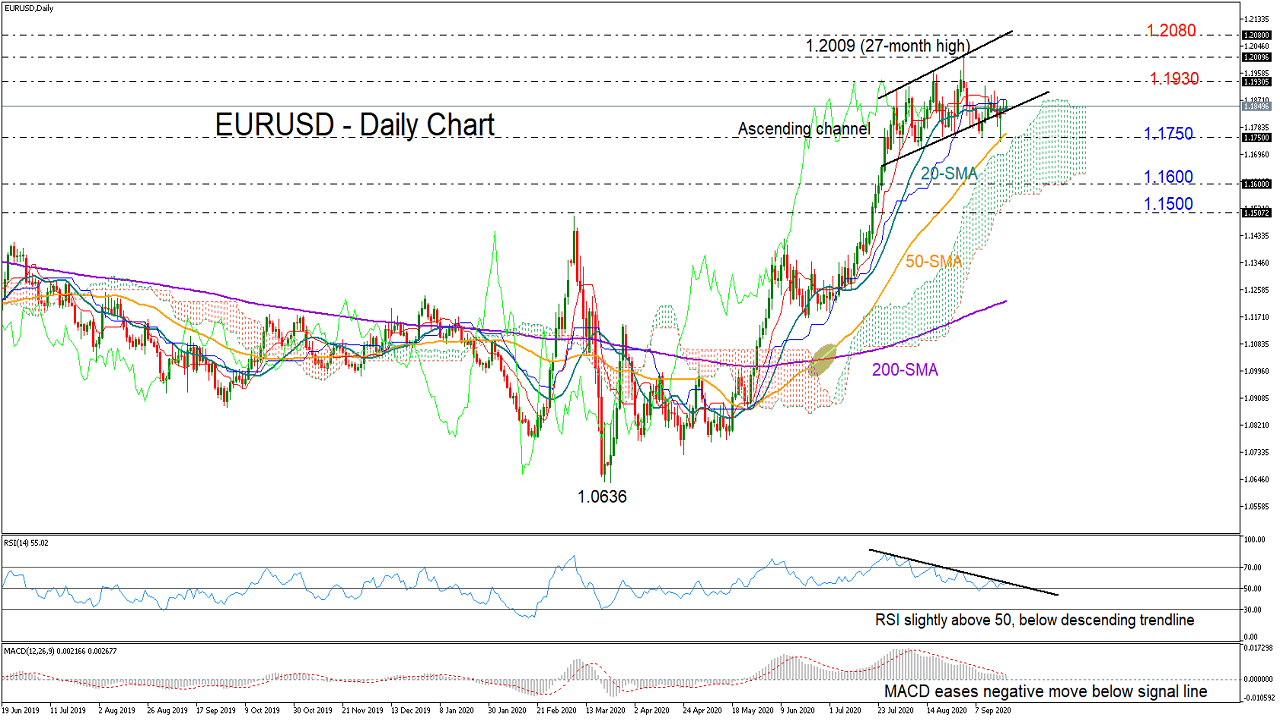
EURUSD opened with a soft positive tone on Monday, refusing to abandon the ascending channel that directed the price to a fresh 17-month high of 1.2009 earlier this month.
 

The rebound near the 50-day simple moving average (SMA) and the 1.1750 level last week signaled that the bulls are still in play, but the momentum indicators have yet to show strength. The RSI, although above its 50 neutral mark, remains around a descending trendline, while the MACD continues to weaken below its red signal line though at a slower pace. Moreover, in Ichimoku indicators, the red Tenkan-sen line has paused its decline immediately after crossing below the blue Kijun-sen. Hence, technically, the short-term bias is currently looking neutral.

A close above 1.1930; a level which could not be overcome earlier this month, may bring the 1.2000 mark under examination. Should the bulls jump that wall, the rally may continue until it touches the roof of the channel around 1.2080.

On the other hand, a clear drop below the 50-day MA and the 1.1750 support area could trigger a steeper decline towards 1.1600, shifting the neutral short-term outlook to bearish. Lower, the door would open for the 1.1500 hurdle, a break of which is expected to downgrade the medium-term picture to neutral.

Summarizing, EURUSD is facing a neutral bias in the short-term, where a break above 1.1930 or below 1.1750 may determine the next move in the market.  A cross beneath the 1.1500 number would also downgrade the positive medium-term outlook to neutral.
EURUSD

Author

Christina Parthenidou

Christina joined Trading Point in May 2017. She holds a master degree in Economics and Business from the Erasmus University Rotterdam with a specialization in International economics.


More from Christina Parthenidou
Share:

Editor's Picks

AUD/USD bulls seem hesitant near 0.6950

AUD/USD attracts some buyers for the second straight day, though it remains confined within Friday's broader range amid mixed cues. The US PCE data and the US NFP report released last week tempered October Fed hike bets, dragging US bond yields away from multi-year highs and keeping US Dollar bulls on the back foot. However, geopolitical uncertainty is a tailwind for the safe-haven buck, while the RBA's cautious outlook caps the Aussie.

USD/JPY remains confined in a range below 158.00

USD/JPY holds steady around 157.75 during the Asian session on Monday, trading within a one-week-old range. Against the backdrop of soft US PCE data, the US NFP report, released on Friday, tempers October Fed rate-hike bets and drags US bond yields away from multi-year highs. Furthermore, hawkish BoJ expectations amid looming intervention risks support the Japanese Yen, capping the pair. However, geopolitical uncertainty acts as a tailwind for the safe-haven buck and limits the downside.

Gold trades with positive bias around $4,150; upside seems capped

Gold attracts some dip-buyers at the start of a new week, though it remains confined in a familiar range held over the past week or so. Against the backdrop of soft US PCE data, Friday's weak US NFP report tempered bets of an October Fed rate hike. This, in turn, drags US bond yields away from multi-year highs and benefits the non-yielding bullion. The US Dollar, however, draws support from geopolitical uncertainties and could act as a headwind for the precious metal.

Week ahead: Fed minutes in the spotlight amid bond market rout
The first full week of October and the final quarter of the year get underway with little fanfare in terms of the economic agenda. But far from being short on excitement, the coming week will test market nerves, as government bond yields continue to soar on growing worries that the energy crisis will only get worse, fuelling inflation.
CFTC Report: Speculators turn more defensive as Oil exposure falls
The week in one sentence: During the week leading up to September 29, long positions in crude oil were significantly reduced, while short positions in the Canadian Dollar went up. In addition, the positioning of the Australian Dollar and the Japanese Yen declined, while Coffee buying stood out against a more general background of defensiveness.
The Euro is near a one-year low: Inflation could trigger its rebound, not its fall

EUR/USD has fallen to its lowest level since May 2025. The pair hit 1.1312 on Wednesday and trades well below the January peak of 1.2082. The decline reflects a powerful combination of US Dollar strength, geopolitical uncertainty and renewed concerns about Europe's exposure to higher energy prices.