Eurozone PMI Preview: Triggering the next EUR/USD fall? Low expectations may be too high
- Purchasing Managers' Indexes for February are st to show ongoing manufacturing weakness.
- After disappointing German data and the coronavirus outbreak, expectations may be too high.
- EUR/USD has room to extend its slump in response to the data.


Sell low and buy even lower – a classic technical pattern may now be relevant for the upcoming release. Economists expect most of Markit's preliminary Purchasing Managers' Indexes (PMIs) for February to drop below January's levels.
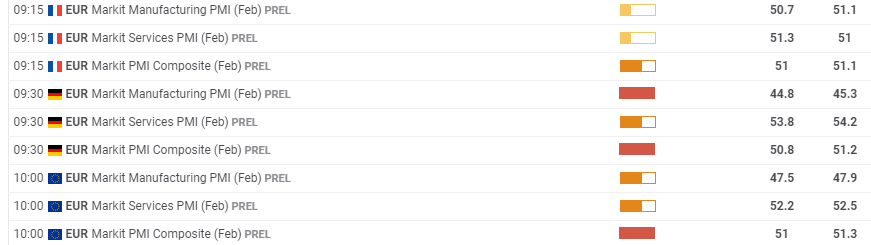
France's Services PMI is the only figure carrying expectations for an increase, albeit a meager one from 51 to 51.3 points and some of the declines are minimal
Nevertheless – and especially for the all-important German Manufacturing PMI – these downbeat estimates may be too optimistic. Here is what the economic calendar is showing:
Why expectations are too high
Germany, the largest economy in the eurozone, has stagnated in the fourth quarter. For the whole of 2019, the economy expanded by a dismal 0.4%. The export-oriented country heavily depends on sales to China, the world's second-largest economy. The manufacturing sector already suffered a downturn in 2019, as seen in plunging Industrial Production and Factory Orders figures in 2019.
The coronavirus outbreak began grabbing the headlines only in January and the full extent of the crisis has become apparent only in February. PMIs are forward-looking surveys, grasping the sentiment at the current moment. Therefore, a minimal drop from 45.3 to 44.8 seems too optimistic. Any score below 50 represents contraction.
Another business survey for February, the ZEW Economic Sentiment, fell to 8.7 points in a release earlier this week, far below 21.5 expected. There is no reason to believe that PMIs would beat estimates. Moreover, the German Manufacturing PMI bottomed at 41.7 points in September – allowing more room for falls.
One thing that may explain the relative optimism is that actual figures exceeded expectations in the past five publications. Forecasters could be moving their estimates higher after previous misses.
Here are the recent trends:

EUR/USD positioning and three scenarios
Euro/dollar has been on a losing streak in recent weeks, descending to the lowest since April 2017 – filling the "Macron Gap" from nearly three years ago. The currency pair could be oversold, allowing for a bounce if PMIs beat expectations.
On the other hand, the downfall is related to US-European economic divergence, and these figures may add fuel to the fire. Overall, there is room for high volatility.
1) Below expectations: As discussed earlier, forecasts seem too optimistic, opening the door to a significant miss. In this case, EUR/USD extends its falls considerably, depending on the magnitude of the disappointment. This scenario has a high probability.
2) Within expectations: If economists hit the nail on the head, euro/dollar has room to stabilize and even recover after long days of falls. Nevertheless, any advance could be short-lived – a dead-cat bounce. The probability is medium.
3) Above expectations: If businesses cling to the glass-half full, the mix of oversold conditions could send EUR/USD to a meaningful recovery that could last until markets close.
Conclusion
Coronavirus fears and recent dismal data are pointing to a more substantial fall in PMIs than economists expect. EUR/USD has room to fall alongside prospets of a worsening slowdown. A surprising beat or even just meeting expectations could help the pair recover after the long-lasting downfall.
Author
Yohay Elam
FXStreet
Yohay is in Forex since 2008 when he founded Forex Crunch, a blog crafted in his free time that turned into a fully-fledged currency website later sold to Finixio.