Euro gains against the Dollar amid mixed economic signals


The EUR/USD pair rose to 1.0707 on Wednesday, driven by increased local risk appetite and the belief that the currency was significantly oversold against the US dollar. This resurgence indicates a temporary rebalancing in the currency market.
In the US, newly published statistics provide fodder for economic analysis. Sales of new homes in March showed a robust increase of 8.8% month-on-month, climbing to 693,000 from February’s 637,000, surpassing expectations. The year-on-year comparison also reflected strength with an 8.3% increase. Additionally, the weighted average price of a sold house in the US rose to USD 524.8 thousand from USD 488.6 thousand in February, pointing to a market that is still vibrant despite elevated interest rates.
These indicators are inherently pro-inflationary, suggesting that consumer behaviour has adapted well to elevated interest rates. Continued activity in the housing market is likely to sustain inflationary pressures in the US for an extended period. If interest rates were to be lowered, the attractiveness of buying property would increase further, prompting the Federal Reserve to keep higher rates to temper economic overheating.
Despite substantial efforts by the Fed to stabilise price pressures, the US economy shows a high degree of resilience to changed conditions. This adaptability is a mixed blessing, maintaining economic vitality but complicating inflation management.
As long as the Fed keeps interest rates at the current peak of 5.5% per annum, the US dollar will likely retain its strength. Any current weakening of the dollar is seen as a temporary adjustment rather than a trend reversal.
EUR/USD technical analysis
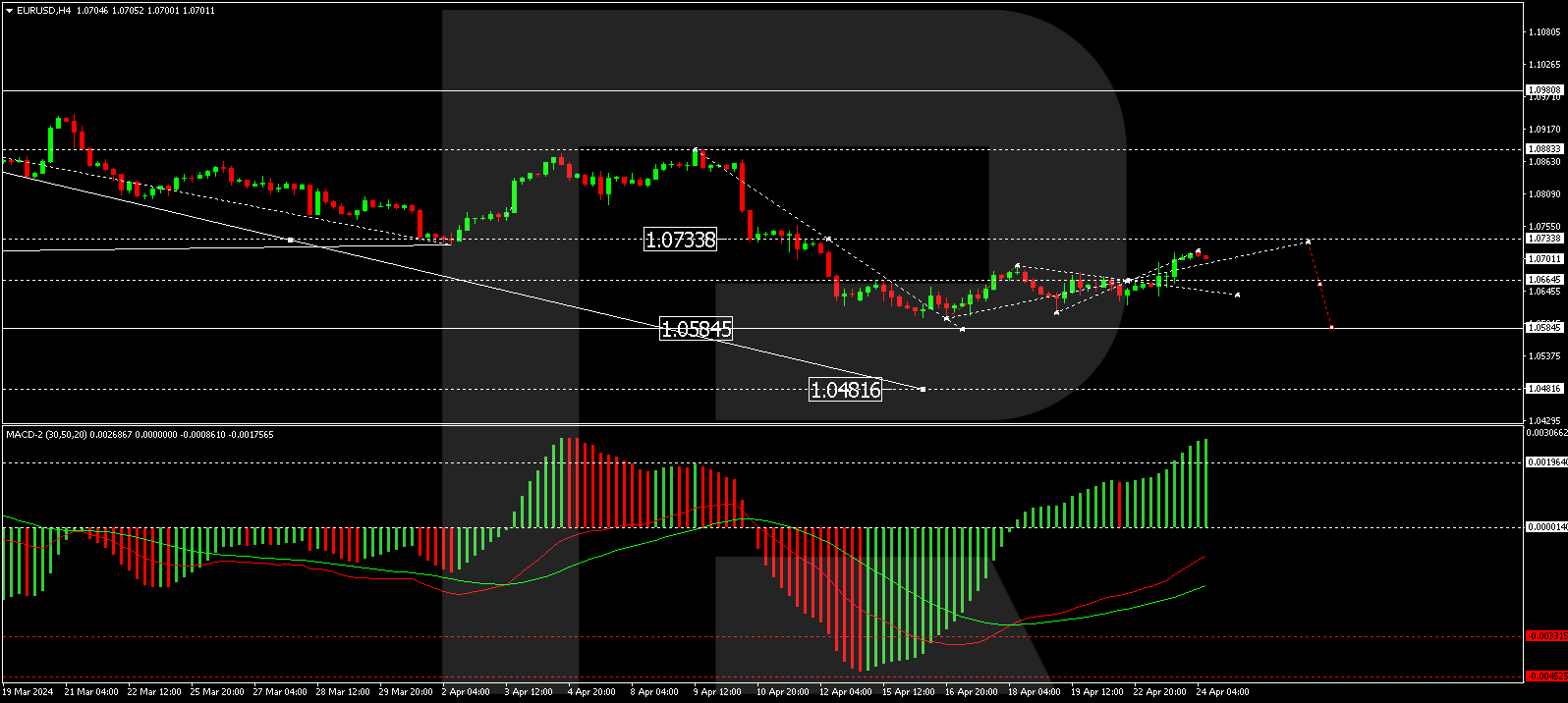
On the H4 chart, the EUR/USD pair formed a consolidation range around 1.0666. A correction to 1.0713 occurred after the market exited the range on the upside. The pair is expected to decline to 1.0660 for a retest from above before potentially developing another growth structure towards 1.0733. The movement from 1.0601 is considered a correction of the last decline wave. After completing this corrective phase, a new downward wave to 1.0585 may begin. This outlook is supported by the MACD indicator, where the signal line is below zero but ascending, while the histograms are at maximums, poised for a decline.
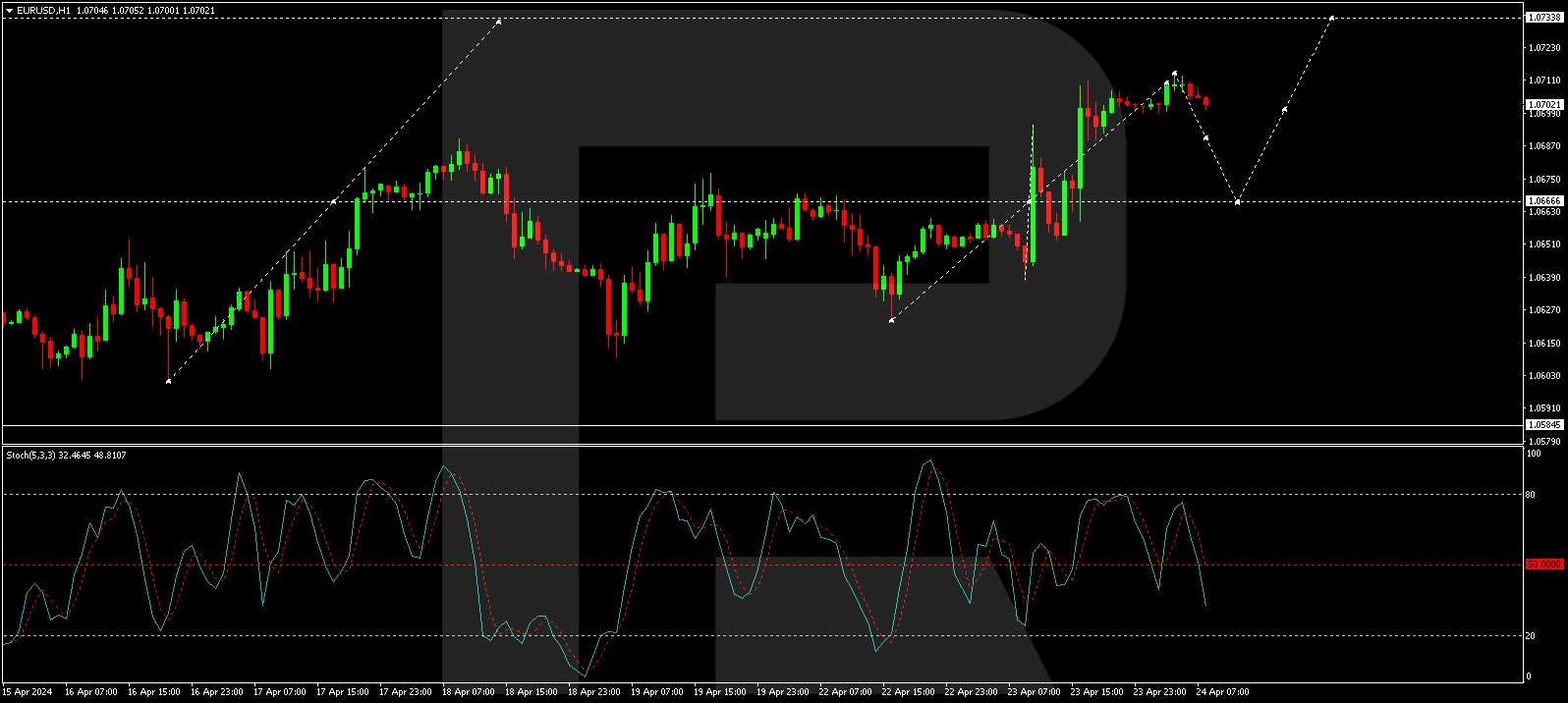
On the H1 chart, after fulfilling the local correction target at 1.0713, a decline to 1.0660 is anticipated. Subsequently, the development of a growth wave to 1.0733, the main correction target, may occur. The Stochastic oscillator, currently below 50, is expected to drop to 20, supporting the potential for further adjustments before any upward movements.
Author
Andrey Goilov
RoboForex
Higher economic education. Andrey Goilov has been working on the Forex market since 2005. A financial analyst and successful trader. Preference in trading is highly volatile instruments.