EUR/USD Weekly Forecast: Inflation figures to make it or break it
- Euro Zone growth-related numbers indicated a steep economic contraction in Q3.
- The US Nonfarm Payroll report showed a strong American labor market.
- EUR/USD bearish continuation puts parity on the table before year-end.

The EUR/USD pair reached a fresh 2023 low of 1.0447, trimming part of its weekly losses ahead of the close to end the week at around 1.0520. The US Dollar retained its overall strength resulting from persistent concerns about the economic future, although extreme overbought conditions triggered a corrective decline mid-week.
In the end, what really matters is that government bond yields hit multi-year highs while stock markets posted substantial losses as continued inflationary pressures and a not-so-tight labor market leaves room for the Federal Reserve (Fed) to contract monetary condition further. As a result, the US Dollar finished the week with a firm tone across the board.
Throughout the first half of the week, investors paid attention to growth-related figures, which fell short of boosting the mood. S&P Global released the final versions of the September Producer Manager Indexes (PMIs), which confirmed the Euro Zone economy contracted sharply in the third quarter of the year, with modest revision in some of the indexes resulting from backlogs. On the other hand, the official United States (US) ISM Manufacturing PMI printed at 51.2 in September, while the services index printed at 50.1, both indicating expansion in the respective sector and reflecting US economic resilience.
Employment and inflation still in the eye of the storm
US employment-related figures released on Friday showed the sector remains tight, and that’s no good news for the Federal Reserve (Fed), which may need to keep rates higher for longer to tame inflation. According to the Nonfarm Payrolls report, the country added 336,000 new job positions in September, nearly doubling the market expectations. The Unemployment Rate remained steady at 3.8%, while the Labor Force Participation Rate was confirmed at 62.8%. The figures sent the 10-year Treasury yield to 4.887%, its highest since 2007, while the 2-year note offered as much as 5.15%, not far from the multi-year high posted at 5.20% mid-September.
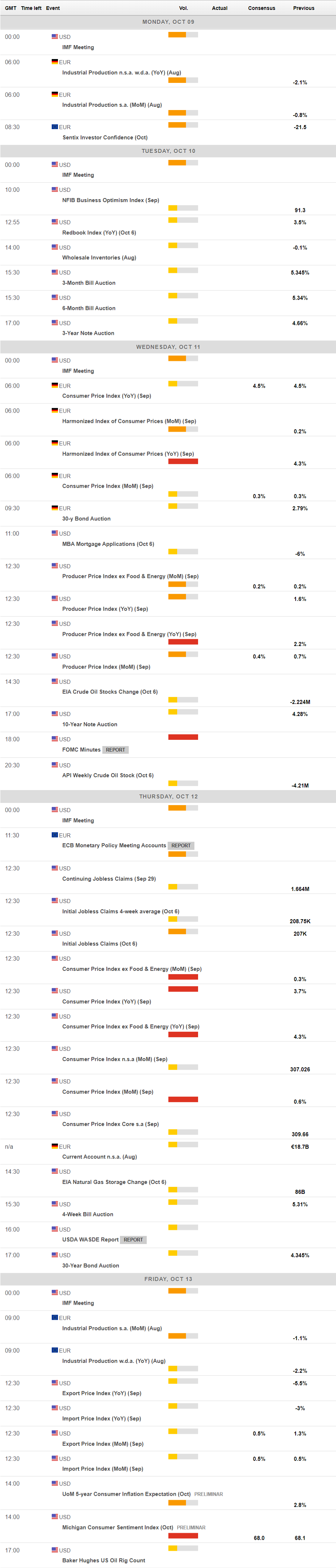
Inflation will return to the spotlight next week, as Germany will publish the September Harmonized Index of Consumer Prices (HICP) while the US will unveil the Producer Price Index (PPI) for the same month. The US Federal Open Market Committee (FOMC) will publish the Minutes of the September meeting on Wednesday.
Finally, the US will unveil the September Consumer Price Index (CPI) on Thursday and the preliminary estimate of the October Michigan Consumer Sentiment Index on Friday.
EUR/USD technical outlook
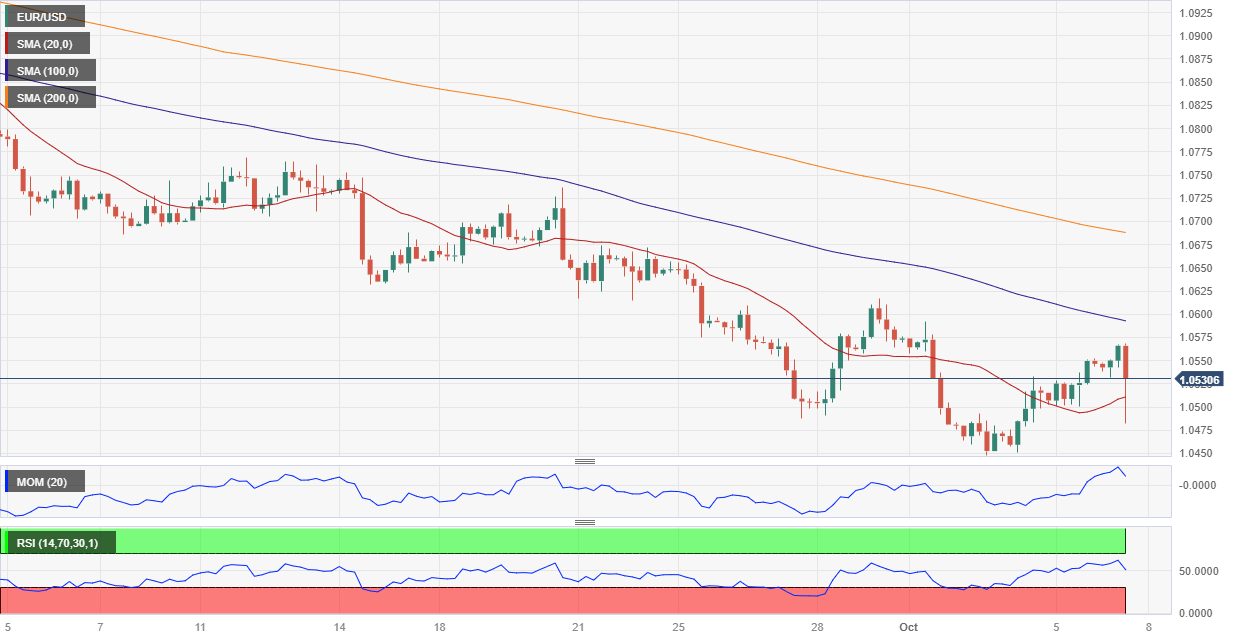
The EUR/USD pair has been in a steady decline ever since reaching 1.1275 in mid-July, closing twelve consecutive weeks in the red. The pair is extremely oversold as corrective advances are shallow and short-lived, yet there are no technical signs of a mid-term interim bottom.
The weekly chart shows that the pair has extended its slide below a bearish 100 Simple Moving Average (SMA) for a fourth consecutive week, while the 20 SMA gains downward traction above it. Furthermore, technical indicators head firmly south within negative levels without indicating bearish exhaustion but instead supporting another leg south.
The EUR/USD outlook is bearish according to the daily chart. Technical indicators resumed their declines within negative levels after correcting extreme oversold conditions, reflecting sellers’ dominance. At the same time, a firmly bearish 20 SMA caps the upside at around 1.0610 while maintaining its downward slope well below the longer ones.
The aforementioned 20 DMA acts as an immediate resistance level ahead of the 1.0700 region, with a steeper correction expected on a break above the latter, aiming for the 1.0840/60 price zone. On the contrary, a break through 1.0447 would expose the 1.0320/40 region, followed by the 1.0260 price area.
EUR/USD sentiment poll
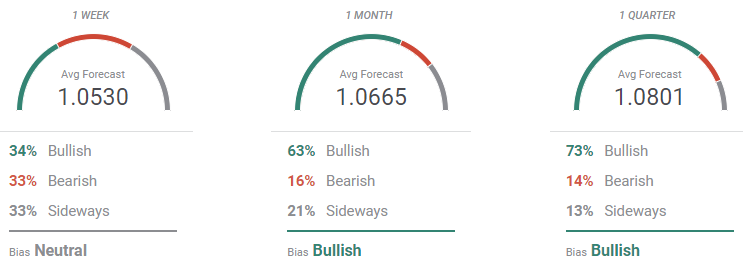
The FXStreet Forecast Poll shows bears are still leading the way, despite the increased risk of a bullish correction. The pair is seen on average, neutral in the near term but bullish in the monthly and quarterly views. The pair is seen at around 1.0800 in the three-month perspective, which will not be enough to confirm a trend change.
Finally, the Overview chart favors a downward continuation, as the three moving averages gained bearish traction, with strong downward slopes, and at fresh multi-month lows. Even further, lower lows are not in sight, with the pair seen as low as 1.0300 in the upcoming weeks. In the monthly view, most targets accumulate between 1.0400 and 1.0800, while the range barely increases in the quarterly view. On the contrary, a potential advance beyond 1.1000 seems less likely.
Author

Valeria Bednarik
FXStreet
Valeria Bednarik was born and lives in Buenos Aires, Argentina. Her passion for math and numbers pushed her into studying economics in her younger years.