EUR/USD Weekly Forecast: US Dollar under pressure as Fed’s rate cut looms
- Softer-than-anticipated United States inflation figures boosted the market mood.
- European growth-related figures to indicate that the Union is not yet out of the woods.
- EUR/USD poised to extend its gains beyond the 1.1100 mark.

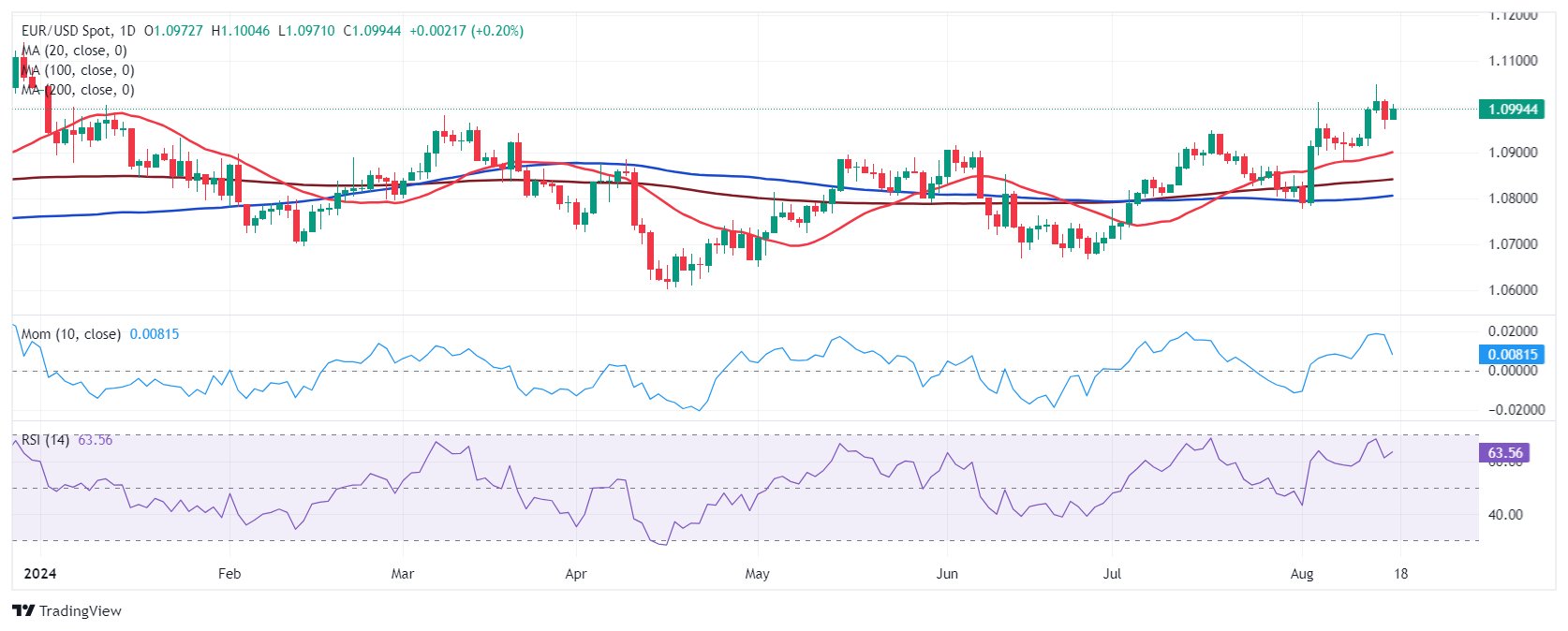
The EUR/USD pair surged to 1.1046 this week, surpassing its yearly opening by a couple of pips and settling a fresh 2024 high. The momentum faded and the US Dollar was able to recover some ground, yet as the weekend approaches, the pair trades with solid gains around the 1.1000 mark.
What happened?
Optimism took over financial markets and undermined demand for the USD following the release of softer-than-anticipated United States (US) inflation-related figures. EUR/USD added roughly 90 pips from its daily low on Tuesday, as the US Producer Price Index (PPI) rose by less than anticipated in July, up 2.2% YoY and 0.1% MoM. The readings were also below June's outcomes. Finally, the core annual PPI rose 2.4%, below the previous 3% and the expected 2.7%. The US Dollar edged sharply lower on rising bets that easing inflationary pressures will allow the Federal Reserve (Fed) to kick-start the loosening monetary policy cycle when it meets in September.
EUR/USD rallied towards the mentioned 2024 high on Wednesday, following the release of the US Consumer Price Index (CPI). The index rose 2.9% on a yearly basis in July, down from the 3% posted in June. The annual core figure printed at 3.2%, slightly below the previous 3.3%, although matching expectations. Finally, the CPI was up 0.2% on a monthly basis as expected.
Enthusiasm about an upcoming rate cut, however, was short-lived as the USD trimmed most of its intraday losses despite the solid momentum in global equities reflecting prevalent risk appetite. As stocks kept rallying, USD gains were held in check. At the end of the day, the inflation data barely affected the odds of a Fed rate cut. What markets are still uncertain is whether the central bank will deliver a 25 or 50 basis points (bps) cut. At this point, that seems more related to economic growth than to inflation levels.
Despite still being above the Fed’s goal of around 2%, inflation has continued to ease. Economic progress, on the other hand, has been bumpy but overall encouraging. Indeed, some tepid figures revived recession-related concerns early in August. Such fears seem to have cooled down, and with the September meeting around the corner, speculative interest abandoned the idea of an out-of-schedule rate cut.
And what about Europe?
The European Central Bank (ECB) has already delivered rate cuts, trimming the three main bank rates by 25 basis points (bps) each. The ECB is widely anticipated to repeat the move in September and December amid stubbornly high inflation. But European policymakers also face the risk of a recession. And signs there have been far more evident than in the US throughout the last year or so.
EU data released this week fell short of impressing. Germany published the ZEW Survey on Economic Sentiment, with the index edging sharply lower in the country and the EU. Even further, the assessment of the current situation worsened by more than anticipated.
Also, the EU unveiled the second estimate of the Q2 Gross Domestic Product (GDP), which converged with the initial estimate, posting a modest 0.3% advance in the three months to June. Meanwhile, Industrial Production declined 0.1% MoM in June and slid 3.9% compared to a year earlier in June.
What’s next for the EUR/USD?
Data-wise, the upcoming week will bring the release of the Federal Open Market Committee (FOMC) meeting minutes. The document is usually released three weeks after the meeting takes place. Back then, the wording of the accompanying statement showed that US officials are more willing to trim interest rates. Chairman Jerome Powell noted that “the second quarter’s inflation readings have added to our confidence, and more good data would further strengthen that confidence.” Furthermore, policymakers sounded less worried about inflationary pressures, saying that “inflation has eased over the past year but remains somewhat elevated” from just “elevated” in the previous statement. For the most, market participants have seen officials paving the way for a September interest rate cut.
Additionally, the Hamburg Commercial Bank (HCOB) and S&P Global will publish the preliminary estimates of the August Purchasing Managers Indexes (PMIs) for most major economies. Finally, the Jackson Hole Economic Symposium, an event that hosts policymakers, academics, and economists from around the world, will start on Friday. Fed Chair Powell will deliver remarks on the economic outlook during the first day of the symposium.
Other than that, the Eurozone will publish the final estimate of the July Harmonized Index of Consumer Prices (HICP).

EUR/USD technical outlook
From a technical point of view, EUR/USD is poised to extend gains. In the weekly chart, technical indicators emerged within positive levels, albeit with uneven momentum. At the same time, the pair further extended its advance above the 20 and 100 Simple Moving Averages (SMAs) and approaches a mildly bearish 200 SMA, providing dynamic resistance at 1.1070. Once beyond the levels, bulls will likely feel more comfortable adding long positions.
The daily chart for the EUR/USD pair shows technical indicators corrected overbought conditions before resuming their advances, supporting continued gains. At the same time, the 20 SMA keeps accelerating north below the current level while above the 100 and 200 SMAs, further supporting the bullish case. Once above 1.1070, bulls will look to test a strong static resistance area at around 1.1140. Gains beyond the latter should lead to an advance towards the 1.1200 figure.
In the case of a pullback, 1.0950 is the immediate support level ahead of the 1.0890 price zone. Below the latter, the pair should move lower towards the 1.0800 region.
Economic Indicator
FOMC Minutes
FOMC stands for The Federal Open Market Committee that organizes 8 meetings in a year and reviews economic and financial conditions, determines the appropriate stance of monetary policy and assesses the risks to its long-run goals of price stability and sustainable economic growth. FOMC Minutes are released by the Board of Governors of the Federal Reserve and are a clear guide to the future US interest rate policy.
Read more.Next release: Wed Aug 21, 2024 18:00
Frequency: Irregular
Consensus: -
Previous: -
Source: Federal Reserve
Minutes of the Federal Open Market Committee (FOMC) is usually published three weeks after the day of the policy decision. Investors look for clues regarding the policy outlook in this publication alongside the vote split. A bullish tone is likely to provide a boost to the greenback while a dovish stance is seen as USD-negative. It needs to be noted that the market reaction to FOMC Minutes could be delayed as news outlets don’t have access to the publication before the release, unlike the FOMC’s Policy Statement.
US Dollar FAQs
The US Dollar (USD) is the official currency of the United States of America, and the ‘de facto’ currency of a significant number of other countries where it is found in circulation alongside local notes. It is the most heavily traded currency in the world, accounting for over 88% of all global foreign exchange turnover, or an average of $6.6 trillion in transactions per day, according to data from 2022. Following the second world war, the USD took over from the British Pound as the world’s reserve currency. For most of its history, the US Dollar was backed by Gold, until the Bretton Woods Agreement in 1971 when the Gold Standard went away.
The most important single factor impacting on the value of the US Dollar is monetary policy, which is shaped by the Federal Reserve (Fed). The Fed has two mandates: to achieve price stability (control inflation) and foster full employment. Its primary tool to achieve these two goals is by adjusting interest rates. When prices are rising too quickly and inflation is above the Fed’s 2% target, the Fed will raise rates, which helps the USD value. When inflation falls below 2% or the Unemployment Rate is too high, the Fed may lower interest rates, which weighs on the Greenback.
In extreme situations, the Federal Reserve can also print more Dollars and enact quantitative easing (QE). QE is the process by which the Fed substantially increases the flow of credit in a stuck financial system. It is a non-standard policy measure used when credit has dried up because banks will not lend to each other (out of the fear of counterparty default). It is a last resort when simply lowering interest rates is unlikely to achieve the necessary result. It was the Fed’s weapon of choice to combat the credit crunch that occurred during the Great Financial Crisis in 2008. It involves the Fed printing more Dollars and using them to buy US government bonds predominantly from financial institutions. QE usually leads to a weaker US Dollar.
Quantitative tightening (QT) is the reverse process whereby the Federal Reserve stops buying bonds from financial institutions and does not reinvest the principal from the bonds it holds maturing in new purchases. It is usually positive for the US Dollar.
Author

Valeria Bednarik
FXStreet
Valeria Bednarik was born and lives in Buenos Aires, Argentina. Her passion for math and numbers pushed her into studying economics in her younger years.