EUR/USD Weekly Forecast: Major pair looks set for volatility as ECB meeting, US NFP data loom
- Bets for interest rate cuts in June by the Fed and ECB helped the pair.
- Investors expect the ECB to keep its rate unchanged next week.
- EUR/USD maintained the positive streak in the weekly chart.

EUR/USD managed to clinch its second consecutive week of gains despite a lacklustre price action in the first half of the week, where the European currency slipped back below the 1.0800 key support against the US Dollar (USD).
Fed and ECB rate cut bets remained in the fore
It was another week dominated by investors’ speculation around the timing of the start of the easing cycle by both the Federal Reserve (Fed) and the European Central Bank (ECB).
Around the Fed, the generalized hawkish comments from rate-setters, along with the persistently firm domestic fundamentals, initially suggest that the likelihood of a “soft landing” remains everything but mitigated. In this context, the chances of an interest rate reduction in June remained well on the rise.
On the latter, Richmond Fed President Thomas Barkin went even further on Friday and suggested that the Fed might not reduce its rates at all this year.
Meanwhile, the CME Group’s FedWatch Tool continues to see a rate cut at the June 12 meeting as the most favourable scenario at around 52%.
In Europe, ECB’s officials also expressed their views that any debate on the reduction of the bank’s policy rate appears premature at least, while they have also pushed back their expectations to such a move at some point in the summer, a view also shared by President Christine Lagarde, as per her latest comments.
More on the ECB, Board member Peter Kazimir expressed his preference for a rate cut in June, followed by a gradual and consistent cycle of policy easing. In addition, Vice President Luis de Guindos indicated that if new data confirm the recent assessment, the ECB's Governing Council will adjust its monetary policy accordingly.
European data paint a mixed outlook
In the meantime, final Manufacturing PMIs in both Germany and the broader Eurozone showed the sector still appears mired in the contraction territory (<50), while the job report in Germany came in below consensus and the unemployment rate in the Eurozone ticked lower in January. Inflation, on the other hand, resumed its downward trend in February, as per preliminary Consumer Price Index (CPI) figures in the Eurozone and Germany.
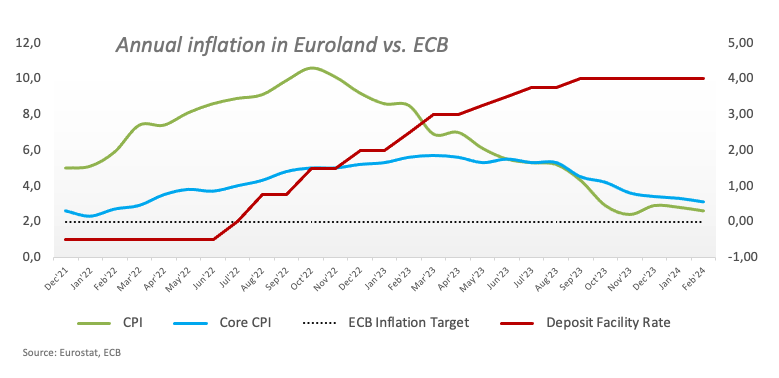
On the whole, while Europe still struggles to see some light at the end of the tunnel, the prospects for the US economy do look far brighter, which could eventually lead to extra strength in the Greenback to the detriment of the risk-linked galaxy, including, of course, the Euro (EUR).
EUR/USD technical outlook
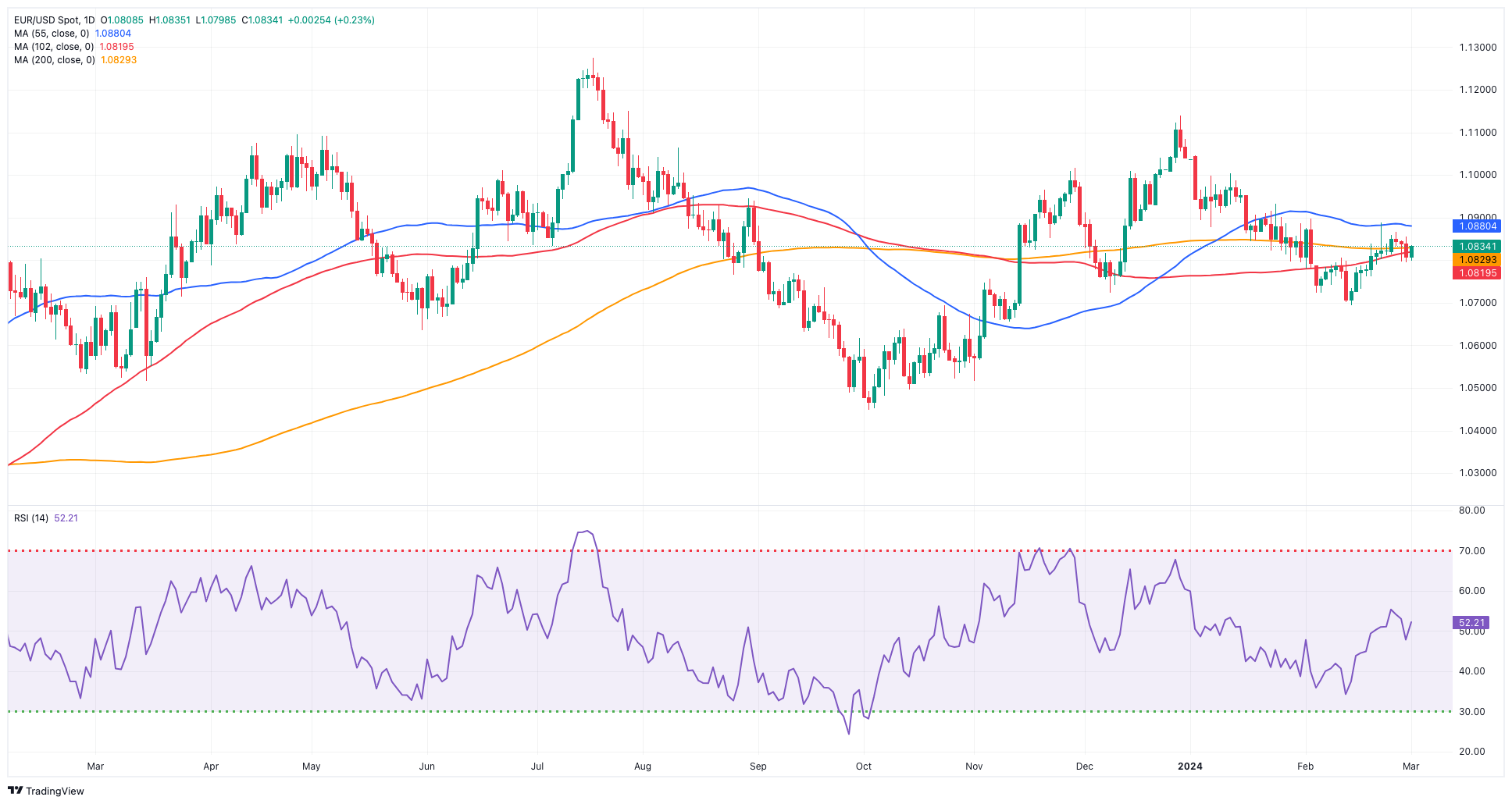
In the event of continued downward momentum, EUR/USD may potentially retest its 2024 low of 1.0694 (observed on February 14), followed by the weekly low of 1.0495 (recorded on October 13, 2023), the 2023 low of 1.0448 (registered on October 3), and eventually reach the psychological level of 1.0400.
Having said that, the pair is currently facing initial resistance at the weekly high of 1.0888, which was seen on February 22. This level also finds support from the provisional 55-day SMA (Simple Moving Average) near 1.0880. If spot manages to surpass this initial hurdle, further up-barriers can be found at the weekly peaks of 1.0932, noted on January 24, and 1.0998, recorded on January 5 and 11. These levels also reinforce the psychological threshold of 1.1000.
In the meantime, extra losses remain well on the cards while EUR/USD navigates the area below the key 200-day SMA, today at 1.0828.
Author

Pablo Piovano
FXStreet
Born and bred in Argentina, Pablo has been carrying on with his passion for FX markets and trading since his first college years.

















