EUR/USD Price Forecast: Remains below 1.1200 on softer French/Spanish CPI; looks to US PCE
- EUR/USD comes under renewed selling pressure on Friday amid a modest USD strength.
- Softer CPI prints from France and Spain exert additional downward pressure on the Euro.
- The USD bulls seem reluctant, limiting losses for the pair ahead of the US PCE Price Index.

The EUR/USD pair continues with its struggle to conquer the 1.1200 mark and attracts some sellers on Friday, reversing a part of the previous day's positive move. The US Dollar (USD) ticks higher amid some repositioning trade ahead of the release of the US Personal Consumption Expenditure (PCE) Price Index and turns out to be a key factor weighing on the currency pair. The USD uptick, however, runs out of steam amid expectations for a more aggressive policy easing by the Federal Reserve (Fed), which, in turn, should limit the downside for the major.
The CME Group's FedWatch Tool indicates over a 50% chance that the US central bank will again lower borrowing costs by 50-basis points at its November policy meeting. This, to a larger extent, offsets the fact that several Fed officials warned this week that rates may not fall as sharply in the coming meetings and Thursday's better-than-expected US macro data. The Bureau of Economic Analysis published the third estimate of the US Gross Domestic Product (GDP) print, which showed that the economy grew at a 3% annualized pace in the second quarter.
Adding to this, the US Census Bureau reported that new orders for manufactured durable goods were virtually unchanged in August after soaring by 9.9% in the previous month. Excluding transportation, new orders increased by 0.5% during the reported month. Separately, the US Labor Department said that initial claims for state unemployment benefits dropped to 218,000 for the week ended September 21, marking the lowest since mid-May and suggesting that the labor market remained fairly healthy. The data, however, failed to provide any respite to the USD bulls.
Meanwhile, expectations that interest rate cuts will boost economic activity, along with a slew of stimulus measures from China, fuel the risk-on rally and cap gains for the safe-haven Greenback. The shared currency, on the other hand, weakens in reaction to softer CPI prints from France and Spain, which reaffirms bets for a 25 bps rate cut by the European Central Bank (ECB) in October. Nevertheless, the mixed fundamental backdrop warrants caution before placing aggressive bearish bets around the EUR/USD pair ahead of the crucial US inflation data.
Technical Outlook
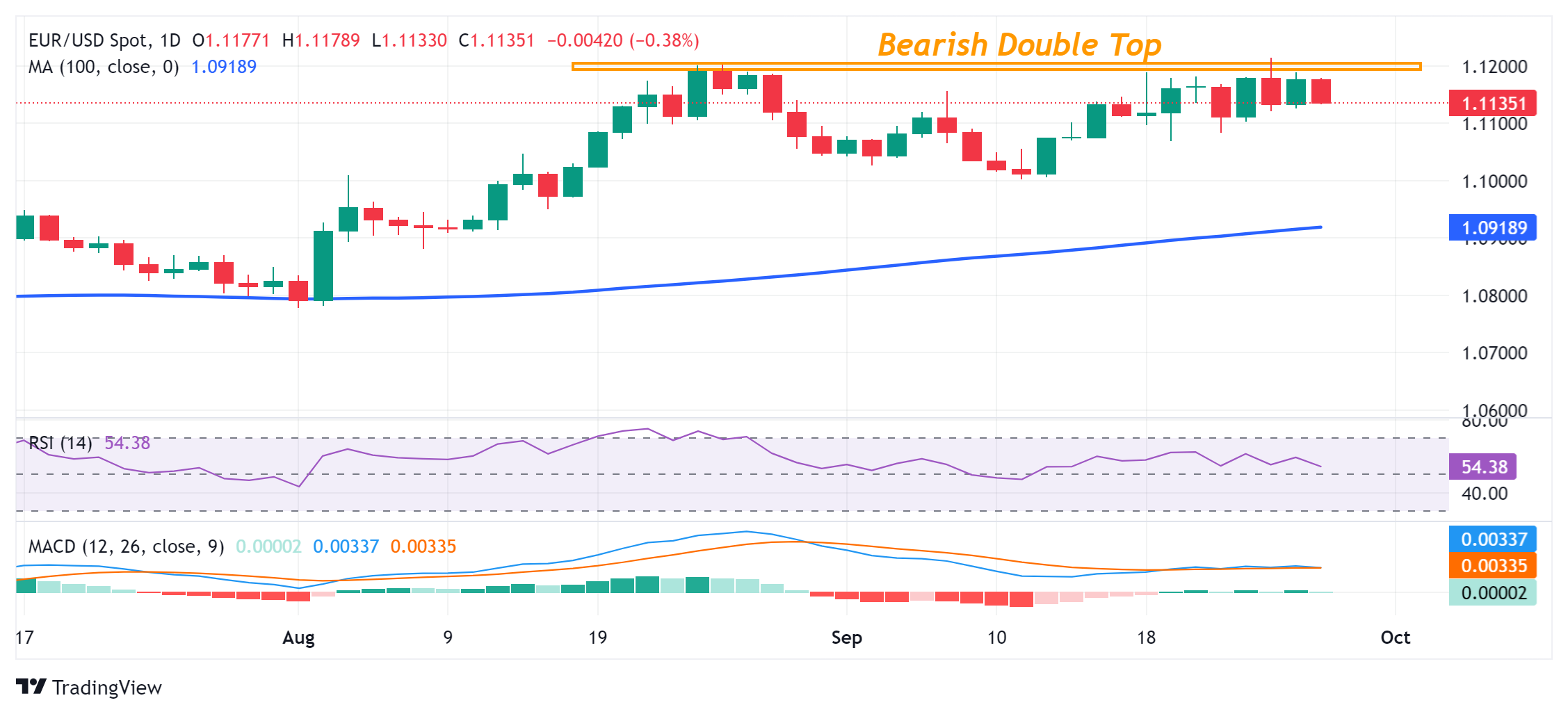
From a technical perspective, the recent repeated failures to build on the momentum and find acceptance above the 1.1200 mark constitute the formation of a bearish double-top pattern. That said, positive oscillators on the daily chart make it prudent to wait for some follow-through selling below the 1.1125-1.1120 immediate support before positioning for deeper losses. The EUR/USD pair might then weaken below the 1.1100 mark, towards testing the weekly low, around the 1.1085-1.1080 zone. Spot prices could eventually drop to the 50-day Simple Moving Average (SMA) support, near the 1.1020 zone. This is closely followed by the 1.1000 psychological mark, which if broken decisively will suggest that the currency pair has topped out and pave the way for deeper losses.
On the flip side, the 1.1200 mark might continue to act as an immediate strong barrier ahead of the 1.1215 region, or a 14-month peak touched on Wednesday. Some follow-through buying will be seen as a fresh trigger for bullish traders and lift the EUR/USD pair towards the July 2023 swing high, around the 1.1275 region. The momentum could extend further beyond the 1.1300 mark, towards the 1.1335 region en route to the 1.1375 area and the 1.1400 round figure.
EUR/USD daily chart
Author

Haresh Menghani
FXStreet
Haresh Menghani is a detail-oriented professional with 10+ years of extensive experience in analysing the global financial markets.