EUR/USD Price Forecast: Failure near 1.1200 warrants caution for bulls ahead of Fed's Powell
- EUR/USD attracts some dip-buyers and stalls the overnight pullback from the YTD peak.
- Fed rate cut bets and a positive risk tone undermine the USD, offering support to the pair.
- Traders now look to US macro data and Fed Chair Powell’s speech for a fresh impetus.

The EUR/USD pair regains some positive traction on Thursday and reverses a part of the previous day's sharp retracement slide from the 1.1215 area, or its highest level since July 2023. The overnight goodish US Dollar (USD) recovery from the YTD low runs out of steam amid bets for a more aggressive policy easing by the Federal Reserve (Fed). In fact, investors are pricing in over a 50% chance that the US central bank will lower borrowing costs by another 50 basis points (bps) in November, despite the fact that several Fed officials this week tried to push back against market expectations.
On Tuesday, Fed Governor Michelle Bowman defended her decision to vote against the oversized interest rate cut and cautioned against steep rate reductions. This comes on top of Atlanta Fed President Raphael Bostic's remarks on Monday, saying that the 50 bps rate cut last week was an appropriate way to kick off the policy-easing cycle, though the Fed needn't go on a mad dash to lower rates. Hence, investors will closely scrutinise Fed Chair Jerome Powell's comments later this Thursday for cues about the future rate-cut path, which will drive the USD and the EUR/USD pair.
Apart from this, Thursday's US economic docket – featuring the release of the final Q2 GDP print, Weekly Initial Jobless Claims and Durable Goods Orders data – and speeches by other influential FOMC members might contribute to producing short-term trading opportunities around the EUR/USD pair. In the meantime, the latest optimism led by a slew of stimulus measures announced this week by China remains supportive of a generally positive risk tone. This, in turn, might continue to undermine the safe-haven Greenback and act as a tailwind for the currency pair.
That said, bets for at least 25 bps rate cut by the European Central Bank (ECB) in October might keep a lid on any sharp appreciation for the shared currency. Hence, it will be prudent to wait for sustained strength and acceptance above the 1.1200 mark before confirming a fresh breakout for the EUR/USD pair and positioning for a further near-term positive move.
Technical Outlook
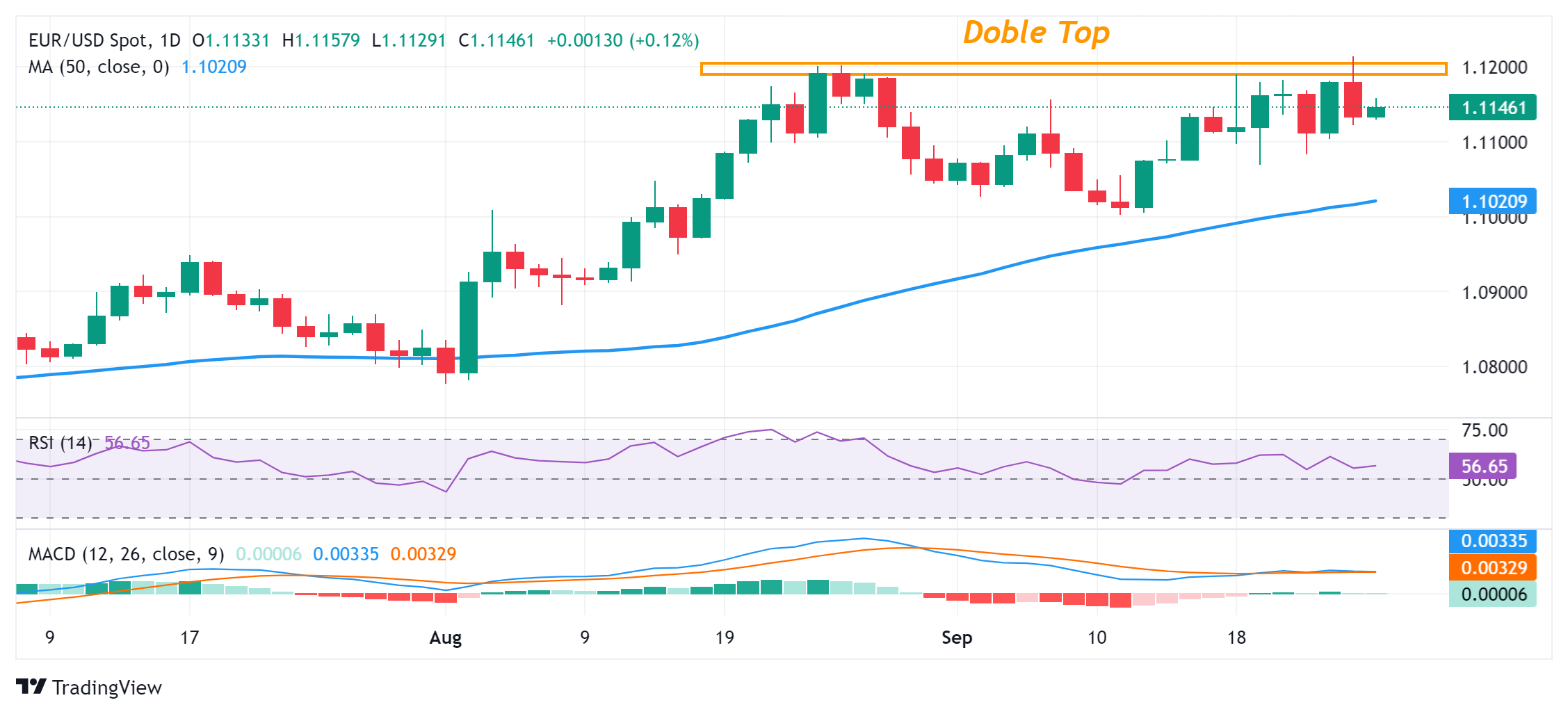
From a technical perspective, the overnight failure to close above the 1.1200 mark constitutes the formation of a bearish double-top pattern on the daily chart. That said, oscillators on the daily chart are holding in the positive territory, which, along with the emergence of some dip-buying on Thursday, favors bullish traders. Hence, some follow-through buying beyond the overnight swing high, around the 1.1215 region, should pave the way for additional gains. The EUR/USD pair might then accelerate the momentum towards the July 2023 swing high, around the 1.1275 region, en route to the 1.1300 mark. Spot prices could climb further towards the 1.1335 region, the 1.1375 area and the 1.1400 round figure.
On the flip side, the overnight swing low, around the 1.1120 region, now seems to protect the immediate downside ahead of the 1.1100 mark. This is closely followed by the weekly low, around the 1.1085-1.1080 zone, below which the EUR/USD pair could drop to the 50-day Simple Moving Average (SMA) support, currently near the 1.1020 zone. Some follow-through selling, leading to a subsequent break below the 1.1000 psychological mark, or the monthly trough, will suggest that spot prices have topped out and expose the next relevant support near the 1.0950-1.0940 region.
EUR/USD daily chart
Author

Haresh Menghani
FXStreet
Haresh Menghani is a detail-oriented professional with 10+ years of extensive experience in analysing the global financial markets.

















