EUR/USD Price Forecast: Bears aim to test the 1.1000 mark

EUR/USD Current price: 1.1040
- Tepid European data undermined demand for the Euro during London trading hours.
- United States services output under the spotlight early in the American session.
- EUR/USD near-term bearish case loses steam as buyers defend 1.1000.
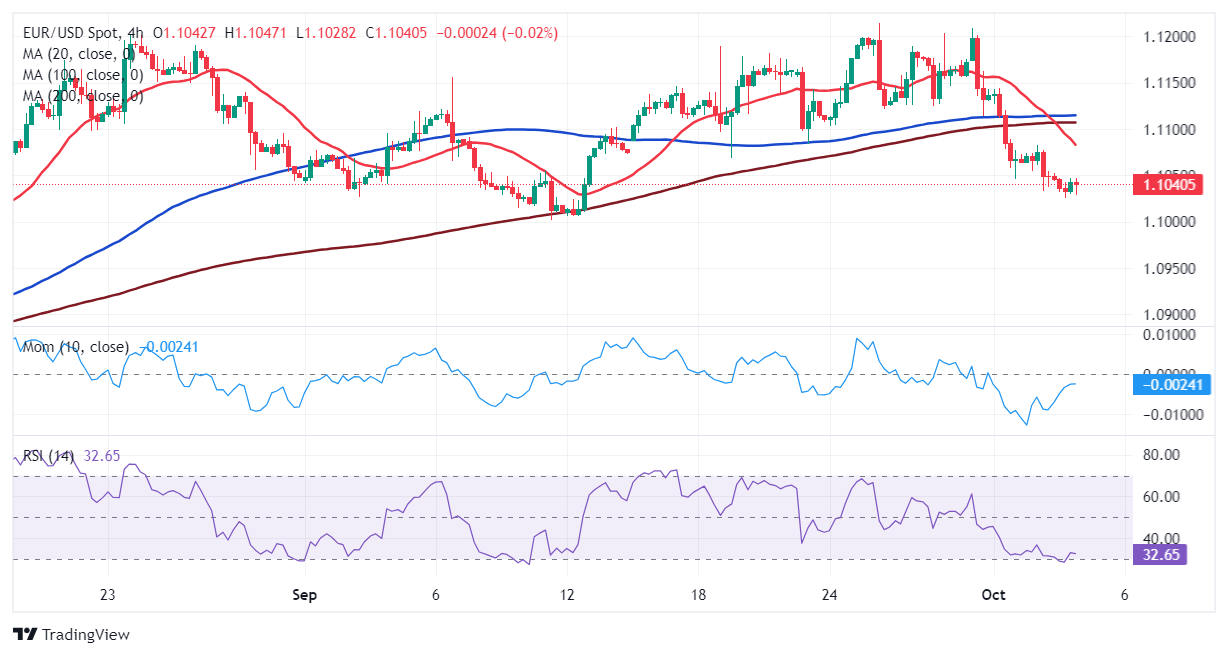
The EUR/USD pair remains on the bearish side on Thursday, having moved one step closer to the 1.1000 mark. The pair posted an intraday low of 1.1024 during European trading hours, with attempts to advance meeting resistance ahead of the 1.1050 mark.
European data took its toll on the Euro. The Eurozone Producer Price Index (PPI) increased by 0.6% on a monthly basis in August, according to first estimates from Eurostat, the statistical office of the European Union. The figure was higher than the 0.3% anticipated. The annual PPI printed -2.3%, also surpassing expectations. Despite far from concerning, the numbers indicated an increase in price pressures at the end of the second quarter.
At the same time, the Hamburg Commercial Bank (HCOB) published the final estimates of the September Purchasing Managers Indexes (PMIs) with modest upward revisions to services output, lifting the final Composite PMI. The EU Services PMI was confirmed at 51.4, while the Composite PMI resulted at 49.6. Still, “the euro area economy suffered a fresh setback at the end of the third quarter as total business activity decreased for the first time since February,” according to the official report.
Across the pond, the United States (US) published the Challenger Job Cuts report, which showed that US-based employers announced 72,821 cuts in September, a 4% decrease from the 75,891 cuts announced one month prior. Additionally, Initial Jobless Claims for the week ended September 27, which rose by 225K, worse than the 220K anticipated.
Following Wall Street’s opening, S&P Global will release the September US Services PMI and the Composite PMI. Later on, the focus will shift to the ISM Services PMI for the same month. By the end of the day, a couple of Federal Reserve (Fed) officials will hit the wires.
EUR/USD short-term technical outlook
From a technical point of view, the daily chart for the EUR/USD pair is neutral to bearish. The Momentum indicator stands just below the 100 line, lacking clear directional strength. At the same time, the 20-day Simple Moving Average (SMA) is positioned above both the 100-day and 200-day SMAs, with the price hovering in between. However, the recent movements of the 20 SMA show a slight decline, which may indicate a waning short-term bullish momentum. EUR/USD is trading at 1.1029, with immediate resistance at 1.1101, closely aligned with the 20-day SMA, which could act as a barrier to further upward movement. On the downside, an ascendant trend line level at 1.0970 serves as a key support level, providing a floor for the currency pair.
In the 4-hour chart, the Momentum indicator currently stands at 99, signaling a bearish potential. Concurrently, the 20-period Simple Moving Average (SMA) is positioned at 1.1078, which remains below both the 100-period SMAs. This alignment underscores the dominance of sellers in the current market structure, reinforcing the bearish outlook. Despite the prevailing bearish indicators, the slight uptick in Momentum hints at a possible weakening of the downward momentum. The 20 SMA consistent position below the longer-term averages signifies sustained selling pressure, yet the potential reversal in Momentum could pave the way for a shift in market sentiment.
Support levels: 1.1020 1.0980 1.0935
Resistance levels: 1.1050 1.1100 1.1140
(The technical analysis section of this story was partially created using an Artificial Intelligence tool and reviewed by an editor.)
Author

Valeria Bednarik
FXStreet
Valeria Bednarik was born and lives in Buenos Aires, Argentina. Her passion for math and numbers pushed her into studying economics in her younger years.