EUR/USD Forecast: Euro shows no signs of life after ECB
- EUR/USD stays under bearish pressure in the European morning on Friday.
- The technical outlook suggests there is more room on the downside before the pair turns oversold.
- The dovish ECB tone and persistent USD strength weigh on the pair.

EUR/USD stays on the back foot and trades near 1.0450 on Friday after closing the fifth consecutive day in negative territory on Thursday. The pair's near-term technical outlook shows that there is more room on the downside before the pair turns oversold.
Euro PRICE This week
The table below shows the percentage change of Euro (EUR) against listed major currencies this week. Euro was the weakest against the US Dollar.
| USD | EUR | GBP | JPY | CAD | AUD | NZD | CHF | |
|---|---|---|---|---|---|---|---|---|
| USD | 1.03% | 0.91% | 2.00% | 0.54% | 0.37% | 1.34% | 1.66% | |
| EUR | -1.03% | -0.10% | 1.09% | -0.40% | -0.56% | 0.39% | 0.71% | |
| GBP | -0.91% | 0.10% | 1.00% | -0.30% | -0.46% | 0.49% | 0.81% | |
| JPY | -2.00% | -1.09% | -1.00% | -1.47% | -1.51% | -0.78% | -0.26% | |
| CAD | -0.54% | 0.40% | 0.30% | 1.47% | -0.12% | 0.79% | 1.12% | |
| AUD | -0.37% | 0.56% | 0.46% | 1.51% | 0.12% | 0.95% | 1.28% | |
| NZD | -1.34% | -0.39% | -0.49% | 0.78% | -0.79% | -0.95% | 0.31% | |
| CHF | -1.66% | -0.71% | -0.81% | 0.26% | -1.12% | -1.28% | -0.31% |
The heat map shows percentage changes of major currencies against each other. The base currency is picked from the left column, while the quote currency is picked from the top row. For example, if you pick the Euro from the left column and move along the horizontal line to the US Dollar, the percentage change displayed in the box will represent EUR (base)/USD (quote).
The European Central Bank (ECB) lowered key rates by 25 basis points (bps) following the December meeting, as expected. In its policy statement, the ECB said that most measures of underlying inflation suggest that inflation will settle at around the Governing Council's 2% medium-target on a sustained basis. In the post-meeting press conference, ECB President Christine Lagarde noted that they have discussed a 50 bps cut at the meeting and acknowledged that the recovery in the Euro area was slower than expected. The Euro came under selling pressure following the ECB event.
In the meantime, the US Dollar (USD) benefited from rising US Treasury bond yields in the American session on Thursday and didn't allow EUR/USD to stage a rebound. The data published by the US Bureau of Labor Statistics showed that the annual Producer Price Index rose by 3% in November, at a stronger pace than the market expectation and October's increase of 2.6%.
The economic calendar will not feature any high-tier data releases on Friday. Ahead of next week's highly-anticipated Federal Reserve meeting, profit-taking and position adjustments heading into the weekend could ramp up EUR/USD's volatility and trigger irregular movements.
EUR/USD Technical Analysis
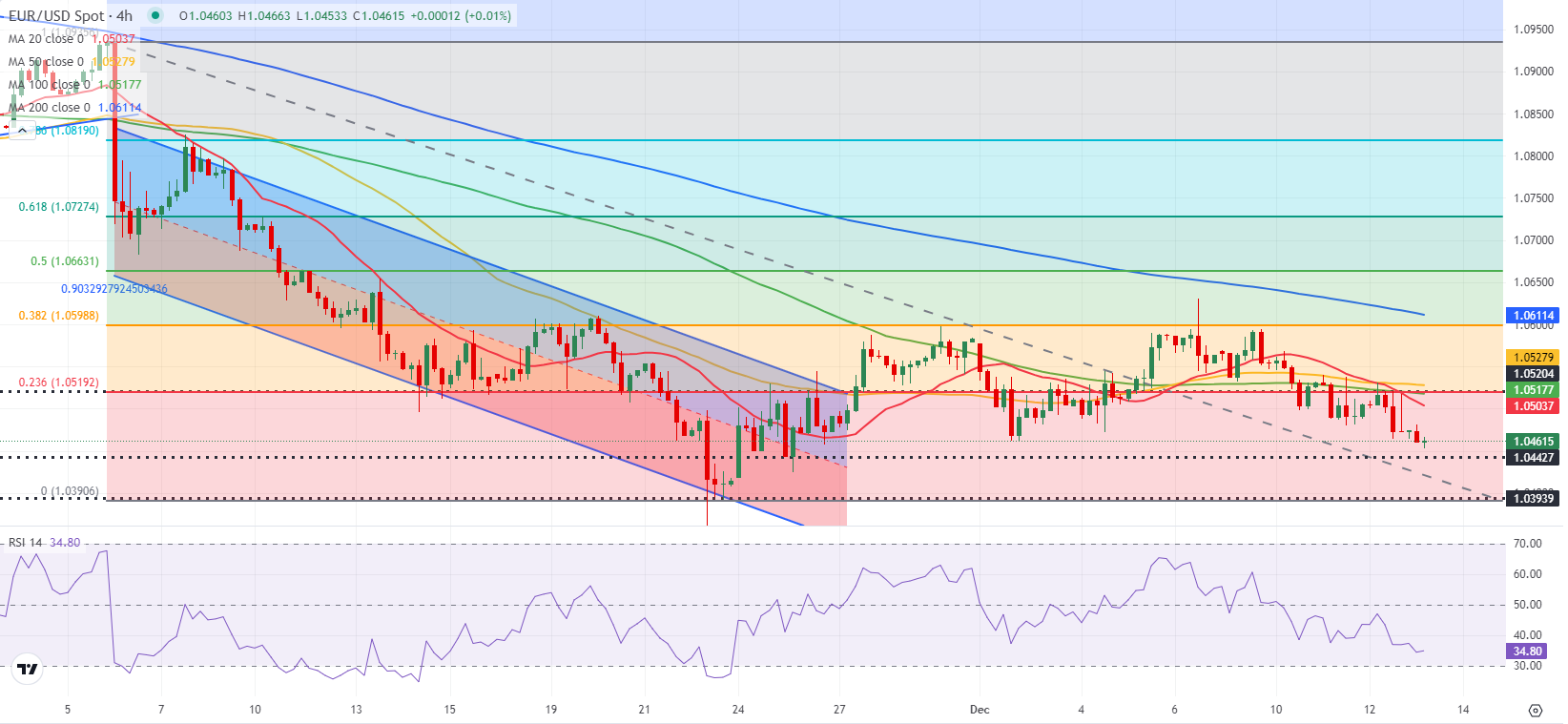
The Relative Strength Index (RSI) indicator on the 4-hour chart dropped below 40, reflecting a buildup of bearish momentum. On the downside, immediate support is located at 1.0440 (static level) ahead of 1.0400 (end-point of the latest downtrend) and 1.0330 (November 22 low).
Looking north, first resistance could be spotted at 1.0520 (100-period Simple Moving Average (SMA), 50-period SMA, Fibonacci 23.6% retracement of the latest downtrend) before 1.0600 (Fibonacci 38.2% retracement).
Euro FAQs
The Euro is the currency for the 20 European Union countries that belong to the Eurozone. It is the second most heavily traded currency in the world behind the US Dollar. In 2022, it accounted for 31% of all foreign exchange transactions, with an average daily turnover of over $2.2 trillion a day, according to data from the Bank of International Settlements. EUR/USD is the most heavily traded currency pair in the world, accounting for an estimated 30% of all transactions, followed by EUR/JPY (4%), EUR/GBP (3%) and EUR/AUD (2%).
Author

Eren Sengezer
FXStreet
As an economist at heart, Eren Sengezer specializes in the assessment of the short-term and long-term impacts of macroeconomic data, central bank policies and political developments on financial assets.

















