EUR/USD Forecast: Euro looks to extend rally after rising above key technical level
- EUR/USD holds above 1.0800 in the European session on Friday.
- Nonfarm Payrolls data from the US could impact the US Dollar's valuation.
- The technical outlook points to overbought conditions in the near term.

EUR/USD edged slightly higher and closed in positive territory above 1.0800 on Thursday. The pair holds its ground early Friday as market focus shifts to June labor market data from the US.
Following the Independence Day holiday in the US, the US Dollar (USD) stays on the back foot and helps EUR/USD hold its ground.
Euro PRICE This week
The table below shows the percentage change of Euro (EUR) against listed major currencies this week. Euro was the strongest against the US Dollar.
| USD | EUR | GBP | JPY | CAD | AUD | NZD | CHF | |
|---|---|---|---|---|---|---|---|---|
| USD | -1.06% | -1.05% | -0.03% | -0.50% | -0.99% | -0.41% | -0.01% | |
| EUR | 1.06% | -0.21% | 0.75% | 0.27% | -0.03% | 0.35% | 0.75% | |
| GBP | 1.05% | 0.21% | 0.94% | 0.48% | 0.18% | 0.57% | 0.98% | |
| JPY | 0.03% | -0.75% | -0.94% | -0.47% | -0.89% | -0.38% | 0.05% | |
| CAD | 0.50% | -0.27% | -0.48% | 0.47% | -0.45% | 0.09% | 0.49% | |
| AUD | 0.99% | 0.03% | -0.18% | 0.89% | 0.45% | 0.39% | 0.87% | |
| NZD | 0.41% | -0.35% | -0.57% | 0.38% | -0.09% | -0.39% | 0.43% | |
| CHF | 0.01% | -0.75% | -0.98% | -0.05% | -0.49% | -0.87% | -0.43% |
The heat map shows percentage changes of major currencies against each other. The base currency is picked from the left column, while the quote currency is picked from the top row. For example, if you pick the Euro from the left column and move along the horizontal line to the US Dollar, the percentage change displayed in the box will represent EUR (base)/USD (quote).
Nonfarm Payrolls in the US are forecast to rise 190,000 in June following the impressive 272,000 increase recorded in May, while the Unemployment Rate is seen staying unchanged at 4%.
The steady increase in the weekly Initial Jobless Claims data throughout June and disappointing ISM Manufacturing and Services PMI reports, which showed a contraction in these sectors' payrolls in June, pointed to loosening conditions in the labor market.
In case the NFP arrives at around 150,000 or lower, the US Dollar could stay under selling pressure heading into the weekend and allow EUR/USD to extend its weekly rally. According to the CME FedWatch Tool, markets are currently pricing in a 25% probability of the Federal Reserve leaving the policy rate unchanged in September. Hence, the market positioning suggests that the USD has more room on the downside in case investors continue to price in a September rate cut on a weak jobs report.
On the other hand, a strong increase in NFP, more than 220,000, could cause investors to reassess the timing of the Fed's policy pivot and trigger a downward correction in EUR/USD in the American session.
EUR/USD Technical Analysis
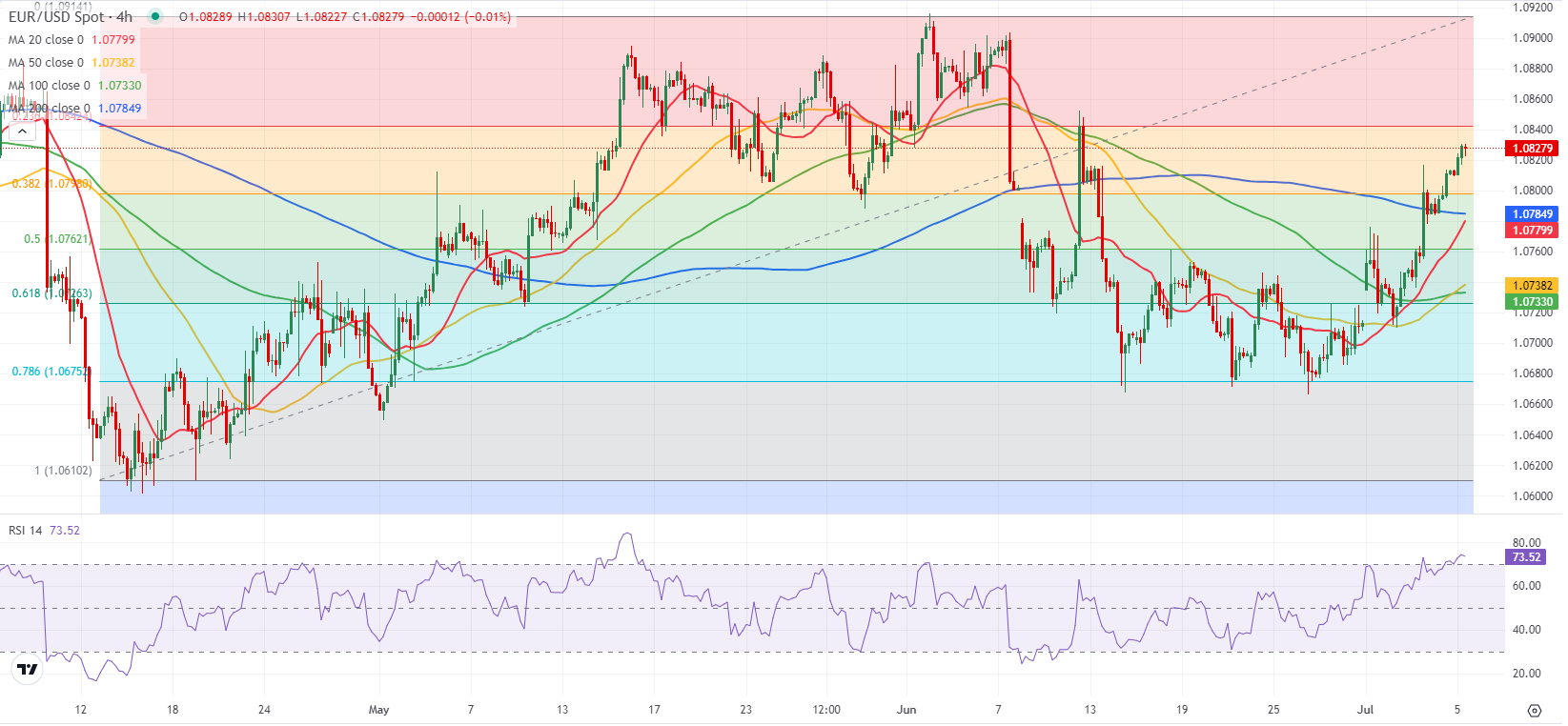
The Relative Strength Index (RSI) indicator on the 4-hour chart rose above 70 on Friday. Although this development suggests that EUR/USD is technically overbought, buyers could look to dominate the action as long as 1.0800 (100-day Simple Moving Average (SMA), 200-day SMA) stays intact as support. On the upside, 1.0840 (Fibonacci 23.6% retracement of the latest uptrend) could be seen as interim resistance before 1.0900 (psychological level, static level).
If EUR/USD drops below 1.0800 and fails to reclaim this level, supports could be seen at 1.0760 (Fibonacci 50% retracement) and 1.0730-1.0740 (Fibonacci 61.8% retracement, 20-day SMA).
Nonfarm Payrolls FAQs
Nonfarm Payrolls (NFP) are part of the US Bureau of Labor Statistics monthly jobs report. The Nonfarm Payrolls component specifically measures the change in the number of people employed in the US during the previous month, excluding the farming industry.
The Nonfarm Payrolls figure can influence the decisions of the Federal Reserve by providing a measure of how successfully the Fed is meeting its mandate of fostering full employment and 2% inflation. A relatively high NFP figure means more people are in employment, earning more money and therefore probably spending more. A relatively low Nonfarm Payrolls’ result, on the either hand, could mean people are struggling to find work. The Fed will typically raise interest rates to combat high inflation triggered by low unemployment, and lower them to stimulate a stagnant labor market.
Nonfarm Payrolls generally have a positive correlation with the US Dollar. This means when payrolls’ figures come out higher-than-expected the USD tends to rally and vice versa when they are lower. NFPs influence the US Dollar by virtue of their impact on inflation, monetary policy expectations and interest rates. A higher NFP usually means the Federal Reserve will be more tight in its monetary policy, supporting the USD.
Nonfarm Payrolls are generally negatively-correlated with the price of Gold. This means a higher-than-expected payrolls’ figure will have a depressing effect on the Gold price and vice versa. Higher NFP generally has a positive effect on the value of the USD, and like most major commodities Gold is priced in US Dollars. If the USD gains in value, therefore, it requires less Dollars to buy an ounce of Gold. Also, higher interest rates (typically helped higher NFPs) also lessen the attractiveness of Gold as an investment compared to staying in cash, where the money will at least earn interest.
Nonfarm Payrolls is only one component within a bigger jobs report and it can be overshadowed by the other components. At times, when NFP come out higher-than-forecast, but the Average Weekly Earnings is lower than expected, the market has ignored the potentially inflationary effect of the headline result and interpreted the fall in earnings as deflationary. The Participation Rate and the Average Weekly Hours components can also influence the market reaction, but only in seldom events like the “Great Resignation” or the Global Financial Crisis.
Author

Eren Sengezer
FXStreet
As an economist at heart, Eren Sengezer specializes in the assessment of the short-term and long-term impacts of macroeconomic data, central bank policies and political developments on financial assets.