EUR/USD Forecast: Euro defines near-term trading range before next breakout
- EUR/USD moves sideways in a tight range below 1.0600 on Tuesday.
- The technical picture points to a neutral outlook in the near term.
- Markets await US inflation data and ECB policy announcements.

EUR/USD rose toward 1.0600 on Monday but lost its traction to end the day flat. The pair fluctuates in a narrow channel slightly above 1.0550 in the European morning on Tuesday.
With investors refraining from taking large positions ahead of the US inflation data and the European Central Bank's (ECB) policy announcements on Wednesday and Thursday, respectively, the pair could have a hard time finding direction in the near term.
The US Dollar (USD) started the week under modest selling pressure on Monday and helped EUR/USD edge higher. As Wall Street's main indexes turned south after the opening bell and the benchmark 10-year US Treasury bond yield recovered toward 4.2%, however, the USD managed to stay resilient against its rivals, capping the pair's upside.
In the second half of the day, the US Bureau of Labor Statistics will announce a revision to the third-quarter Unit Labor Costs. Markets expect the data to be confirmed at 1.9%. An upward revision could support the USD with the immediate reaction.
Investors are likely to pay close attention to changes in risk perception in the second half of the day. In case US stocks gain traction, the USD could struggle to preserve its strength and help EUR/USD edge higher.
EUR/USD Technical Analysis
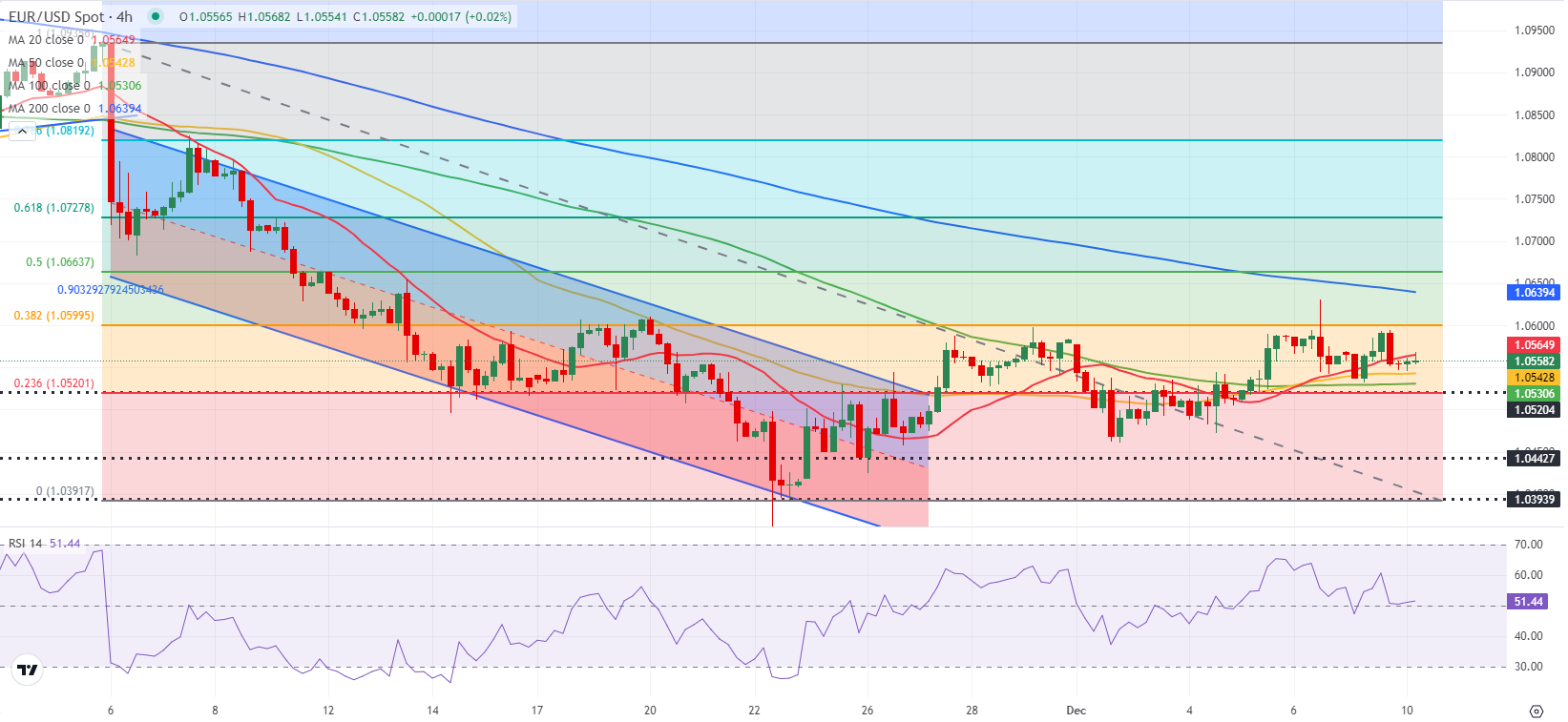
The Relative Strength Index (RSI) indicator on the 4-hour chart moves sideways near 50 early Tuesday, reflecting EUR/USD's indecisiveness.
On the upside, 1.0600 (Fibonacci 38.2% retracement of the latest downtrend) could be seen as first resistance before 1.0640 (200-period Simple Moving Average (SMA)), 1.0660 (Fibonacci 50% retracement) and 1.0730 (Fibonacci 61.8% retracement).
Looking south, supports are located at 1.0520-1.0530 (100-period SMA, Fibonacci 23.6% retracement), 1.0500 (psychological level, static level) and 1.0440 (static level).
Euro FAQs
The Euro is the currency for the 20 European Union countries that belong to the Eurozone. It is the second most heavily traded currency in the world behind the US Dollar. In 2022, it accounted for 31% of all foreign exchange transactions, with an average daily turnover of over $2.2 trillion a day, according to data from the Bank of International Settlements. EUR/USD is the most heavily traded currency pair in the world, accounting for an estimated 30% of all transactions, followed by EUR/JPY (4%), EUR/GBP (3%) and EUR/AUD (2%).
Premium
You have reached your limit of 3 free articles for this month.
Start your subscription and get access to all our original articles.
Author
Eren Sengezer
FXStreet
As an economist at heart, Eren Sengezer specializes in the assessment of the short-term and long-term impacts of macroeconomic data, central bank policies and political developments on financial assets.

















