EUR/USD Forecast: Downward correction could extend toward 1.0760
- EUR/USD came under renewed bearish pressure following a quiet Asian session.
- The pair needs to reclaim 1.0820 to shake off the bearish pressure.
- US economic docket will feature JOLTS Job Openings and ISM Services PMI data.

After closing in negative territory on Monday, EUR/USD extended its slide and touched its lowest level in three weeks near 1.0800 early Tuesday. Unless the pair manages to stabilize above 1.0820, technical sellers could remain interested.
The steady recovery seen in the US Treasury bond yields and the risk-averse market atmosphere helped the US Dollar (USD) outperform its rivals on the first trading day of the week. As investors remain concerned over the Israel-Hamas conflict turning into a widespread conflict in the Middle East, safe haven flows continue to dominate the action in financial markets early Tuesday. At the time of press, US stock index futures were down between 0.3% and 0.4%.
In the second half of the day, JOLTS Job Openings data for October and the ISM Services PMI for November will be featured in the US economic docket. In case there is a significant decrease in the number of job openings, the USD could have a difficult time preserving its strength.
Investors will also pay close attention to the inflation component of the ISM survey – the Prices Paid Index. An unexpected increase in this figure could help the USD find demand.
Nevertheless, unless the risk mood improves later in the day, EUR/USD could struggle to regain its traction even if the data don't support the USD.
EUR/USD Technical Analysis
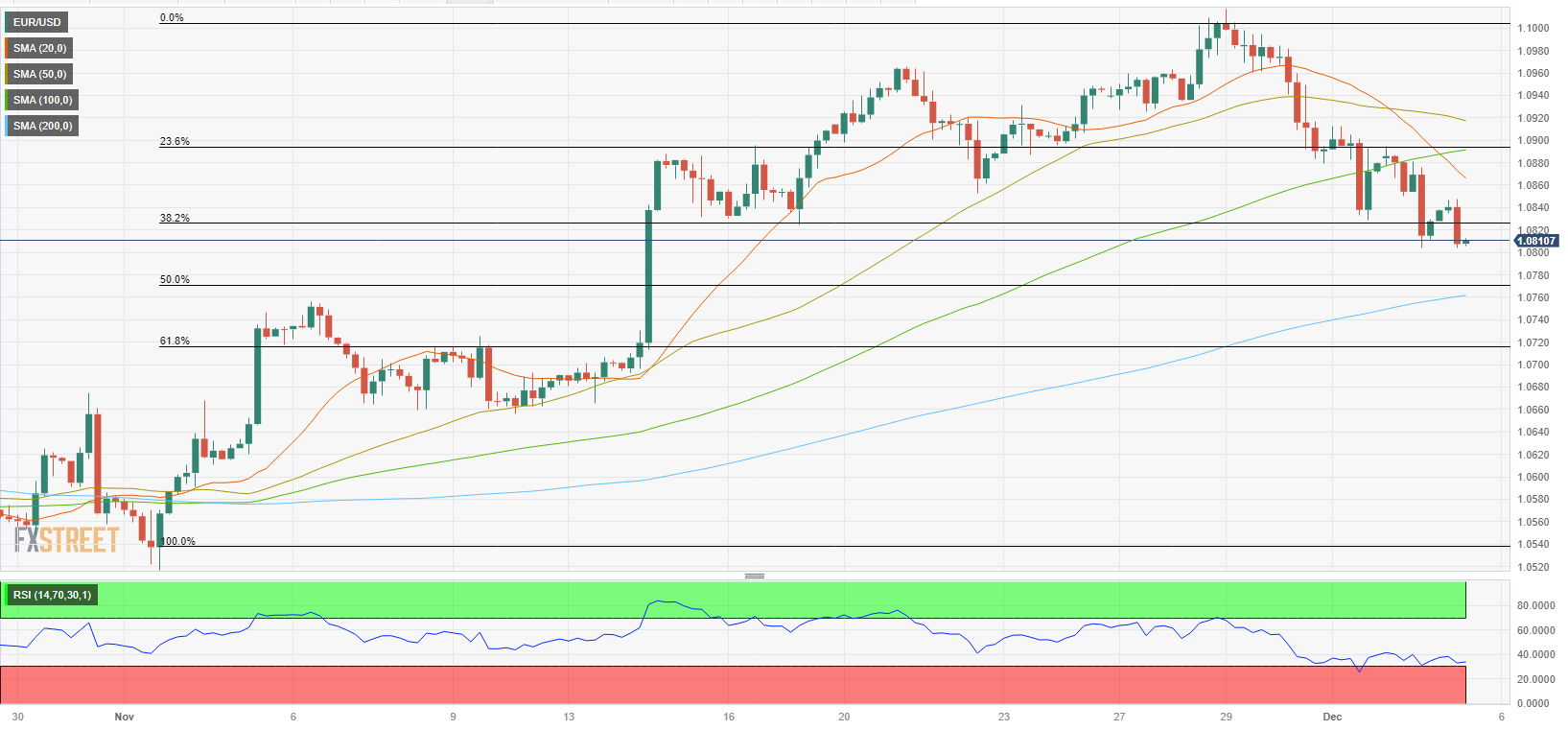
EUR/USD declined below 1.0820 early Tuesday, where the 200-day Simple Moving Average (SMA) and the Fibonacci 38.2% retracement of the latest uptrend are located. Below this level, 1.0800 (psychological level) aligns as interim support before 1.0760-1.0770 area (Fibonacci 50% retracement, 200-period SMA on the 4-hour chart).
If EUR/USD rebounds above 1.0820 and confirms that level as support, sellers could be discouraged. In this scenario, 1.0860 (20-period SMA) could be seen as first resistance ahead of 1.0900 (Fibonacci 23.6% retracement, 100-period SMA).
Author

Eren Sengezer
FXStreet
As an economist at heart, Eren Sengezer specializes in the assessment of the short-term and long-term impacts of macroeconomic data, central bank policies and political developments on financial assets.

















