|premium|

EUR/USD Forecast: Bearish case firm in place ahead of US Retail Sales

EUR/USD Current Price: 1.2078

  • US weekly unemployment claims dropped to 473K in the week ended May 7.
  • The focus shifts to US Retail Sales to be out this Friday.
  • EUR/USD is technically bearish and could challenge the 1.2000 level.
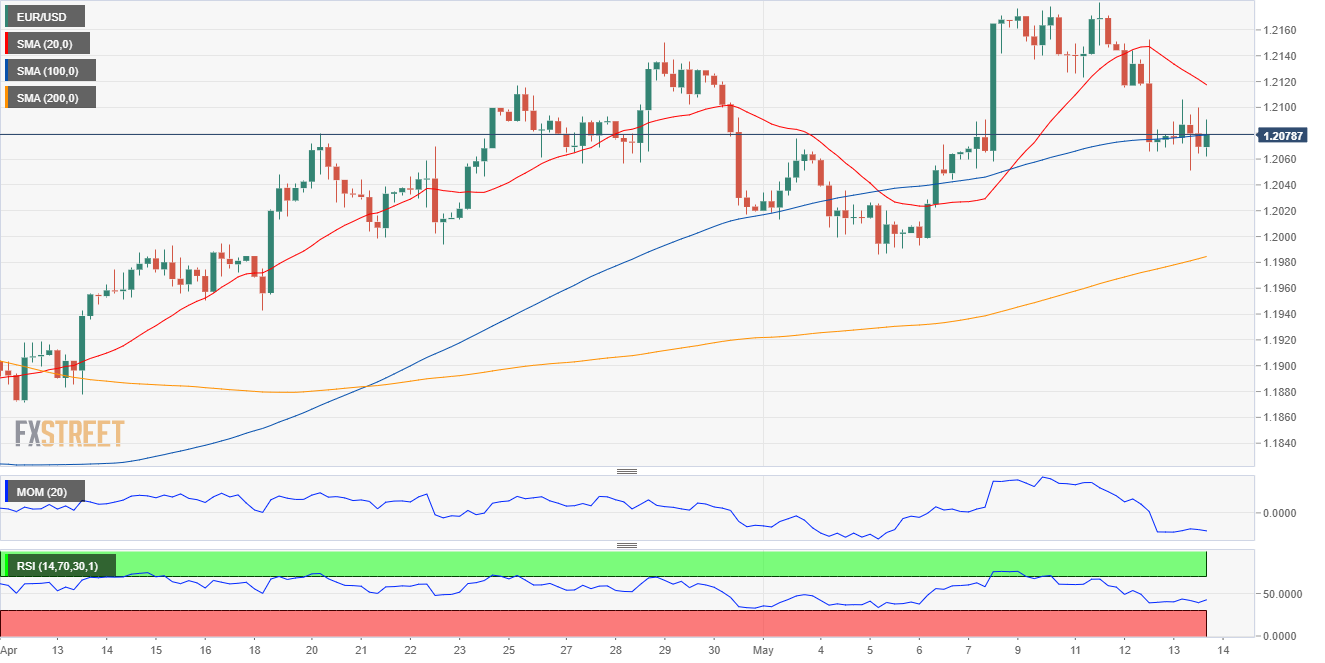
The EUR/USD pair finished Thursday with modest losses around the 1.2080 level, as the greenback retained its strength despite an improved market’s mood. The American dollar advanced during the first half of the day, as global equities remained on the losing side while government bond yields advanced on the back of mounting concerns about rising US inflation. However, encouraging US data provided modest support to Wall Street, which in turn put a halt to the dollar’s rally.

 The US published the April Producer Price Index, which surged by more than anticipated, printing at 6.2% YoY. More relevant, Initial Jobless Claims for the week ended May 7 came in at  473K vs the 490K expected, and the lowest reading since March 2020. On Friday, the country will publish April Retail Sales, expected to have declined by 0.2%, and the preliminary estimate of the May Michigan Consumer Sentiment Index, foreseen at 90.3 from 88.3 previously. The ECB will release the minutes of its latest meeting.

EUR/USD short-term technical outlook

The EUR/USD pair seesawed between gains and losses, meeting sellers around the 1.2100 threshold. The 4-hour chart offers a neutral-to-bearish stance, as the pair spent the day hovering around a directionless 100 SMA, while the 20 SMA  gains bearish strength above the current price. Technical indicators have resumed their declines within negative levels, currently approaching oversold readings without signs of giving up.

Support levels: 1.2050 1.2000 1.1960

Resistance levels: 1.2110 1.2150 1.2190  

View Live Chart for the EUR/USD

Premium

You have reached your limit of 3 free articles for this month.

Start your subscription and get access to all our original articles.

Subscribe to PremiumSign In

Author

Valeria Bednarik

Valeria Bednarik was born and lives in Buenos Aires, Argentina. Her passion for math and numbers pushed her into studying economics in her younger years.


More from Valeria Bednarik
Share:

Editor's Picks

GBP/USD bounces off lows, back above 1.3200

After bottoming out near 1.3160, GBP/USD manages to regain a bit of shine and reclaim the 1.3200 mark and beyond at the end of the week. Stronger-than-expected UK Retail Sales data seem to be helping the British Pound limit its losses, while the chaotic UK political environment keeps the bulls at bay for now.

EUR/USD looks consolidative around 1.1460

EUR/USD stages a modest rebound after slipping to a three-month low below 1.1420 at the end of the week. That said, the pair now looks to consolidate humble gains just above 1.1460 despite growing uncertainty surrounding the next round of US-Iran negotiations, which keeps the US Dollar’s downside contained.

Gold slips back to six-day lows, targets $4,100

Gold retreats for the third consecutive day on Friday, eroding gains seen in the first half of the week and approaching the key $4,100 mark per troy ounce. Indeed, the precious metal continues to face headwinds from the Fed's hawkish stance and renewed uncertainty surrounding the next round of US-Iran negotiations.

Solana extends correction despite ETF inflows, RWA adoption

Solana (SOL) price edges below $70 extending its losses for the fourth straight day this week. The institutional demand for Solana is building, with steady inflows so far this week and Morgan Stanley’s amended S-1 filing for a Solana-focused Exchange-Traded Fund.

The Iran war didn't break the US economy, but what happens next?

Nearly four months after the start of the Iran war, the US economy remains remarkably resilient. While the conflict initially triggered a severe disruption to global energy markets and a sharp rise in Oil prices, recent diplomatic progress between Washington and Tehran has eased concerns about a prolonged supply shock.

Regime change: Inside Kevin Warsh's first move to make the Fed unreadable on purpose

The rate did not move. That was the least interesting thing about Kevin Warsh's first meeting in charge of the Fed. The FOMC held its benchmark at 3.50%-3.75% for the fourth straight meeting, exactly as priced, and then the new chair used his first press conference to dismantle the machinery the market has leaned on for a decade.