EUR/USD Forecast: Bear attack on 1.17? Three reasons why the dollar may extend its gains
- EUR/USD is struggling amid deteriorating Sino-American relations.
- The fiscal impasse in Washington may drag for longer, also boosting the greenback.
- Europe's coronavirus advantage is eroding.
- Monday's four-hour chart is painting a mixed picture.

Bears do not bath on the beach in August – the world's preferred month for vacation tends to be everything but relaxed in financial markets. EUR/USD has stalled its upward move in what seems like more than a correction.
Here are three reasons why the dollar has more room to rise:
1) Sino-American tensions escalate
Taiwan's defense ministry has confirmed that a Chinese fighter jet crossed the median line of the Taiwan Strait early on Monday seemingly in response to the visit of US Health Secretary Alex Azar in Taipei. Any American recognition of the island nation – which China sees as its own – angers Beijing.
Tensions around Taiwan follow the ongoing clash around Hong Kong. Jimmy Lai, a prominent Hong-Jong media mogul, was arrested under the new security law that China imposed on the city-state. Beijing is tightening its grip, in a move that seems to be response to American sanctions against Carrie Lam, Hong Kong's leader.
The world's largest economies are also clashing on technology, most recently around TikTok. Nevertheless, the Phase One trade deal remains intact – and that is what matters to markets. Negotiators from the world's largest economies will meet late in the week to take stock of the deal.
Investors are certain the US and China will stick to the accord – yet China hinted it is in danger. Any nasty surprise may shake confidence and could boost the safe-haven dollar.
2) Smaller fiscal support
Talks between Republicans and Democrats on the next relief package broke down on Friday amid various disagreements. President Donald Trump followed with four executive orders, most notably announcing $400/week in federal unemployment benefits, lower than $600/week previously provided.
It is unclear if these orders can withstand court scrutiny – as the power of the purse belongs to Congress. However, his move was an attempt to break the impasse. Talks are set to resume at some point, with aid to states being one of the most contentious points.
The chances of a large, $3 trillion package that Democrats aimed for, is diminishing. The opposition party was already willing to compromise and lower it to $2 trillion, halfway to the $1 trillion frameworks the ruling party aimed for.
Moreover, the relatively upbeat Non-Farm Payrolls report – showing a better than expected gain of 1.763 million workers in July – may lower pressure for action. Despite beating estimates, the pace of job restoration has significantly slowed and 13 million Americans are still out of work.
See NFP Quick Analysis: Slow hiring downbeat for the dollar, good for gold, no silver lining
3) Europe's eroding coronavirus advantage
One of the factors propelling EUR/USD to the highest in two years was Europe's better coping with coronavirus. COVID-19 flareups seem to remain small but are less localized than beforehand.
On the other hand, the US case curve is now clearly leaning lower, while the pace of new deaths from the disease is also showing tentative signs of dropping.
The situation in America remains worse than in Europe, but that gap is narrower – and may weigh on the currency pair.

Source: New York Times
Overall, EUR/USD may come under pressure.
EUR/USD Technical Analysis
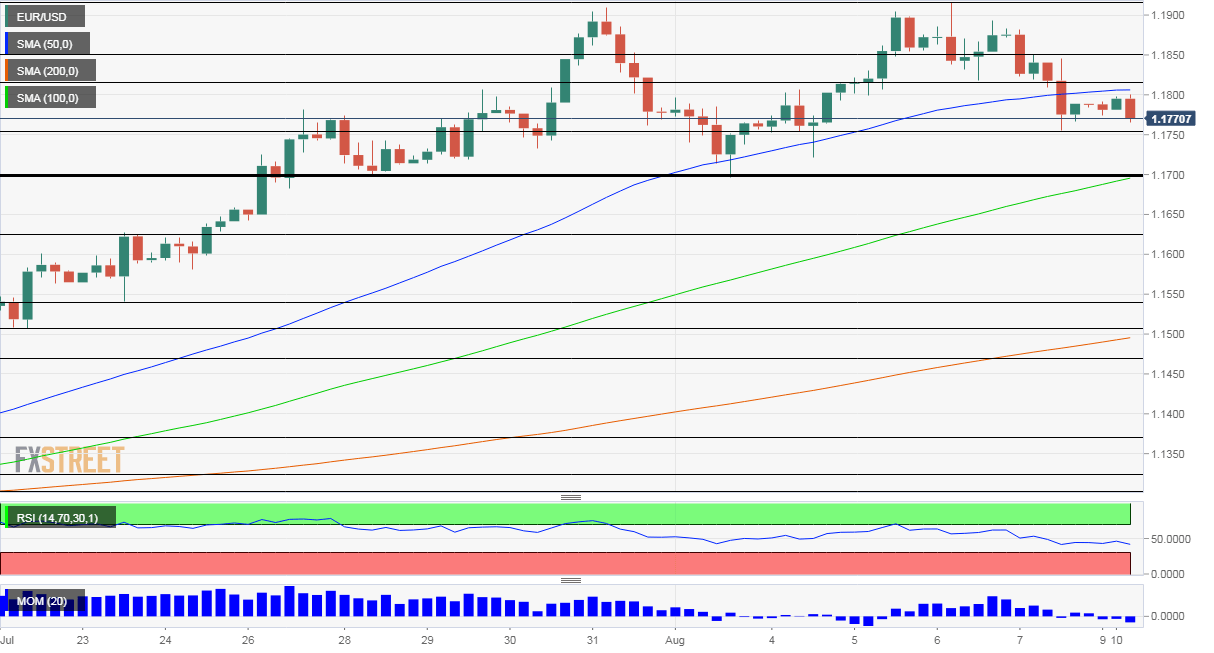
Euro/dollar has lost its upward momentum on the four-hour chart and fell under the 50 Simple Moving Average – both bearish signs. Critical support is at 1.17, a support line from late July, and also where the 100 SMA hits the price.
Ahead of 1.17, EUR/USD has some support at 1.1750, Friday's low. Further down, 1.1630 and 1.1545 await the currency pair.
Resistance is at 1.1815, a support line from last week, followed by 1.1820, a temporary separator of ranges. The two-year high of 1.1915 is the upside target.
See 2020 US Election: August is for calculating, September for campaigning
Author

Yohay Elam
FXStreet
Yohay is in Forex since 2008 when he founded Forex Crunch, a blog crafted in his free time that turned into a fully-fledged currency website later sold to Finixio.
















