ECB Preview: time to taper? - Not yet

With the French Presidential election fear out of the way, focus now shifts to the next big event risk - the European Central Bank (ECB) monetary policy decision on Thursday. Despite of the pro-EU candidate winning the first round of the French Presidential elections, most analysts think that the central bank will maintain status-quo and is unlikely to alter its current monetary policy stance.
At the last meeting in March, ECB President Mario Draghi stressed on downside risks to the outlook, including political uncertainty. But with the incoming polls showing Emmanuel Macron leading in the May 7 run-off, one of the major hurdles to a potential tapering of the current asset purchase facility is now out of the way. Still market participants do not anticipate the central bank to provide any hints regarding scaling back its aggressive easing program, just to avoid any uncertainties before the second round in France is over.
The other reason that could allow the central bank to opt for a more accommodative policy stance is subdued inflation outlook. Since the March meeting, we have seen a sharp fall in the price growth. With headline CPI falling to 1.5%, and core CPI dropping to 0.7%, the central bank is more likely to reiterate to keep monetary policy extremely loose until at least the end of this year.
In the March statement, the central bank had also reaffirmed that the bond purchased could be extended into 2018, if needed, and that interest rates will remain at present or lower levels even when QE purchases come to an end. Hence, uncertainty as to when the first hints of future tightening will come should eventually result into yet another volatile trading session for the shared currency.
Technical outlook
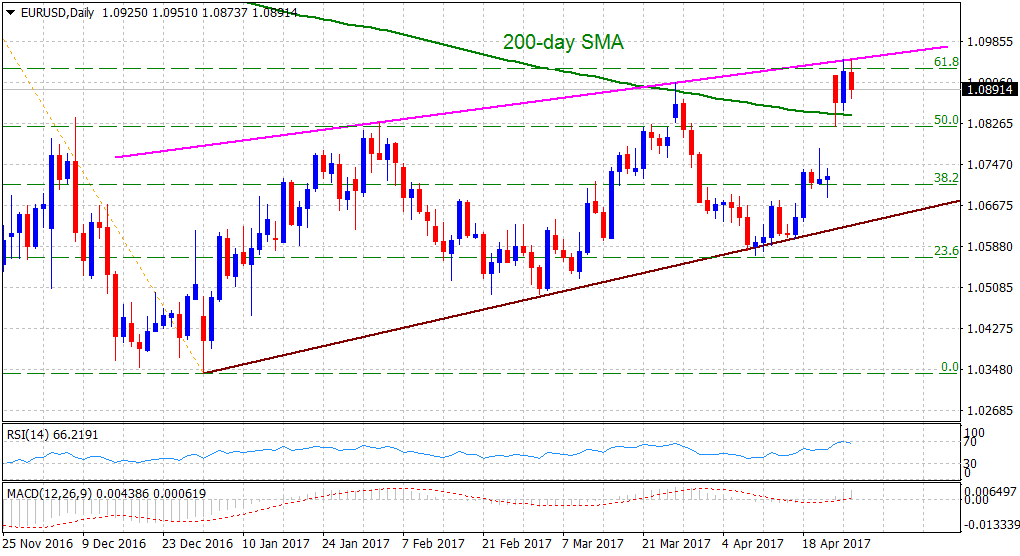
The pair now seems to have entered a consolidation phase and has been oscillating within 100-pips broader trading range over the past couple of days. Although the pair has held above the very important 200-day SMA, further up-move has been capped at 1.0930-50 confluence region.
The said resistance comprises of a short-term ascending trend-line and 61.8% Fibonacci retracement level of 1.1300-1.0341 downfall. Hence, it would prudent to wait for a decisive break through this immediate strong hurdle to confirm additional near-term up-move. On a convincing break through this immediate barrier, the pair is likely to extend the rally beyond the key 1.1000 psychological mark towards testing its next static hurdle near 1.1025-30 area.
Meanwhile on the downside, critical support is pegged at 200-day SMA near 1.0840 region, closely followed by 50% Fibonacci retracement level around 1.0820 level (Monday's low). On a sustained weakness below the mentioned supports should accelerate the slide towards 1.0775-70 area, previous resistance now turned support, and a follow through selling pressure has the potential to continue dragging the pair further towards 38.2% Fibonacci retracement level support near 1.0705-1.0700 region.
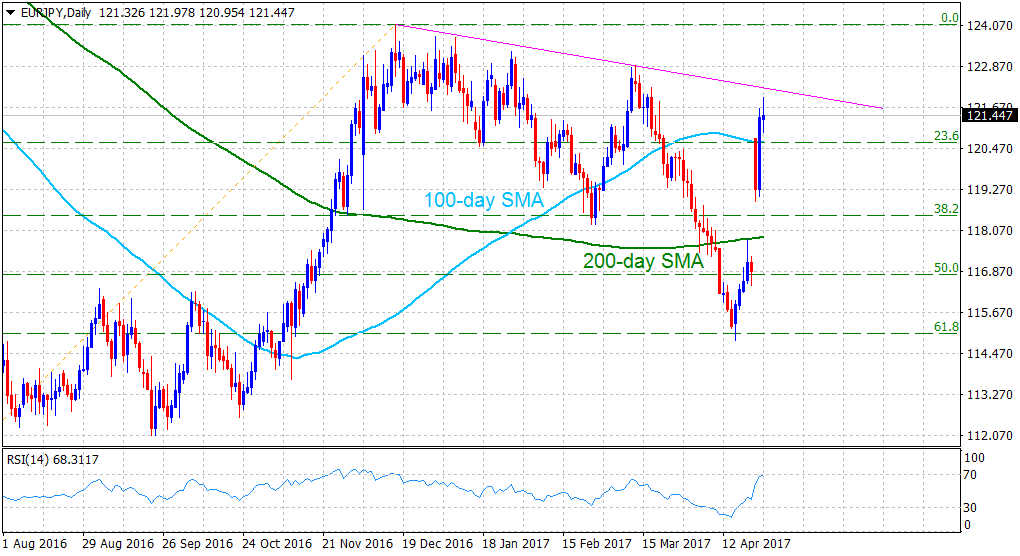
With both the BOJ and ECB monetary policy decisions scheduled to be announced in a span of less than 12-hours, the EUR/JPY cross is likely to remain volatile on Thursday.
From a technical perspective, the pair's aggressive bullish reversal from over 5-month lows, touched earlier this month, happened from 61.8% Fibonacci retracement level of its strong up-surge from June 2016 lows to highs touched in December. The cross subsequently recovered back above the very important moving averages (200-day and 100-day SMAs).
Any further up-move, however, now seems to confront resistance at a short-term descending trend-line, currently near 122.20-25 region. A decisive break through this immediate hurdle would reaffirm near-term bullish bias and continue boosting the cross further towards March monthly highs resistance near 122.85-90 region.
Alternatively, reversal from the trend-line resistance is likely to attract fresh buying interest near 120.65-60 confluence region, comprising of 100-day SMA and 23.6% Fibonacci retracement. Any follow through retracement below this important support is more likely to remain shallow and could be bought into near the key 120.00 psychological mark support.
Author

Haresh Menghani
FXStreet
Haresh Menghani is a detail-oriented professional with 10+ years of extensive experience in analysing the global financial markets.