|

Currency Point: welcome to 2020, will the USD final rollover? [Video]

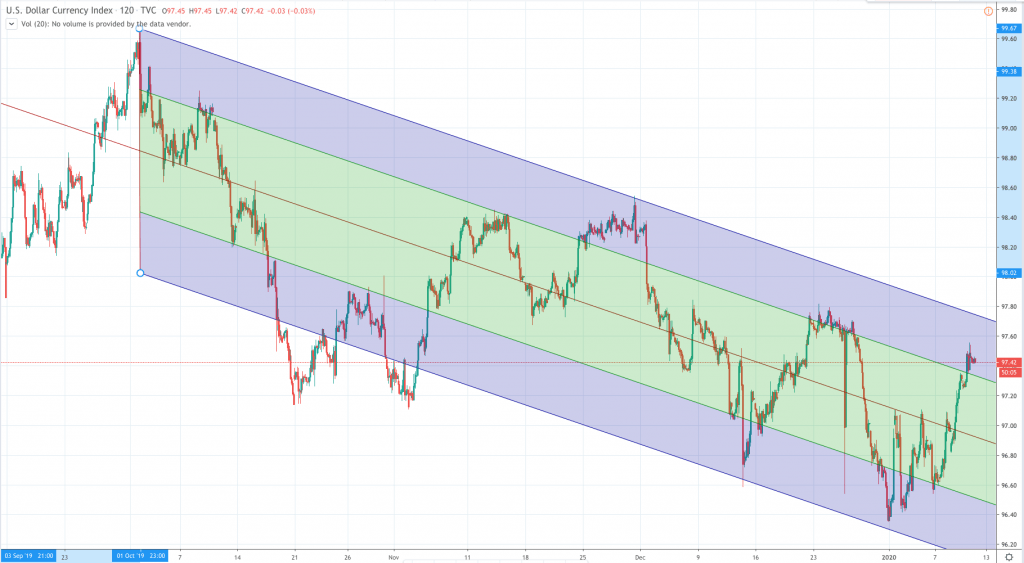
The weakening of the USD continues to play out. The confirmation from Beijing that phase 1 of the trade deal will be signed this coming week coupled with rising expectations for an economic recovery in 2020 have started to see DXY breakdown.

The USD is a ‘counter’ cyclical currency. Thus, as capital flow to risks (i.e. E.M. Asia and the like), it flows from the US. This normally manifests into a steepening of the yield curve also a USD negative.

There are three points to watch in 2020 for the USD:

The Fed has cut interest rates multiple times since June 2019 and is now expanding its balance sheet via repo operations and Treasury bill purchases. All of this has and is, cutting the interest rate premium it enjoyed over the rest of the world. It could even be suggested that this new balance sheet expansion programme will mark the peak of the USD.

“uncertainty” diminishing – uncertainty is a great safety inflow influencer and a core driver of the USD. At the end of 2019, the global uncertainty began to diminish, and outflow have begun. This trend should show up in DXY declines in the first half of the year as outflows move to cyclical and attractively valued markets ex US.

The final point is a flow on from points 1 and 2. As these events ramp up the stubbornly high net long speculative positions that have built up in USD over the past 3 years will unwind. It is a very crowded position and it is still 2 standard deviations above the long-term average.

DXY Since October 2019
US Dollar

Author

Evan Lucas

Evan Lucas

FP Markets

Evan has over a decade experience in finance and financial markets and has worked in Amsterdam, Singapore and Australia. Evan's core passion is using macro economics for thematic trading.


More from Evan Lucas
Share:

Editor's Picks

EUR/USD weakens as US jobs data trims Fed rate cut bets

The EUR/USD pair trades in negative territory for the third consecutive day near 1.1860 during the early European session on Thursday. Traders will keep an eye on the US weekly Initial Jobless Claims data. On Friday, the attention will shift to the US Consumer Price Index inflation report. 

GBP/USD bullish outlook prevails above 1.3600, UK GDP data looms

The GBP/USD pair gains ground near 1.3635, snapping the two-day losing streak during the early European session on Thursday. The preliminary reading of UK Gross Domestic Product for the fourth quarter will be closely watched later on Thursday. The UK economy is estimated to grow 0.2% QoQ in Q4, versus 0.1% in Q1. 

Gold remains on the defensive below two-week top; lacks bearish conviction amid mixed cues

Gold sticks to modest intraday losses through the Asian session on Thursday, though it lacks follow-through selling and remains close to a nearly two-week high, touched the previous day. The commodity currently trades above the $5,070 level, down just over 0.20% for the day, amid mixed cues.

UK GDP set to post weak growth as markets rise bets on March rate cut

Markets will be watching closely on Thursday, when the United Kingdom’s Office for National Statistics will release the advance estimate of Q4 Gross Domestic Product. If the data land in line with consensus, the UK economy would have continued to grow at an annualised pace of 1.2%, compared with 1.3% recorded the previous year. 

The market trades the path not the past

The payroll number did not just beat. It reset the tone. 130,000 vs. 65,000 expected, with a 35,000 whisper. 79 of 80 economists leaning the wrong way. Unemployment and underemployment are edging lower. For all the statistical fog around birth-death adjustments and seasonal quirks, the core message was unmistakable. The labour market is not cracking.

Sonic Labs’ vertical integration fuels recovery in S token

Sonic, previously Fantom (FTM), is extending its recovery trade at $0.048 at the time of writing, after rebounding by over 12% the previous day. The recovery thesis’ strengths lie in the optimism surrounding Sonic Labs’ Wednesday announcement to shift to a vertically integrated model, aimed at boosting S token utility.