COT Report: Similar trends in Australian dollar, British pound

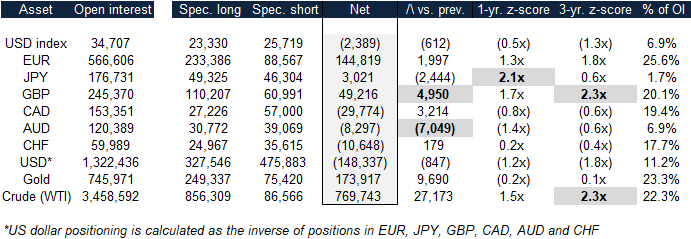
Looking at this week’s Commitments of Traders Report, the most notable changes include falling net positions in the Australian dollar and rising net positions in the British pound. Changes in other currencies and commodities were fairly limited. In general, speculators continue to buy the euro and the British pound, while betting against the US dollar, the Swiss franc and the Australian dollar. Thanks to rising US-China trade tensions and weakness in Chinese financial markets, speculators are net short the Australian dollar for the second week in a row.
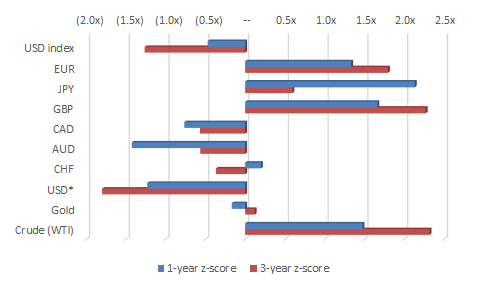
Looking at extremes in positioning, net long positions in the Japanese yen are at a bullish extreme based on trailing 12-month averages. Net long positions in the British pound and crude oil are at a bullish extreme based on trailing 36-month averages. Last week, we flagged the same three extremes.
The purpose of this weekly report is to track how the consensus is positioned across various major currencies and commodities. When net long positions become crowded in either direction, we flag extended positioning as a risk. Crowded positions do not suggest an imminent reversal, but should be considered as a significant risk factor when investing in the same direction as the crowd. This is shown below:
CFTC COT speculator positions (futures & options combined) – April 17, 2018
Source: CFTC, MarketsNow
Notable extremes, significant changes in weekly positions, and large net positions as a proportion of open interest are highlighted above. Extremes in net positions are highlighted when speculator positioning is more than two standard deviations above trailing 1-year and 3-year averages. Weekly changes are highlighted when they are significant as a proportion of open interest. Finally, net positions as a proportion of outstanding interest are highlighted when they are large relative to historical averages. 1-year and 3-year z-scores are visually represented below:
1-year and 3-year z-scores based on net speculator positions
Source: CFTC, MarketsNow
Looking at this week’s changes in more detail, Australian dollar speculators are losing faith in the currency. By historical standards, positioning in the currency is fairly moderate today. When sentiment was at a bullish extreme last September, speculator net long positions as a proportion of total open interest was nearly 45%. The last time sentiment hit bearish extremes back in November 2015, speculator net short positions as a proportion of total open interest was nearly 38%. Today, net short positions are just 6.9% of total open interest.
Looking at British pound net positions, the size of today’s net long position is far more concerning. The last time pound speculators were at a bullish extreme was in June 2014 (the currency peaked in early July 2014). At the time, net long positions as a proportion of total open interest was 18.9%. Today, net long positions relative to open interest is 20.1%. Moreover, positioning is also at a bullish extreme looking at the size of the position relative to trailing 36-month averages. Following the recent sell-off in the pound, speculators are likely to become less bullish over the coming weeks.
Author

Deb Shaw
MarketsNow
Deb is the Founder and Head of Research of MarketsNow.