
|

Big week ahead

S&P 500 charge higher continued, and high beta plays didn‘t disappoint. Energy, financials, Russell 2000, emerging markets – all on fire. After Thursday‘s climb of bear market rally wall of worry (we‘re rather to meet recession and not soft landing – the contraction will be mild till Q3 2023), we‘re in for a daily deceleration today as I don‘t think yesterday‘s complacency would last till the closing bell.

The weakness will likely show up in bonds first, underpinning the dollar – and the rest would be history. All on a daily basis – you can look forward for extensive pre-FOMC analysis next week!

Keep enjoying the lively Twitter feed serving you all already in, which comes on top of getting the key daily analytics right into your mailbox. Plenty gets addressed there (or on Telegram if you prefer), but the analyses (whether short or long format, depending on market action) over email are the bedrock.
So, make sure you‘re signed up for the free newsletter and that you have my Twitter profile open with notifications on so as not to miss a thing, and to benefit from extra intraday calls.

Let‘s move right into the charts.

S&P 500 and Nasdaq outlook
Chart

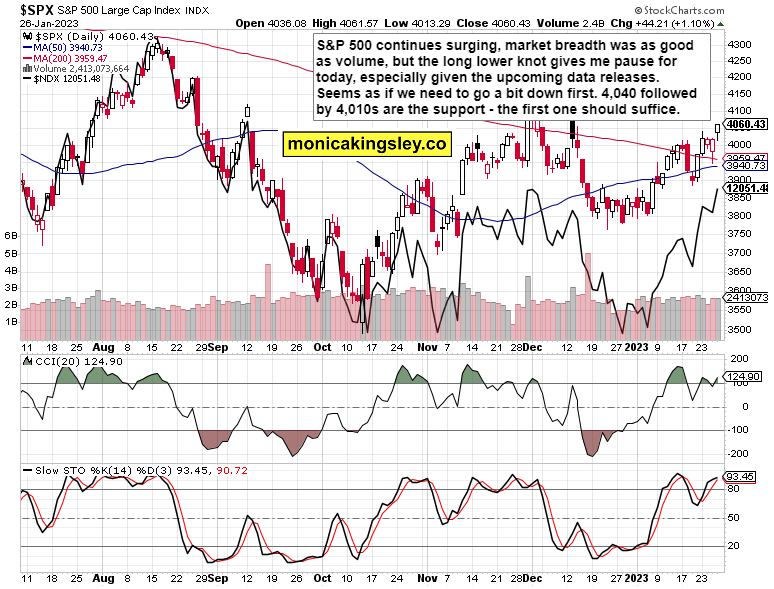
S&P 500 bulls will have to defend yesterday‘s initiative - 4,040 is the first line of support, followed by (high) 4,010s. Any downswing attempt is though likely to be confined to the roughly mid point of this two strong supports‘ range. I don‘t think 4,075 would be overcome today.

Credit markets
Chart

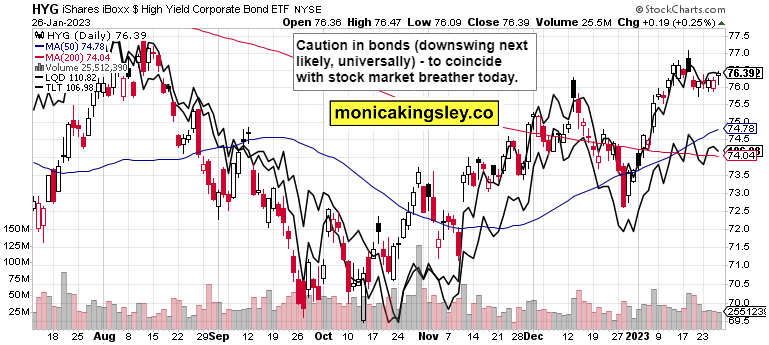
Bonds give me a pause – we‘re likely to see stocks play defence first, especially on another housing data release (disappointment).

Author

Monica Kingsley

Monica Kingsley

Monicakingsley

Monica Kingsley is a trader and financial analyst serving countless investors and traders since Feb 2020.


More from Monica Kingsley
Share:

Editor's Picks

AUD/USD keeps the red near 0.6950 after weak Aussie jobs data

AUD/USD holds losses near 0.6950 on disappointing Australian jobs data, extending the previous day's retracement slide from the monthly high and hitting a fresh weekly low during Thursday’s Asian session. Meanwhile, declining US bond yields drag the US Dollar away from the April 2025 high, touched after Wednesday's hot US CPI, helping limit losses for the currency pair.

USD/JPY slides back below 158.00 as USD reverses post-CPI gains

USD/JPY extends the previous day's pullback from a three-week high, attracting follow-through selling and sliding below 158.00 during Thursday's Asian session. Traders remain on high alert amid speculation that authorities will step in to prop up the Japanese Yen. The US Dollar, meanwhile, reverses Wednesday's hot CPI-led gains to April 2025 highs as US bond yields retreat on China bond-buying talk, further pressuring the pair.

Gold rebounds as global equity sell-off weigh on Treasury yields

Gold attracts fresh buying on Thursday as weakness across global equities, driven by mounting concerns over AI-related investments, triggers a sharp pullback in US Treasury yields and drags the US Dollar lower from fresh year-to-date highs. At the time of writing, XAU/USD trades around $4,155, up 1.21% on the day.

Bitcoin, XRP analyst sentiment jumps as Solana bulls hit 91%: CryptoQuant

Analyst sentiment on Bitcoin, Ethereum, Solana, BNB and XRP has flipped bullish since July, as the top five cryptocurrencies recovered faster and more strongly than during the 2022-2023 market phase, according to CryptoQuant.

Budget preview: Is Healey impressing the bond market?

There is less than 2 weeks to go before the Chancellor delivers his first budget. Unusually for the UK, the economic and financial backdrop to this budget is upbeat. UK bonds have been rallying, the FTSE 100 is the top performing major stock index this week, and the Pound is also stabilising versus the Dollar.

Has Bitcoin really escaped the macro forces it was built to fight?
Over 17 years ago, Satoshi Nakamoto designed Bitcoin (BTC) on the back of a global financial crisis as an alternative to the global monetary system outside the control of central banks, governments and traditional intermediaries. This raises a key question: has Bitcoin really become independent of the macroeconomic forces it was built to challenge?















