AUD/USD Price Forecast: Selling bias remains unabated ahead of Fed; fresh YTD low and counting
- AUD/USD drops to a fresh YTD low and is pressured by a combination of factors.
- The RBA’s dovish tilt and China’s economic woes seem to weigh on the Aussie.
- Expected hawkish cut from Fed act as a tailwind for US bond yields and the USD.


The AUD/USD pair extends its descending trend through the first half of trading action on Wednesday and drops to the 0.6300 neighborhood, or its lowest level since November 11 during the early European session. The Australian Dollar (AUD) continues to be undermined by the Reserve Bank of Australia's (RBA) dovish tilt and China's economic woes. This, along with worries about US President-elect Donald Trump's tariff plans, overshadows hopes for more government stimulus from China. Apart from this, the cautious market mood continues to undermine the China-proxy Aussie and exert pressure on the currency pair amid a bullish sentiment surrounding the US Dollar (USD).
The US Census Bureau reported on Tuesday that Retail Sales jumped 0.7% in November, better than the market expectation for an increase of 0.5% and the 0.4% growth recorded in the previous month. The data underscored robust consumer spending and was consistent with strong underlying momentum in the economy, suggesting that the Federal Reserve (Fed) will adopt a more cautious stance on cutting interest rates going forward. The prospects for a less dovish Fed pushed the yield on the benchmark 10-year US government bond to its highest level since November 22, which, along with persistent geopolitical tensions and trade war fears, act as a tailwind for the safe-haven Greenback.
The USD bulls, however, seem reluctant to place aggressive bets and opt to wait for the outcome of the highly anticipated two-day FOMC policy meeting. The US central bank will announce its decision later this Wednesday and is widely expected to lower borrowing costs by 25 basis points. The market focus, however, will be on the updated economic projections, which include the so-called dot plot, and Fed Chair Jerome Powell's comments at the post-meeting press conference. Investors will look for fresh cues about the future rate-cut path, which, in turn, will play a key role in influencing the near-term USD price dynamics and determining the next leg of a directional move for the AUD/USD pair.
AUD/USD daly chart
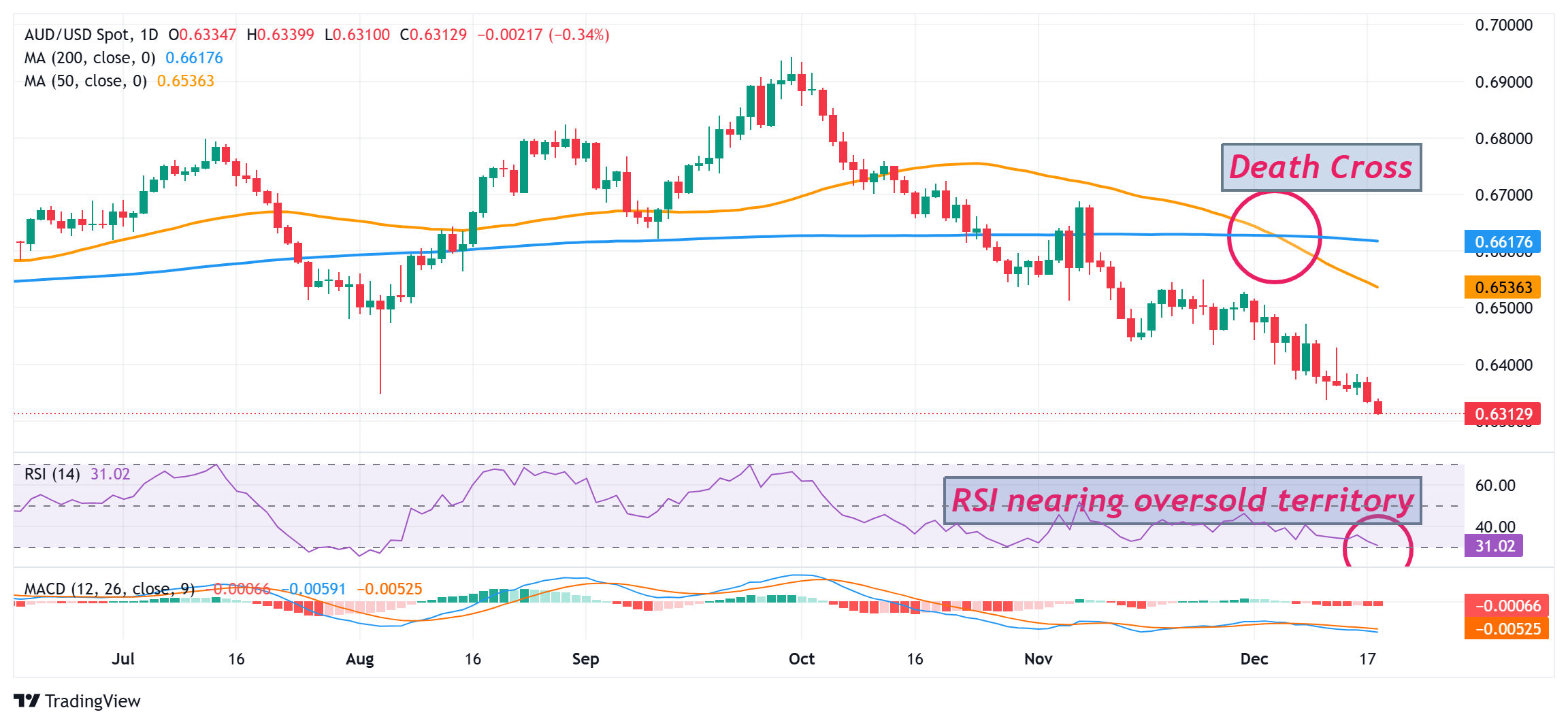
Technical Outlook
The fundamental backdrop and the occurrence of a death cross suggest that the path of least resistance for the AUD/USD pair is to the downside. That said, the Relative Strength Index (RSI) has moved on the verge of breaking into oversold territory on the daily chart and warrants caution for bearish traders. This makes it prudent to wait for some near-term consolidation or a modest bounce before positioning for an extension of a well-established downtrend witnessed over the past two-and-half months or so.
Any attempted recovery, however, might confront resistance near the 0.6355-0.6360 area ahead of the 0.6380-0.6385 supply zone and the 0.6400 round figure. The next relevant hurdle is pegged near the 0.6430 area, or the post-upbeat Aussie jobs data swing high, which if cleared decisively might trigger a short-covering rally. The AUD/USD pair might then accelerate the move up and aim to reclaim the 0.6500 psychological mark before climbing further towards the 0.6530-0.6540 horizontal barrier.
Meanwhile, bearish traders might now wait for a convincing break and acceptance below the 0.6300 mark before positioning for further losses. The subsequent decline has the potential to drag the AUD/USD pair to the October 2023 low, around the 0.6270 area en route to the 0.6200 round figure. The downward trajectory could extend further towards the 0.6200 mark and the 2022 yearly swing low, around the 0.6170 region.
Premium
You have reached your limit of 3 free articles for this month.
Start your subscription and get access to all our original articles.
Author
Haresh Menghani
FXStreet
Haresh Menghani is a detail-oriented professional with 10+ years of extensive experience in analysing the global financial markets.

















