AUD/USD Price Forecast: Seems vulnerable below 100-day SMA ahead of Australian jobs data
- AUD/USD continues losing ground for the third straight day and drops to over a one-month low.
- Disappointment over China’s stimulus, risk-off mood and a bullish USD contribute to the decline.
- Bears turn cautious ahead of the Australian jobs data on Thursday and Chinese data on Friday.

The AUD/USD pair maintains its offered tone through the first half of the European session and trades around the 0.6690-0.6685 region, just above a one-month low touched earlier this Thursday. The lack of specifics about the overall size of the fiscal stimulus from China left investors uncertain and derailed the recent positive momentum in the equity markets. Apart from this, persistent geopolitical risks stemming from the ongoing conflicts in the Middle East temper investors' appetite for riskier assets, which, in turn, is seen undermining demand for the Aussie.
Apart from this, the prevalent bullish sentiment surrounding the US Dollar (USD) overshadows the Reserve Bank of Australia (RBA) Deputy Governor Sarah Hunter's hawkish remarks and exerts additional downward pressure on the AUD/USD pair. Hunter noted that price growth has remained a sticking point and that the RBA remains determined to keep inflation under control. Hunter added that the RBA is not obligated to conform to other central banks on policies, reaffirming expectations of a no change in the cash rate target rate at the November policy meeting.
Meanwhile, the USD Index (DXY), which tracks the Greenback against a basket of currencies, jumps to its highest level since August 8 amid growing acceptance that the Federal Reserve (Fed) will proceed with modest interest rate cuts. The markets are currently pricing in over a 90% chance that the US central bank will lower borrowing costs by 25 basis points on November 7. This, in turn, assists the USD to capitalize on its recent uptrend witnessed over the past three weeks or so and contributes to the AUD/USD pair's intraday fall below the 100-day Simple Moving Average (SMA).
The intraday slide, however, stalls near the 0.6670-0.6665 region as traders opt to move on the sidelines ahead of the Australian monthly employment details, due for release during the Asian session on Thursday. This will be followed by US economic releases – Retail Sales, Weekly Initial Jobless Claims and Industrial Production figures. Apart from this, the Chinese macro data dump on Friday – including the third quarter GDP report – will influence the Australian Dollar (AUD) and help in determining the next leg of a directional move for the AUD/USD pair.
Technical Outlook
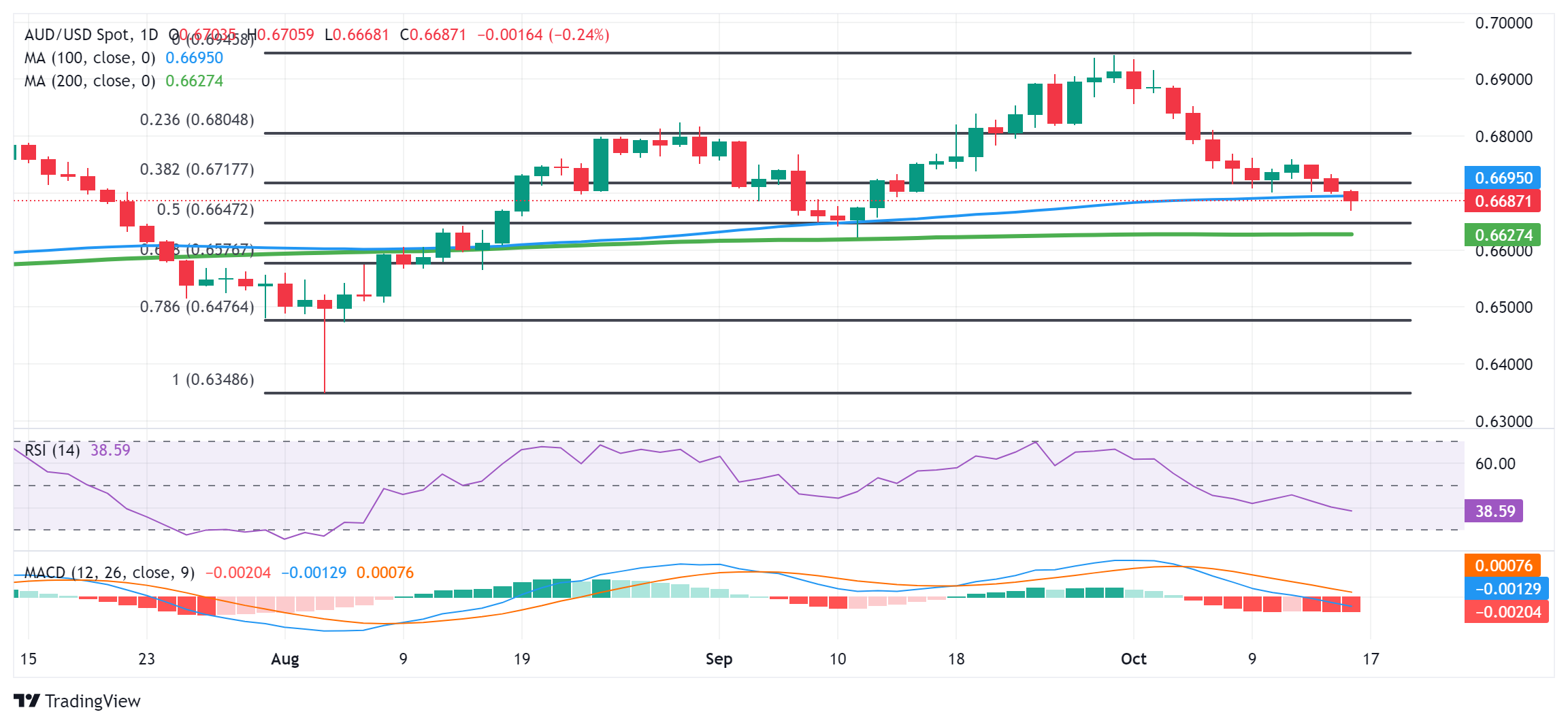
From a technical perspective, the intraday breakdown below the 100-day SMA could be seen as a fresh trigger for bearish traders. Moreover, oscillators on the daily chart have been gaining negative traction and are still away from being in the oversold territory. This, in turn, suggests that the path of least resistance for the AUD/USD pair is to the downside. Hence, a subsequent fall towards challenging the very important 200-day SMA, currently pegged near the 0.6625 region, looks like a distinct possibility. The latter coincides with the September monthly swing low and should act as a key pivotal point, which if broken decisively should pave the way for a further near-term depreciating move.
On the flip side, any attempted recovery beyond the 0.6700 mark is likely to attract fresh sellers and remain capped near the 0.6750-0.6760 region. A sustained strength beyond, however, might trigger a short-covering rally and lift the AUD/USD pair to the 0.6800 mark. The momentum could extend further towards the 0.6820-0.6825 region, above which spot prices could climb to the 0.6900 round figure. The momentum could extend further towards the 0.6940-0.6945 area, or the highest since February 2023 touched last month.
AUD/USD daily chart
(This story was corrected on October 16 at 07:30 GMT to say that the AUD/USD pair trades near a one-month low touched earlier this Wednesday, not Thursday.)
Author

Haresh Menghani
FXStreet
Haresh Menghani is a detail-oriented professional with 10+ years of extensive experience in analysing the global financial markets.

















