AUD/USD Price Forecast: Bears not ready to give up; fresh multi-year low and counting
- AUD/USD drops to its lowest level since October 2022 amid sustained USD buying.
- The Fed’s hawkish stance and the cautious market mood underpin the Greenback.
- Rising bets for an early RBA rate cut and China’s economic woes weigh on the Aussie.

The AUD/USD pair attracts some sellers for the third successive day on Thursday and drops to its lowest level since October 2022 during the early European session amid a bullish US Dollar (USD). In fact, the USD Index (DXY), which tracks the Greenback against a basket of currencies, stands firm near a two-year peak in the wake of the Federal Reserve's (Fed) hawkish shift. The outlook was reaffirmed by the Minutes of the December FOMC meeting, which showed that policymakers viewed labor market conditions as gradually easing and were in favor of slowing the pace of rate cuts amid stalling disinflation.
Meanwhile, CNN reported on Wednesday that US President-elect Donald Trump is considering declaring a national economic emergency to provide legal justification for a series of universal tariffs on allies and adversaries. The yield on the benchmark 10-year US government bond shot to its highest level since April 25 in reaction to the news amid speculations that Trump's policies could cause a reacceleration in inflation and force the Fed to slow the pace of interest rate cuts in 2025. Moreover, data released on Wednesday indicated that the US labor market remained robust and lent additional support to the USD.
Automatic Data Processing (ADP) reported that US private sector employment rose by 122,000 in December as compared to the 146,000 recorded in November and missed market expectations of 140,000. Separately, the US Department of Labor reported that the number of Americans filing new applications for unemployment benefits fell to an 11-month low of 201K in the week ending January 4. This, along with the cautious market mood, geopolitical risks and trade war fears, further benefits the safe-haven Greenback and contributes to driving lows away from perceived riskier currencies, including the Aussie.
The AUD/USD pair is further pressured by rising bets for an interest rate cut by the Reserve Bank of Australia (RBA) as early as next month, bolstered by a drop in Australia's core inflation. Adding to this, data released this Thursday showed that Australian Retail Sales rose less than expected in November. Apart from this, weak inflation data from China overshadowed a jump in Australia's trade surplus in November, boosted by strong commodity exports. This, in turn, suggests that the path of least resistance for spot prices remains to the downside and supports prospects for an extension of the depreciating move.
Traders now look forward to speeches from a slew of influential FOMC members, which, along with the US bond yields and the broader risk sentiment, will drive the USD demand and provide some impetus to the AUD/USD pair. The focus, however, will remain glued to the release of the closely-watched US monthly employment details – popularly known as the Nonfarm Payrolls (NFP) report scheduled for release on Friday. Nevertheless, the aforementioned fundamental backdrop suggests that any attempted recovery could be seen as a selling opportunity and runs the risk of fizzling out rather quickly.
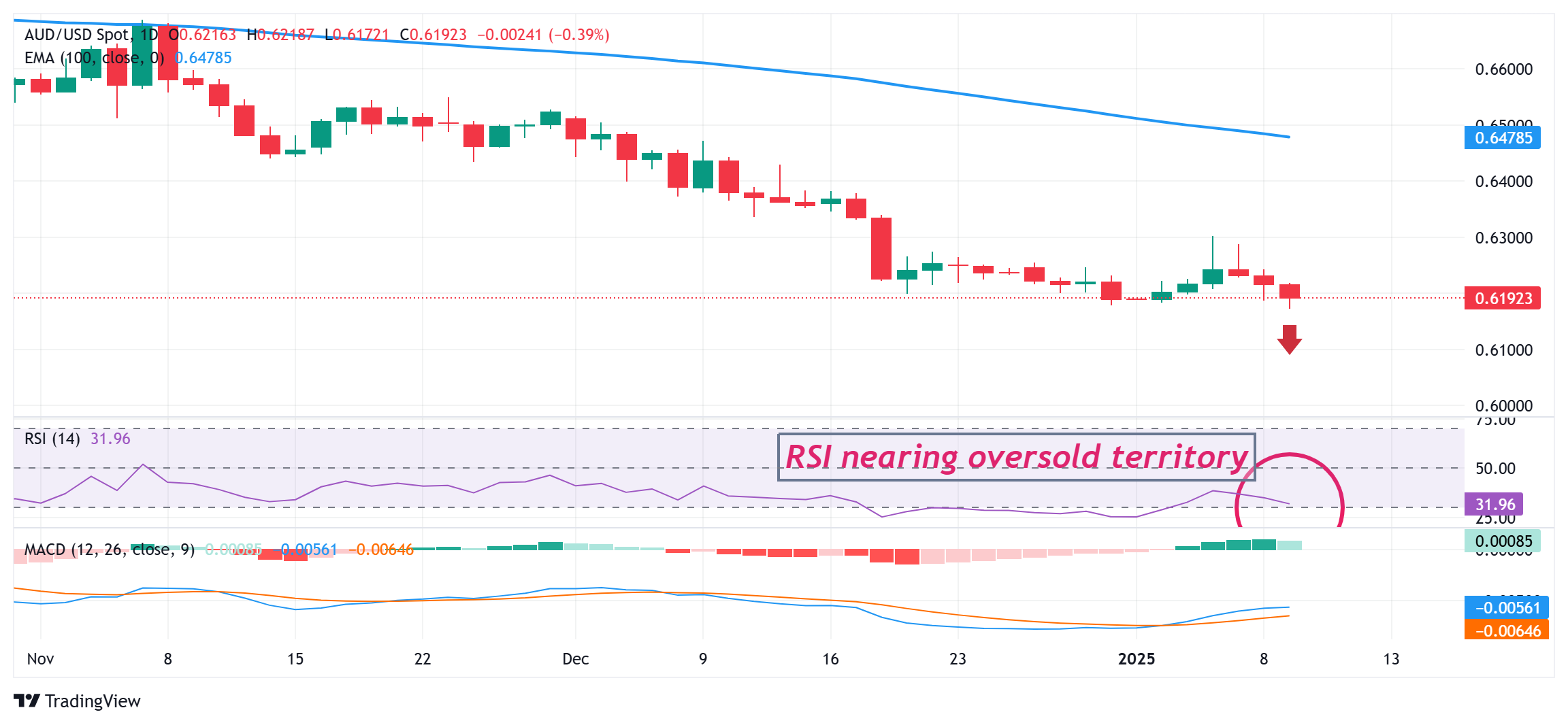
AUD/USD daily chart
Technical Outlook
From a technical perspective, some follow-through selling below the October 2022 swing low, around the 0.6170 area, will be seen as a fresh trigger for bearish traders. That said, the Relative Strength Index (RSI) on the daily chart is on the verge of falling into oversold territory and makes it prudent to wait for some near-term consolidation or a modest bounce before positioning for any further losses.
Any attempted recovery, however, is likely to confront immediate resistance near the 0.6200 mark and attract fresh sellers near the 0.6220-0.6225 region, which should cap the AUD/USD pair ahead of mid-0.6200s. Some follow-through buying, however, could allow spot prices to make a fresh attempt to conquer the 0.6300 mark.
Nevertheless, the AUD/USD pair remains on track to prolong the downward trajectory towards the 0.6130-0.6125 intermediate support en route to the 0.6100 mark. The descending trend could eventually drag spot prices to the 0.6000 psychological mark and the April 2020 swing low, around the 0.5980 region.
Author

Haresh Menghani
FXStreet
Haresh Menghani is a detail-oriented professional with 10+ years of extensive experience in analysing the global financial markets.

















