AUD/USD Forecast: Challenging the elusive 0.7300 level
- Australian solid employment figures revived hopes of economic progress.
- AUD/USD capped by 0.7300 since August, bullish

The AUD/USD pair seems poised to close a third consecutive week with gains, although the 0.7300 level remains a tough bone to break. The financial world was all about Brexit developments, but the Aussie got extra aid from a solid employment report, which kept it afloat despite the U-turn in Brexit developments and sentiment. For once, the commodity-linked currency refused to trade alongside equities, which are poised to close the week with losses, a good sign for bulls, and a worrisome one for bears. Still, the pair has been unable to retain gains beyond 0.7300 since August, with September high at 0.7314 being the highest achieved in the last three months.
According to the official release, the economy added 32.9K new jobs in October, with 42.3K new full-time jobs created and part-time jobs decreasing by 9.5K. Also relevant, the unemployment rate remained at 5.0%, its lowest since 2012, against an expected increase to 5.1%, despite the participation rate increased to 65.6%. Wages, however, are still to growth, with the quarterly Wage Price Index at 0.6% in Q3, while Q2 reading was downwardly revised to 0.5%, while underemployment remains at record highs. Anyway, the report was encouraging enough to fuel hopes and therefore, the Aussie.
Meanwhile, the US-China trade war remains in a stalemate. On Thursday, there were some headlines suggesting that China made an offer to the US to try to move forward in trade negotiations, but the optimism triggered was short-lived. The leaders of both countries are set to talk in the next G-20 meeting in Argentina the upcoming week.
Base metals recovered, another factor underpinning the AUD/USD pair, although gains there seem corrective, and with oil prices plummeting, commodities pose a downward risk for the pair.
Chinese data released this week was mixed, as October Retail Sales grew by last-than-expected up by 8.6% vs. September 9.1.%, although Industrial Production surged in the same month, increasing by 5.9%.
Next Tuesday, the RBA will release the Minutes of its latest meeting, followed by the Westpac Leading Index for October. The week will be pretty quiet beyond that, with no macroeconomic news scheduled in China. The US will offer next week Durable Goods Orders and the preliminary November Manufacturing and Services PMI indexes.
AUD/USD technical outlook
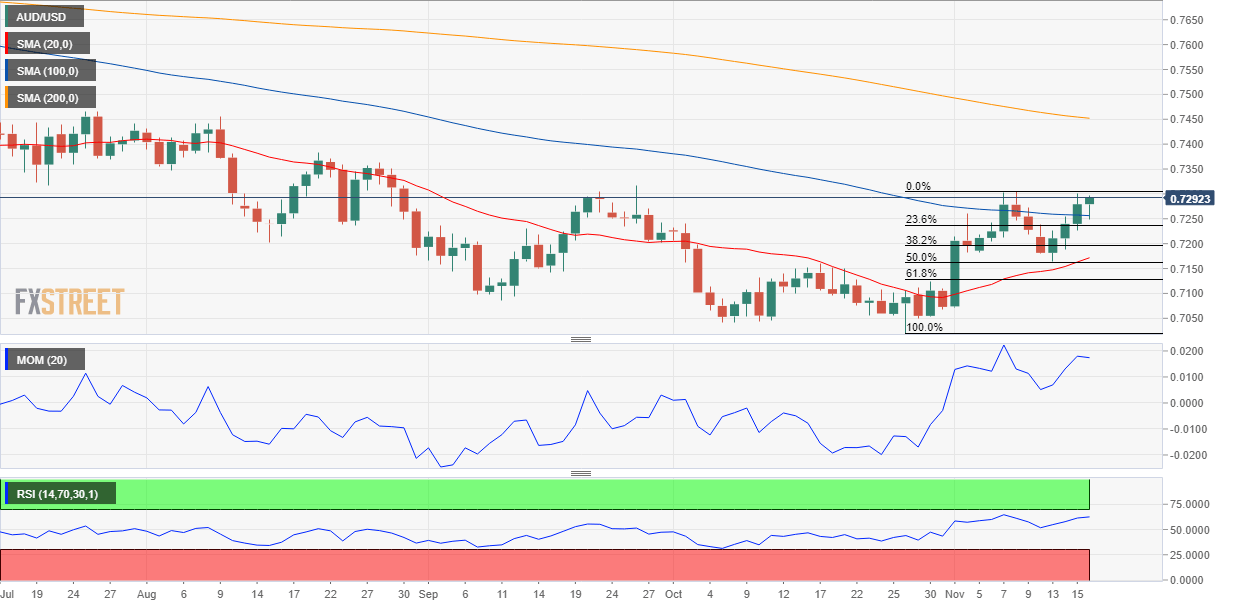
The pair rallied pretty much straight from 0.7020, the yearly low, to 0.7302, this month high. The pair bottomed this week at the 50% retracement of such rally at 0.7160, now heading into the weekend close to the top of the range, which maintains the risk skewed to the update. From a technical point of view, the pair gains upward traction in its weekly chart, but is still far from bullish, given that technical indicators advance continues taking place below their midlines. In the mentioned chart, the pair is struggling with a bearish 20 SMA at around 0.7250, still far below the 100 and 200 SMA. A firmer advance beyond 0.7300 these upcoming days, will surely back a steeper recovery.
In the daily chart, the positive tone is firmer, as the pair is developing right above a bearish 100 DMA but well above a bullish 20 SMA. Indicators favor another leg higher, as the Momentum maintains its strong bullish slope in overbought levels, while the RSI consolidates at 59, rather reflecting Friday's lack of follow-through than suggesting downward exhaustion.
Beyond 0.7314, the mentioned September high, the advance could continue up to 0.7380, where the pair has several highs from last July, while above this last, the rally can continue up to the 0.7440/60 price zone. Supports come at 0.7200 and 0.7160, the mentioned 50%, with a steeper decline expected only below the 0.7070 price zone.
AUD/USD sentiment poll
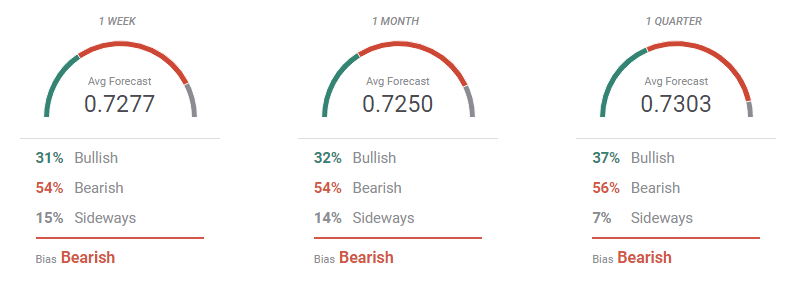
According to the FXStreet Forecast Poll, the AUD/USD pair will lose ground from here, despite closing the week at at the upper end of its monthly range, as bears are a majority in all the time frames under study.
However, reading within the lines, there are some hints indicating that bulls may win the battle this time. The weekly average target has been upgraded to 0.7277, while the monthly one is steady at 0.7250. The three-month view is being distorted by banks, which are firmly bullish and targeting levels close to the 0.8000 figure, although the Overview chart shows that the largest number of polled experts are targeting the 0.70/0.72 region. The same chart shows that, while the weekly and monthly moving averages extend their bullish slopes, the 3-month one poses a sharp downward turn.
Related content:
Author

Valeria Bednarik
FXStreet
Valeria Bednarik was born and lives in Buenos Aires, Argentina. Her passion for math and numbers pushed her into studying economics in her younger years.

















