|

YouGov Poll: MRP model projects a Tory majority of 68 – The Times (GBP prints fresh highs 1.2925)

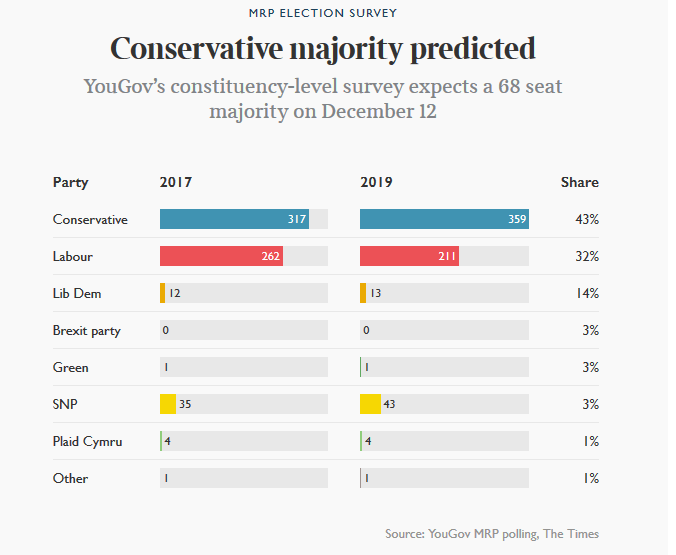
  • YouGov /times mMRPmodel projects the Conservative majority of 68.
  • Labour party on track for 211 seats - YouGov /Times MRP model.
  • conservative party on track for 359 seats - YouGov /Times MRP model.

The YouGov's official MRP poll has been released - This poll is regarded as the most reliable and has the capacity to really move GBP crosses – (The model accurately forecast the hung parliament in the 2017 General Election, even correctly projecting that seats such as Kensington & Chelsea and Canterbury would be won by the Labour Party).

Overnight, citing sources who have seen the YouGov MRP poll, the Guardian journalist Owen Jones reported that British Prime Minister Boris Johnson's Conservatives had a significant majority over the Labour Party.

"Labour's national share has gone up by a few points in the last week," Jones tweeted. "If that trend continued over the next week, it'd be a hung Parliament." GBP/USD bulls were all over the leak and cable subsequently rose into the 1.29 handle but a hung Parliament scenario was a thorn in the side for the bulls. "For clarity - if the rate of Labour’s recovery over the last week was replicated over the coming week, then next week’s figures would show a hung parliament," Jones further explained.

Results as follows (via Reuters)

  • Boris Johnson on track 359.
  • Labour on track for 211.
  • MRP model projects a Tory Majority of 68.

"Johnson's Conservative Party could win 359 seats out of 650, up from 317 in the 2017 general election, according to the YouGov results published by the Times of London newspaper. The opposition Labour Party looks on track to secure 211 seats, down from 262, The Times said" - Reuters

Full report - The Times
FX implications

GBP has moved with 30 pip range on the release and is currently making fresh highs of 1.2925 at the time of writing. 

Author

Ross J Burland

Ross J Burland, born in England, UK, is a sportsman at heart. He played Rugby and Judo for his county, Kent and the South East of England Rugby team.


More from Ross J Burland
Share:

Editor's Picks

AUD/USD remains below 0.7000 amid light trading

AUD/USD fills a modest bearish gap on Monday, but remains below 0.7000 in the Asian session amid holiday-thinned liquidity. The US Dollar attempts a bounce even as US bond yields pull back from multi-year highs, limiting the pair. Moreover, diminishing odds of another RBA rate hike in November cap the Aussie.

USD/JPY hovers above 158.00 amid Japan/ US holiday

USD/JPY extends its range-bound price action into a new week, trading above 158.00 as bulls remain on high alert amid speculation that authorities will step in to prop up the Japanese Yen. Meanwhile, softer US bond yields keep US Dollar bulls on the back foot and cap the pair's upside. However, geopolitical uncertainties could limit losses for the safe-haven buck amid thin liquidity due to a holiday in Japan and the US.

Gold  remains vulnerable below $4,200 on Fed hike bets

Gold is under mild selling pressure on Monday, trading at around $4,170. The US Dollar advances modestly in thin trading, supported by bets that the Federal Reserve will hike rates at least one more time before year-end.

Bitcoin struggles as ETF outflows, geopolitical uncertainty weigh

Bitcoin hovers around $83,600 on Monday after a 3.1% correction last week. US-listed spot ETFs recorded an outflow of $681.10 million last week, snapping the three-week inflow streak. Geopolitical uncertainty and mixed signals keep investors cautious.

The week ahead: A critical week as earnings and CPI test market

The Oil price is relatively stable this morning, and US and European stock markets are poised to open higher, as risk sentiment shrugs off an escalation in the Middle East and concerns about rising bond yields.

Has Bitcoin really escaped the macro forces it was built to fight?
Over 17 years ago, Satoshi Nakamoto designed Bitcoin (BTC) on the back of a global financial crisis as an alternative to the global monetary system outside the control of central banks, governments and traditional intermediaries. This raises a key question: has Bitcoin really become independent of the macroeconomic forces it was built to challenge?














