|

WTI turns positive, hovering around $85.00 a barrel as the US Dollar tumbles

  • Western Texas Intermediate (WTI) s set to finish the week with losses of 0.55%.
  • China’s demand and a soft US Dollar underpinned oil prices.
  • WTI buyers unable to crack the 50-day EMA keeps the commodity downward biased.

WTI is about to finish Friday’s trading session almost flat, as Wall Street ended the day with hefty gains amidst hopes of a Fed pivot, as wires mentioned Fed officials debating to slow the pace of rate increases following November’s meeting. At the time of writing, WTI is trading at $85.17 a barrel, up by a minimal 0.19%.

WTI trimmed earlier losses courtesy of a soft US Dollar and China’s demand

Given that the Fed would diminish its aggression, the greenback fell, a tailwind for the US Dollar denominated commodity. US Treasury yields retraced their earlier gains, undermining the buck, which, as shown by its US Dollar Index, fell 0.88%, down at 111.865, after hitting a YTD high of 113.942.

Aside from this, oil prices increased in choppy trading on the likelihood of China’s more robust demand. News that the country might ease quarantine restrictions for visitors abroad from 10 to 7 days spurred a jump in oil prices.

The Organization of Petroleum Exporters Countries (OPEC) and its allies decided to cut oil production amidst the weakened global economic outlook, threatening to tip the largest economies into a recession. OPEC+ drew 2 million barrels daily, in a widely criticized decision by the White House, which reacted negatively to the decision.

WTI Price Forecast

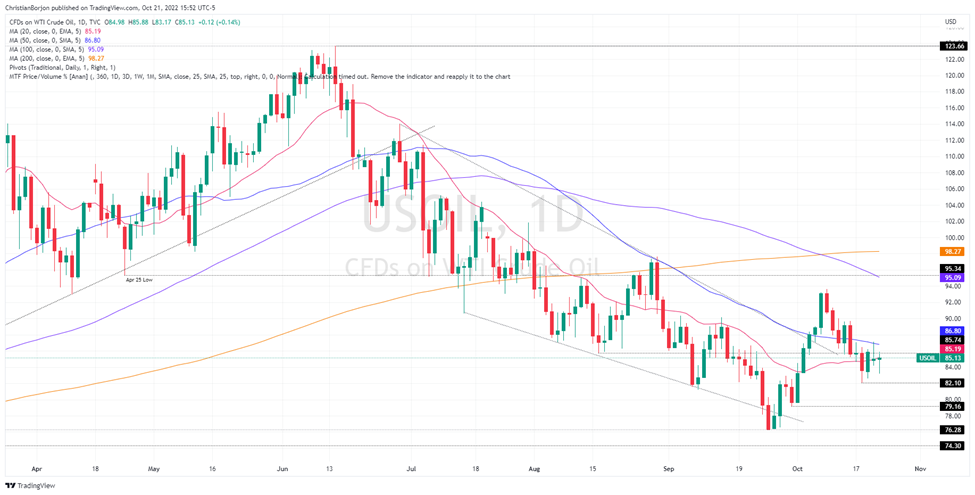
Western Texas Intermediate (WTI) recovered some ground during the day and is clinging to the 20-day Exponential Moving Average (EMA) at $85.13 PB as volume dry. In the week, the US crude oil benchmark could not trade above its 50-day EMA at $86.80, meaning that risks remain skewed to the downside.

Therefore, WTI’s first support would be the October 18 daily low at $82.10, followed by the September 30 swing low at $79,16, and then a re-test of the YTD low at $76.28.
Author

Christian Borjon Valencia

Markets analyst, news editor, and trading instructor with over 14 years of experience across FX, commodities, US equity indices, and global macro markets.


More from Christian Borjon Valencia
Share:

Editor's Picks

AUD/USD losses steam at 0.7000 as PMIs signal a deceleration

The Australian Dollar retreats 0.17% against the US Dollar on Thursday as sentiment soured on US tech stocks falling on worries about AI valuations, while Oil surged on an escalation of the US-Iran conflict. The AUD/USD trades at 0.7017.

USD/JPY declines to a one-week low; eyes trading range support near 157.50 on weaker USD

USD/JPY drops to a one-week low during Thursday’s Asian session, with bears now awaiting a break below multi-week range support near mid-157.00s before placing fresh bets amid a broadly weaker US Dollar. Despite bets for a December Fed rate hike and Middle East jitters, the recent decline in US bond yields keeps USD depressed near a three-week low. Moreover, hawkish BoJ expectations and intervention risks underpin the Japanese Yen, further weighing on the currency pair.

Gold falls to two‑month low below $4,050 as oil spikes

Gold price falls to the lowest in more than two months near $4,025 during the early Asian session on Friday. The precious metal faces some selling pressure as escalating tensions in the Middle East send oil surging ahead of a Federal Reserve policy meeting.


Bitcoin falls 4% as chip stocks plunge 6.7% and oil surges
Bitcoin (BTC) fell below $82,000 on Thursday as the crypto market joined a broader market sell-off driven by concerns over artificial intelligence (AI) spending, rising oil prices and escalating geopolitical tensions involving the US and Iran. The top crypto fell 4% to $81,130 as macro fears weighed on prices across the digital asset market.
The Bank of England just got its clearest reason to hike. Here's what it's really watching

UK inflation as measured by the CPI accelerated to 3.5% YoY in September, up from 3.1% in August, according to the Office for National Statistics. This is the highest level since October 2025, exceeding economists' expectations of 3.4% and pushing inflation further from the BoE's 2% target.

What November 3 means for the Fed's rate path and the US Dollar

The USD faces a decisive period ahead of the November 3 midterm elections. While markets anticipate another interest rate increase from the Fed in December, the battle for control of Congress could reshape fiscal policy expectations and, indirectly, the path of US monetary policy in 2027.















