When is the US GDP report and how could it affect EUR/USD?

US Q1 GDP Overview
Thursday's US economic docket highlights the release of the final version of the US GDP report for the first quarter of 2019 and is scheduled to be published at 12:30 GMT. The economic growth in the January-March quarter is anticipated to match the preliminary estimate and hold steady at 3.1% annualized pace as compared to a 2.2% rise recorded in the last quarter of 2018.
Deviation impact on EUR/USD
Readers can find FX Street's proprietary deviation impact map of the event below. As observed the reaction on the pair, in case of a deviation by -0.82 likely to be around 24-pips in the first 15-minutes and could extend to 54-pips in the following 4-hours. Conversely, the reaction in case of positive deviation by 0.68 is likely to be in the range of 20-pips during the first 15-minutes, which could extend to 45-pips in the subsequent 4-hours.
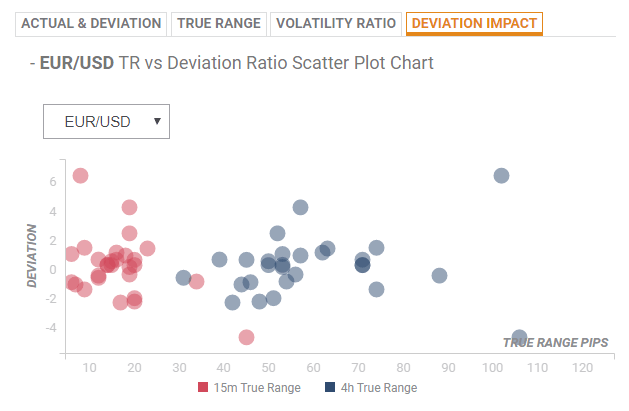
How could it affect EUR/USD?
Ahead of the important release, Yohay Elam, Analyst at FXStreet offers important technical levels to trade the major – “1.1320 capped EUR/USD on its way up to current levels, and 1.1245 held it down beforehand. The next support line is 1.1180 which was a low point in mid-June.”
“Looking up, 1.1385 was a high point on Wednesday and is immediate resistance. It is followed by 1.1415 that was the peak this week and the highest since March. The next levels are 1.1445 and 1.1520,” he added further.
Key Notes
• US Q1 GDP Final Revision Preview: Look ahead not behind
• EUR/USD Forecast: On the verge of losing critical support after failing to rise on upbeat news
• EUR/USD Technical Analysis: The pair remains supported by the 200-day/week SMAs
About the US GDP
The Gross Domestic Product Annualized released by the US Bureau of Economic Analysis shows the monetary value of all the goods, services and structures produced within a country in a given period of time. GDP Annualized is a gross measure of market activity because it indicates the pace at which a country's economy is growing or decreasing. Generally speaking, a high reading or a better than expected number is seen as positive for the USD, while a low reading is negative.
Author

Haresh Menghani
FXStreet
Haresh Menghani is a detail-oriented professional with 10+ years of extensive experience in analysing the global financial markets.