US Q1 GDP Final Revision Preview: Look ahead not behind
- No change expected from second and final revision of Q1 GDP
- Annualized expansion to be 3.1% in the first quarter
- Most statistical inputs for GDP are complete

The Bureau of Economic Analysis, a division of the Commerce Department will issue its third and final version of first quarter gross domestic product (GDP) on Thursday, June 27th at 8:30 am EDT, 12:30 pm GMT.
Forecast
The second revision and third version of first quarter annualized GDP is expected to be unchanged at 3.1%. The initial release was 3.2% and the first revision was 3.1%.
GDP and the US Economy
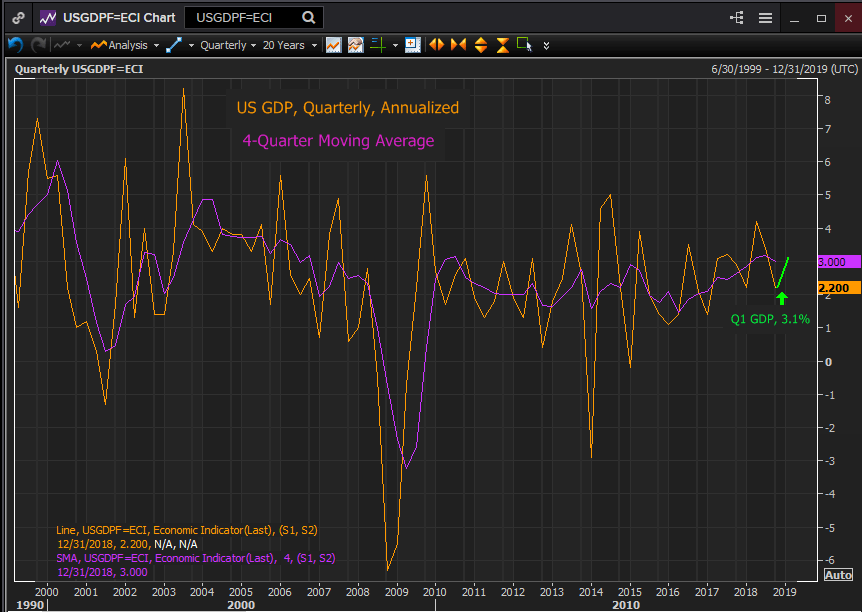
The unexpected strength of the US economy in the first quarter came after a successful 2018 which saw the first annual 3% quarterly average for GDP in 12 years.
Reuters
Nonetheless the declining rate of expansion following the 4.2% second quarter, 3.4% in the third and 2.2% in the fourth led to speculation that the burst of growth in the middle six months was transitory, based on the tax reform and spending bills of the previous year. The concern was that once the stimulus was spent the economy would revert to its 2-2.5% performance of the post-recession years. The GDP average for the eight years from 2010 through 2017 was just 2.203%.
The 3.2% initial release was 0.9% greater than the last Atlanta Fed GDPNow estimate of 2.3%. It was an uncommonly large miss for that model. The latest estimate for the second quarter is 2.0%. The range has been 0.9% to 2.1%. There are eight more estimates with the final one on July 25th.
Statistical inputs for GDP
At this point all of the major statistical components for first quarter GDP have been released. Several of the items will receiver further revision in the months ahead but substantial changes to the third GDP release are rare.
Non-farm payrolls are adjusted annually to account for any discrepancies between the so-called birth-death model estimates for new job creation and the actual employment numbers reported to the government for tax purposes. Trade numbers are also modified over time and can make important changes to GDP as exports add to the accounting for economic activity and imports subtract. But in general the reporting for the first quarter is complete by the third GDP version.
The tendency with long term growth rates is to extrapolate in reverse, to see a weakening in the prior quarter if growth in the current period is markedly lower. However, this seemingly intuitive response is not born out statistically. The calculations used by the BEA do produce the abrupt shifts in GDP rate from quarter to quarter seen in the historical record.
Currency and policy implications
Fed policy is forward looking. The central bank is not concerned about growth in the first quarter though admitting it was stronger than anticipated. Inflation is of greater moment to the FOMC but it is the potential for a much weaker expansion and the impact of the China trade dispute and other potential conflicts that is driving bank policy. With the tilt toward easing in July and beyond already established a weaker than expected Q1 GDP will reinforce that policy and a stronger than predicted growth rate will be ignored by the credit and currency markets as having little to add to the current situation.
Author

Joseph Trevisani
FXStreet
Joseph Trevisani began his thirty-year career in the financial markets at Credit Suisse in New York and Singapore where he worked for 12 years as an interbank currency trader and trading desk manager.
















