Visa Earnings Preview: Another V stock beat should keep market happy
- Visa reports earnings FQ3 earnings after close on Tuesday.
- Wall Street expects adjusted EPS of $1.75 for V stock.
- Walmart's falling guidance may lead to second guessing.


Visa (V) is one of those stocks that does not get the attention it deserves because there is so much consensus that it is a solid investment. Since going public in March 2008, Visa has returned 1,265% to shareholders. Despite falling revenue during the first year of the covid pandemic, Visa has become a trusted stock due to its ability to grow earnings at a fairly steady pace year after year.
Also read: Amazon Stock Deep Dive: AMZN price target at $106 with near-term risks offset by long-term growth
Visa has only missed one EPS forecast and two revenue projections in the past ten quarters. For the fiscal third quarter ending in June, Wall Street consensus expects adjusted earnings per share (EPS) of $1.75 on revenue of $7.07 billion.
Visa stock earnings news
Walmart's (WMT) revised guidance for the second quarter sent shivers down the spines of many a market analyst on Monday. Company executives downwardly revised second quarter EPS and full-year EPS, blaming the economy and general inflation. As the US's largest retailer, Walmart is typically a good signal of changes in consumer spending patterns.
“The increasing levels of food and fuel inflation are affecting how customers spend, and while we’ve made good progress clearing hardline categories, apparel in Walmart US is requiring more markdown dollars," Walmart CEO Doug McMillon in a statement.
As another major proxy of consumer sentiment, Visa fell 0.2% on the news ($213.90), though not comparable to Walmart, which lost 9% after-hours. Visa stock is down just 3% YTD, which is a major outperformance compared with the S&P 500, which has lost 17%. This knack for safety and reduced volatility kept Visa stock's share price elevated during the first half of the year when inflation and talk of recession were sending stock prices lower week after week.
Visa stock consensus EPS this quarter is 17% of last year's fiscal Q3, and the revenue figure is also a 15% advance YoY. Over the past 90 days, 16 analysts have revised their EPS estimate for Q3 upward, while eight have revised it down. This stands in stark contrast to many of the other public companies reporting this quarter. Analysts have been busy marking most companies down due to expectations for a recession in the second half of the year.
A series of analysts have recently cut their price targets on Visa due to the economic situation. Oppenheimer cut its target from $262 to $242. Baird lowered the target from $290 to $265. Wells Fargo reduced its price target from $280 to $255. At the lower end, Mizuho and Piper Sandler lowered their targets to $215 and $204, respectively, but as you can see most analysts are still bullish on Visa stock.
UBS recently placed Visa on its conviction buy list: "Trading at 24x our FY 2023E EPS, valuation already prices-in a mild recession and does not fully price-in Visa’s 5-year top and bottom-line growth potential of low teens and high-teens, respectively." The bank attached an extremely bullish $292 price target to Visa.
Visa stock forecast
Visa stock could easily make it to $224 or $229 in the event of an earnings beat. These highs come from March and April. Visa stock has been trading underneath a descending top line since June 2021.
V stock is currently right on top of that top line at $214. A breakout above this one-year barrier should lead to a quick jump into the 2020s, but obviously, for the sake of the weekly chart, we need a close outside the top line to sustain it. The Accumulation/Distribution line just under 6.4 billion shares shows that institutions keep buying and holding onto shares, which is a good sign for longer-term Visa share price appreciation. In the event of a miss, expect the long-term support at $187 to hold.
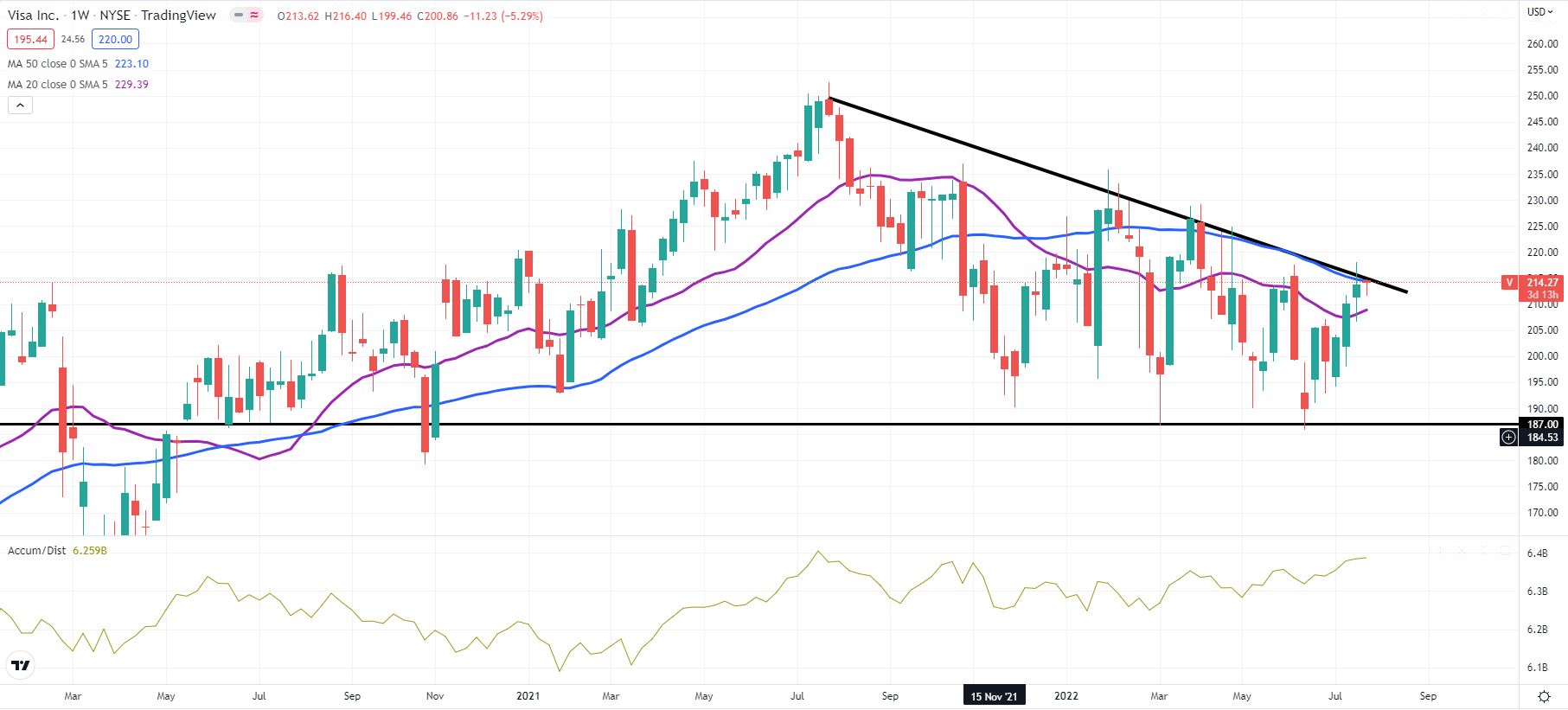
Visa weekly chart
Premium
You have reached your limit of 3 free articles for this month.
Start your subscription and get access to all our original articles.
Author
Clay Webster
FXStreet
Clay Webster grew up in the US outside Buffalo, New York and Lancaster, Pennsylvania. He began investing after college following the 2008 financial crisis.

















