USD/MXN soars above the 20-DMA scores weekly gains after Banxico’s pause
- USD/MXN eyes its first weekly gain since April 28, currently trading at 17.7767, as risk-off sentiment prompts outflows from the emerging market Peso.
- US Treasury Secretary Janet Yellen’s comments and Fed Chair Jerome Powell’s remarks on inflation triggered a shift towards safe-haven assets like the US Dollar.
- Banxico’s halt on its rate hike cycle and weaker-than-expected Mexican Retail Sales data contribute to the weakening of the Mexican Peso.

USD/MXN rises above the 20-day Exponential Moving Average (EMA) as the pair eyes its first weekly gain since April 28, up more than 1%, ahead into the weekend. The Mexican Peso (MXN) weakened after Banxico’s halted its tightening cycle, while solid US data justifies another interest rate increase by the Fed in June. At the time of writing, the USD/MXN is trading at 17.7767, up 0.30%.
USD/MXN fundamental backdrop: US Dollar strengthens as the Mexican Peso falters on safe-haven flows
Sentiment turned negative since the mid-North American session, as Wall Street closed with modest losses. Commentaries on Thursday by US Treasury Secretary Janet Yellen to bank CEOs that more merges may be necessary after a series of bank failures spooked investors. Therefore flows towards safe-haven assets triggered outflows from the emerging market Peso towards the US Dollar safety.
Aside from this, Federal Reserve commentary throughout the week was split between dovish and hawkish commentary. However, on Friday, Federal Reserve Chair Jerome Powell said that inflation is far above the objective and emphasized the Fed is strongly committed to returning inflation to the 2% objective, adding “failure would cause greater harm.” Powell said the banking system is robust, and rates may not rise as otherwise due to tightening banking credit conditions.
According to Bloomberg, US House Speaker Kevin McCarthy paused negotiations regarding the US debt ceiling negotiations, blaming the White House for “resisting spending cuts, casting doubt on efforts in Washington to avert a catastrophic default,” according to Bloomberg.
On the Mexican Peso front, Banxico decided to pause its 725 bps of rate hikes, mentioning that the economy is going through a disinflationary process as many pressures have eased. Nevertheless, Mexico’s central bank said that it would keep the main reference rate at its current level for an extended period.
Must read: Mexico: After 15 consecutive hikes, central bank keeps key rate unchanged at 11.25%
Data-wise, the Mexican economic docket reported that March’s Retail Sales jumped by 2.5% YoY, below estimates of 2.9%, and trailed February’s 3.4% advance. Monthly based, sales stood at 0%, below the 0.1% expected.
USD/MXN Price Analysis: Technical outlook
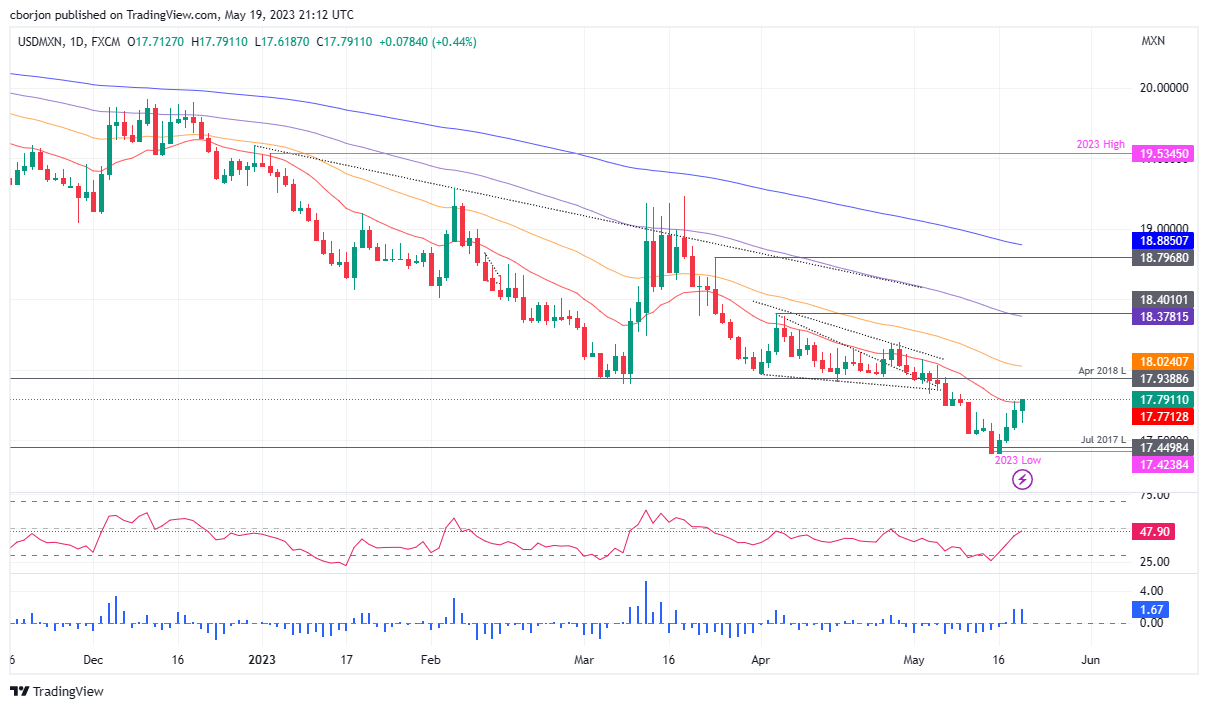
From a technical perspective, the USD/MXN downtrend remains intact, but Friday’s close above the 20-day Exponential Moving Average (EMA) at 17.7712 opened the door for further gains. Upside risks lie at the April 2018 daily low of 17.9388, followed by the 18.0000 psychological level and the 50-day EMA at 18.0240. On the flip side, bears appear to remain in charge, as the Relative Strength Index (RSI) indicator stays at bearish territory but is about to cross into a bullish area. If USD/MXN resumes downwards, the first support would be the May 19 low at 17.6187, followed by the May 18 low of 17.5757, before clashing the 17.5000 area.
Author

Christian Borjon Valencia
FXStreet
Markets analyst, news editor, and trading instructor with over 14 years of experience across FX, commodities, US equity indices, and global macro markets.















