|

USD/MXN climbs as investors brace for the Fed’s decision and eye Mexican inflation

  • USD/MXN trades at 17.1182, rebounding from a daily low of 17.0296, as markets anticipate key central bank decisions this week.
  • US Federal Reserve expected to hold rates steady, but last week’s uptick in inflation keeps options open; traders await updated ‘dot-plots.’
  • Mexican Private Consumption slows to 4.3% YoY in Q2 2023, while upcoming data could show a decline in Retail Sales and a slowdown in inflation.

The Mexican Peso (MXN) loses ground versus the Greenback (USD) on Monday, ahead of a busy week in the central bank space, as three of the most important are set to deliver their decisions. At the time of writing, the USD/MXN is trading at 17.1182 after printing a daily low of 17.0296.

Mexican Peso weakens against the US Dollar ahead of a pivotal week for central banks, with focus on the Fed’s ‘dot-plots’ and inflation data

Investors’ mood depreciated the Mexican currency as the US Federal Reserve (Fed) is expected to deliver its decision on Wednesday, at around 18:00 GMT, followed by Jerome Powell’s press conference. According to data, the swaps market sees the Fed holding rates unchanged, at 5.25%-5.50%, thought would likely keep their options open due to last week’s inflation uptick. USD/MXN traders would look at the update of the so-called ‘dot-plots.’

The US economy witnessed a slight jump in consumer and producer price indices. As fewer Americans filed for unemployment benefits, the jobs market remains hot. That was depicted by Retail Sales, which expanded at a slower rate, while consumer sentiment deteriorated, blamed on high gasoline prices. Notably, inflation expectations were pushed lower, as revealed by the University of Michigan.

On the Mexican front, Private Consumption in Mexico grew by 4.3% YoY in Q2 2023, below the previous reading of  4.8%, according to figures revealed by the Instituto Nacional de Estadistica Geografia e Informatica (INEGI).

Sentiment amongst investors improved as Chinese data witnessed the economy has found its bottom after the Government’s efforts to stimulate the economy, which faltered to recover as expected by most financial market analysts.

In the week ahead, the US economic docket will feature housing data, \the Fed’s decision, jobs data, and S&P Global PMIs. Retail Sales are expected to deteriorate on the Mexican front, while inflation for the first half of September is foreseen to slow down.

USD/MXN Price Analysis: Technical outlook

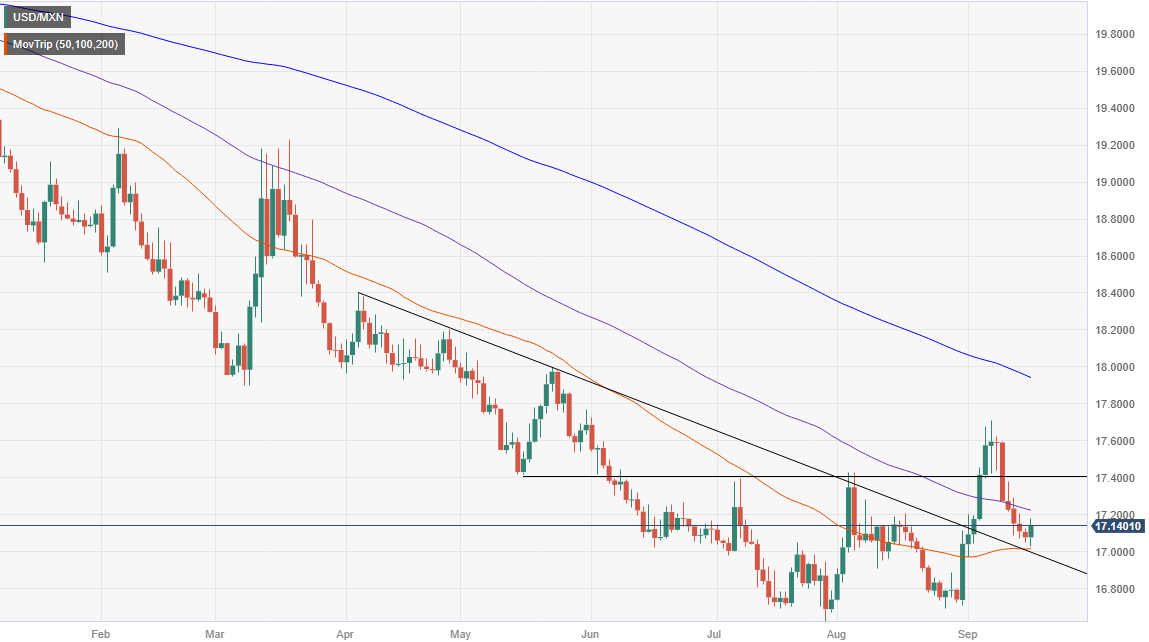
The pair found its foot at around 17.0297 before testing the 50-day Moving Average (DMA), which has risen above the 20-DMA at 17.0992, exacerbating a test of the 100-DMA at 17.2188. A breach of the latter will expose the 17.50 area, followed by the September 7 swing high at 17.7074. ahead of challenging the 18.0000 psychological level. Conversely, if the pair slides toward the 20-DMA, it could pave the way for a crack under 17.0000. The next support will emerge at August’s 28 daily low of 16.6923.
USD/MXN

Overview
Today last price17.1363
Today Daily Change0.0581
Today Daily Change %0.34
Today daily open17.0782
 
Trends
Daily SMA2017.0986
Daily SMA5017.015
Daily SMA10017.2333
Daily SMA20017.9561
 
Levels
Previous Daily High17.1269
Previous Daily Low17.0504
Previous Weekly High17.5959
Previous Weekly Low17.0504
Previous Monthly High17.4274
Previous Monthly Low16.6945
Daily Fibonacci 38.2%17.0796
Daily Fibonacci 61.8%17.0977
Daily Pivot Point S117.0434
Daily Pivot Point S217.0087
Daily Pivot Point S316.9669
Daily Pivot Point R117.1199
Daily Pivot Point R217.1617
Daily Pivot Point R317.1964

Author

Christian Borjon Valencia

Markets analyst, news editor, and trading instructor with over 14 years of experience across FX, commodities, US equity indices, and global macro markets.


More from Christian Borjon Valencia
Share:

Editor's Picks

AUD/USD eyes 0.7000 on softer USD, ahead of Chinese data

AUD/USD consolidates below 0.7000 in Wednesday’s Asian session, ahead of China's inflation and trade balance data. However, focus will be on the US consumer inflation figures, which will drive the US Dollar and provide a fresh impetus. Meanwhile, the recent pullback in US bond yields keeps the USD below an 18-month low, though hawkish Fed and geopolitical risks limit losses, capping the currency pair.

USD/JPY consolidates below 158.50; looks to US CPI for fresh impetus

USD/JPY steadies below mid-158.00s during the Asian session on Wednesday, with looming intervention risks supporting the Japanese Yen and capping the upside amid a softer US Dollar. However, geopolitical uncertainties act as a tailwind for the safe-haven USD and the currency pair. Traders also seem hesitant ahead of the release of the latest US consumer inflation figures.

Gold holds steady above $4,150 as traders await US CPI report

Gold is seen oscillating in a narrow band above $4,150 during the Asian session on Wednesday, awaiting US consumer inflation figures for more cues about the Fed's policy path. Meanwhile, expectations of at least one more Fed rate hike this year cap the non-yielding bullion. However, a softer US Dollar, weighed down by the recent pullback in US bond yields, helps limit the downside for the commodity.

Strategy bitcoin buying model faces scrutiny as STRC costs climb
Strategy’s (MSTR) STRC financing strategy increased its Bitcoin (BTC) holdings in H1, but made its capital structure more expensive, prompting an examination of its effectiveness, according to a Tuesday report by K33. STRC recovered close to its $100 par value, closing at $99.90 after an extended period of heavy buybacks.
S&P 500 earnings just hit a record. The AI data centre bill hasn't landed yet
S&P 500 companies are on track for a third straight quarter of earnings growth above 25%, according to FactSet. Their profit margin hit 17% in the April-June quarter, the highest in FactSet data going back to 2009. The cash behind those earnings has been shrinking for two years, and almost all of the shrinkage is in the handful of companies building data centres for artificial intelligence (AI).
Has Bitcoin really escaped the macro forces it was built to fight?
Over 17 years ago, Satoshi Nakamoto designed Bitcoin (BTC) on the back of a global financial crisis as an alternative to the global monetary system outside the control of central banks, governments and traditional intermediaries. This raises a key question: has Bitcoin really become independent of the macroeconomic forces it was built to challenge?















