USD/JPY rallies on technical bounce on Friday
- USD/JPY rebounded 0.6% on Friday as the Greenback stiffens.
- The pair gave a tidy technical bounce from a key moving average.
- Markets are broadly pivoting back into Fed rate cut hopes.

USD/JPY rallied on Friday, gaining six-tenths of one percent and snapping a two-day losing streak as the Greenback finds broad-market support and bolsters the Dollar-Yen pairing from a fresh tap of the 50-day Exponential Moving Average (EMA).
The US Dollar broadly gained ground on Friday as the Greenback gets bolstered by declining US Treasury yields in the face of renewed bets of Federal Reserve (Fed) rate cuts in 2025. Key segments of US inflation figures eased slightly throughout the week, reinvigorating hopes that price growth pressure will ease enough to push the Fed toward delivering rate cuts earlier in the first half of the year than previously expected.
The Bank of Japan’s (BoJ) next rate call is due early next Friday, where the normally-hyperdovish Japanese central bank is expected to raise interest rates by another 25 bps. US Purchasing Managers Index (PMI) activity survey results are also expected next Friday, but the runup to the key events are a notably sedate data docket on the cards, leaving investors to focus on jawboning from policymakers.
USD/JPY price forecast
USD/JPY gave a tidy technical bounce from the 50-day EMA on Friday, bouncing from 155.00 and setting up Greenback bulls for a fresh run up the charts after snapping a two-day backslide. The immediate ceiling is still priced in near the 159.00 handle.
Even if the pair rotates into a fresh bullish stance, there is still plenty of room to run before the Dollar-Yen pair runs into record highs set in 2024 near 162.00. There is a hard limit on how high Dollar bulls can run the pair before the BoJ begins getting nervous again and hovering one hand over the intervention button.
USD/JPY daily chart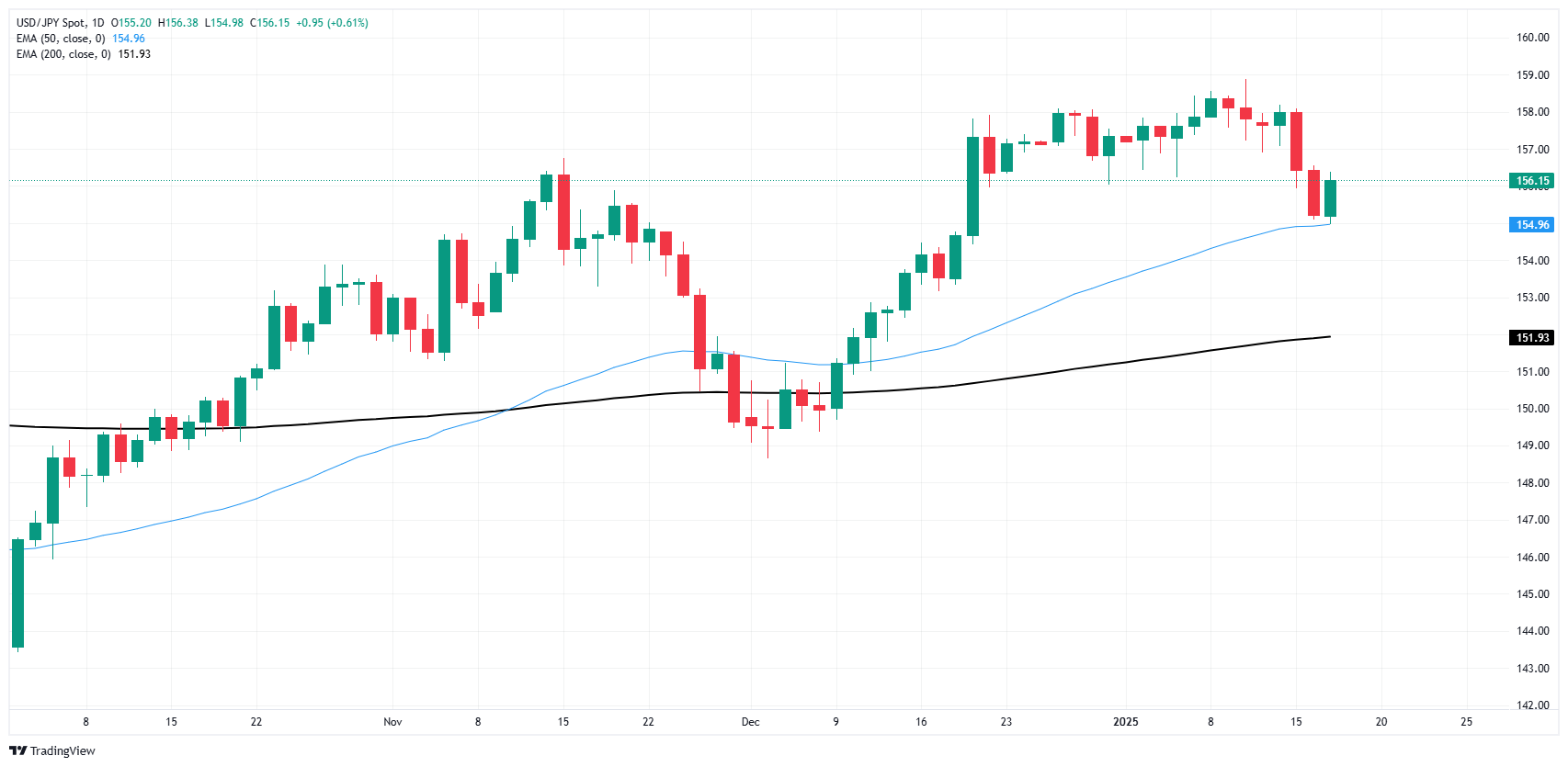
Japanese Yen FAQs
The Japanese Yen (JPY) is one of the world’s most traded currencies. Its value is broadly determined by the performance of the Japanese economy, but more specifically by the Bank of Japan’s policy, the differential between Japanese and US bond yields, or risk sentiment among traders, among other factors.
One of the Bank of Japan’s mandates is currency control, so its moves are key for the Yen. The BoJ has directly intervened in currency markets sometimes, generally to lower the value of the Yen, although it refrains from doing it often due to political concerns of its main trading partners. The BoJ ultra-loose monetary policy between 2013 and 2024 caused the Yen to depreciate against its main currency peers due to an increasing policy divergence between the Bank of Japan and other main central banks. More recently, the gradually unwinding of this ultra-loose policy has given some support to the Yen.
Over the last decade, the BoJ’s stance of sticking to ultra-loose monetary policy has led to a widening policy divergence with other central banks, particularly with the US Federal Reserve. This supported a widening of the differential between the 10-year US and Japanese bonds, which favored the US Dollar against the Japanese Yen. The BoJ decision in 2024 to gradually abandon the ultra-loose policy, coupled with interest-rate cuts in other major central banks, is narrowing this differential.
The Japanese Yen is often seen as a safe-haven investment. This means that in times of market stress, investors are more likely to put their money in the Japanese currency due to its supposed reliability and stability. Turbulent times are likely to strengthen the Yen’s value against other currencies seen as more risky to invest in.
Author

Joshua Gibson
FXStreet
Joshua joins the FXStreet team as an Economics and Finance double major from Vancouver Island University with twelve years' experience as an independent trader focusing on technical analysis.














