|

USD/JPY Price Analysis: Long-term trend at risk of reversing

  • USD/JPY has fallen to key make-or-break support for the pair. 
  • A break below could indicate a change of the long-term trend and more downside. 

USD/JPY has weakened over the last three weeks and reached support at a key price level on the charts, roughly in the 151.80s – which coincides with the October 2022 and 2023 highs. 

USD/JPY Weekly Chart 
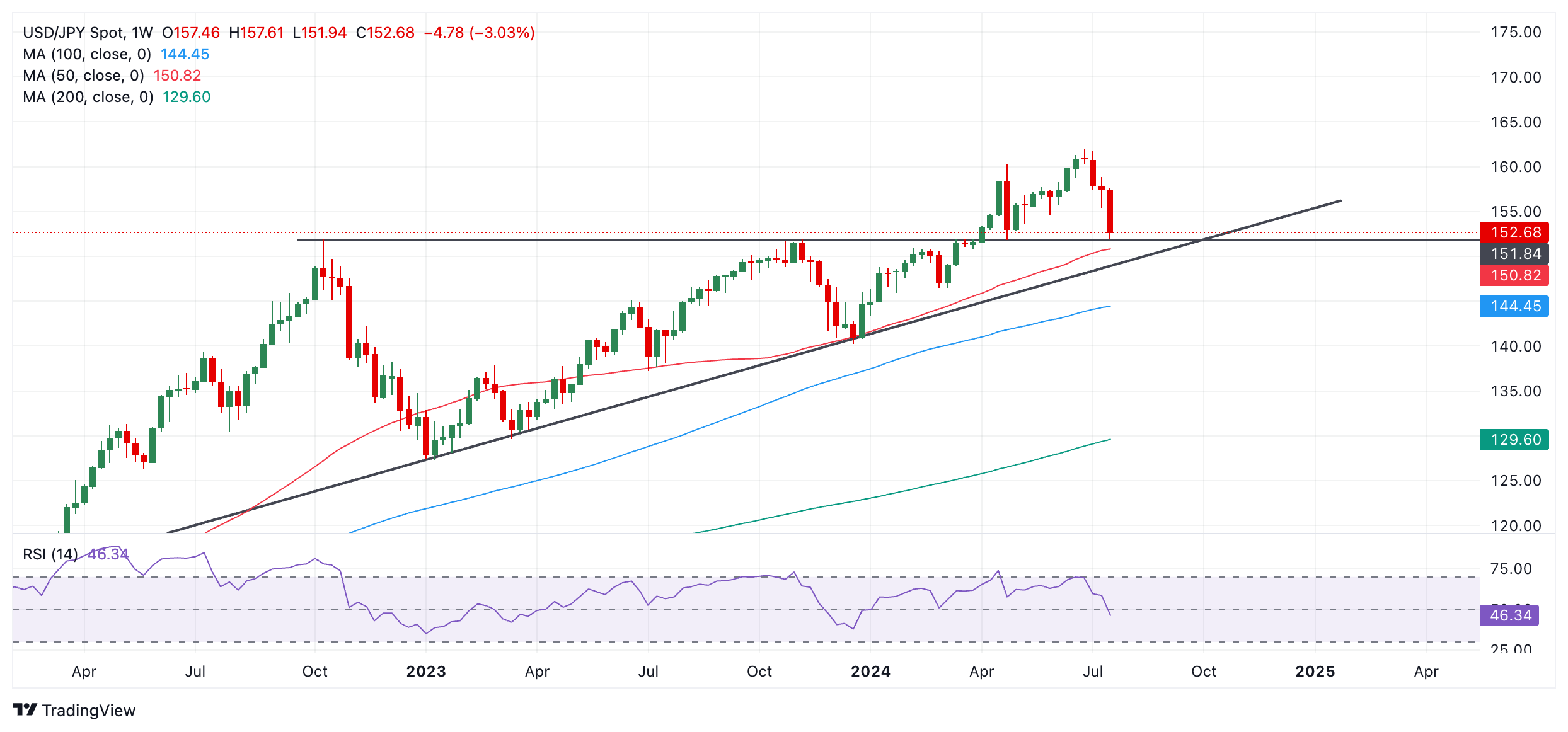
  

The long-term trend remains bullish suggesting the odds on balance favor a recovery, however, there are no signs yet from price action that this is the case. USD/JPY keeps going lower. In addition, if this week ends as a long red candlestick (we are already halfway through Thursday) the weekly chart will have formed an ominous Three Black Crows Japanese candlestick pattern, with bearish implications. 

The current support level is very significant and represents a crossroads for price. A recovery bounce from here might indicate the longer-term uptrend was resuming. On the other hand a break below would bring the long-term uptrending bias into doubt. 

Further, a break below the 50-week Simple Moving Average and a decisive break below the major trendline for the uptrend situated at roughly 149.50, would confirm a reversal in the long-term trend. Such a break would open up downside targets at roughly 141.60, followed by 136.85. 

A decisive break would be one in which USD/JPY broke clearly below the trendline with a long red candlestick that closed near its low, or three red candlesticks in a row. 

Price would need to form a bullish reversal pattern at the current level for confidence the longer-term uptrend was resuming. This could be a Japanese Hammer or a Two-Bar reversal, for example. This would then indicate prices might recover and retouch the 161.95 high (June 28), and perhaps even make a new higher high.

Author

Joaquin Monfort

Joaquin Monfort is a financial writer and analyst with over 10 years experience writing about financial markets and alt data. He holds a degree in Anthropology from London University and a Diploma in Technical analysis.


More from Joaquin Monfort
Share:

Editor's Picks

AUD/USD consolidates above 0.7000; remains close to monthly top

AUD/USD holds steady above 0.7000 during the Asian session on Friday, trading just below the previous day's monthly low amid diverging forces. A hawkish RBA continues to support the Aussie, while the recent decline in US bond yields keeps the US Dollar depressed near a three-week low. However, oil-driven inflation fears reinforce Fed hike bets, which, along with geopolitical risks, could benefit the safe-haven buck and cap the currency pair.

USD/JPY bounces off one-month low; climbs to 157.00 amid reviving USD demand

USD/JPY rebounds from the 156.00 neighborhood, or a one-month low touched during Friday’s Asian session, with bulls looking to extend momentum beyond 157.00 amid the emergence of some US Dollar buying. Meanwhile, Japan's National CPI rose to a nine-month peak and reaffirmed BoJ rate-hike bets, which could support the Japanese Yen and cap gains for the currency pair.

Gold hits fresh three-month low below $4,000 amid surging energy prices

Gold slides to a fresh three-month low at $3,986.74 in the Asian trade on Friday. The precious metal faces intense selling pressure, following a consolidation breakdown that took place on the range between $4,227.90 and $4,066.64 in the past three weeks.


Cardano: Whale selling deepens correction
Cardano (ADA) edges higher by nearly 2% on Friday, following a roughly 6% decline the previous day. The pullback aligns with the sell-side appeal among large-wallet investors, commonly referred to as whales, and Cardano derivatives. The technical outlook for ADA is bearish, with downside momentum persisting. Whales are losing their appetite for holding ADA tokens, fueling near-term selling pressure.
The Bank of England just got its clearest reason to hike. Here's what it's really watching

UK inflation as measured by the CPI accelerated to 3.5% YoY in September, up from 3.1% in August, according to the Office for National Statistics. This is the highest level since October 2025, exceeding economists' expectations of 3.4% and pushing inflation further from the BoE's 2% target.

What November 3 means for the Fed's rate path and the US Dollar

The USD faces a decisive period ahead of the November 3 midterm elections. While markets anticipate another interest rate increase from the Fed in December, the battle for control of Congress could reshape fiscal policy expectations and, indirectly, the path of US monetary policy in 2027.