|

USD/JPY bears print a 4-week low

  • USD/JPY sinks as US yields fall out of the sky. 
  • The Credit Suisse crisis is roiling markets and supporting the safe havens.

USD/JPY sank to a 4-week low on Wednesday while US and European yields tumble in the face of a slide in the European banking index that fell in its biggest one-day drop in nearly 13 months. Credit Suisse's 2022 annual report was published on Tuesday and it cited "material weaknesses" in its internal controls over financial reporting, noting that it had not yet stemmed customer outflows. This has provoked a flight to safety in financial markets, massaging the downside in USD/JPY. 

At the time of writing, USD/JPY is done by over 0.7% but off the lows of the day that were printed at 132.21. The currency pair dropped from a high of 135.11 in the Europen session and is back to trading at around 133.30 at the time of writing. Two-year Treasury notes have dropped 98 basis points in the last five days, the biggest drop since the week of Black Monday on Oct. 19, 1987.

Markets are now pricing in an 80% chance of a 25 basis point Federal Reserve hike next week. Investors are also pricing in a 50% chance of no change. Moreover, the December Fed funds futures, which reflect the overnight rate that banks use to lend to each other has dropped to 3.62% in a sign market expect the Federal Reserve to be cutting interest rates by year's end, if not before.

USD/JPY weekly chart
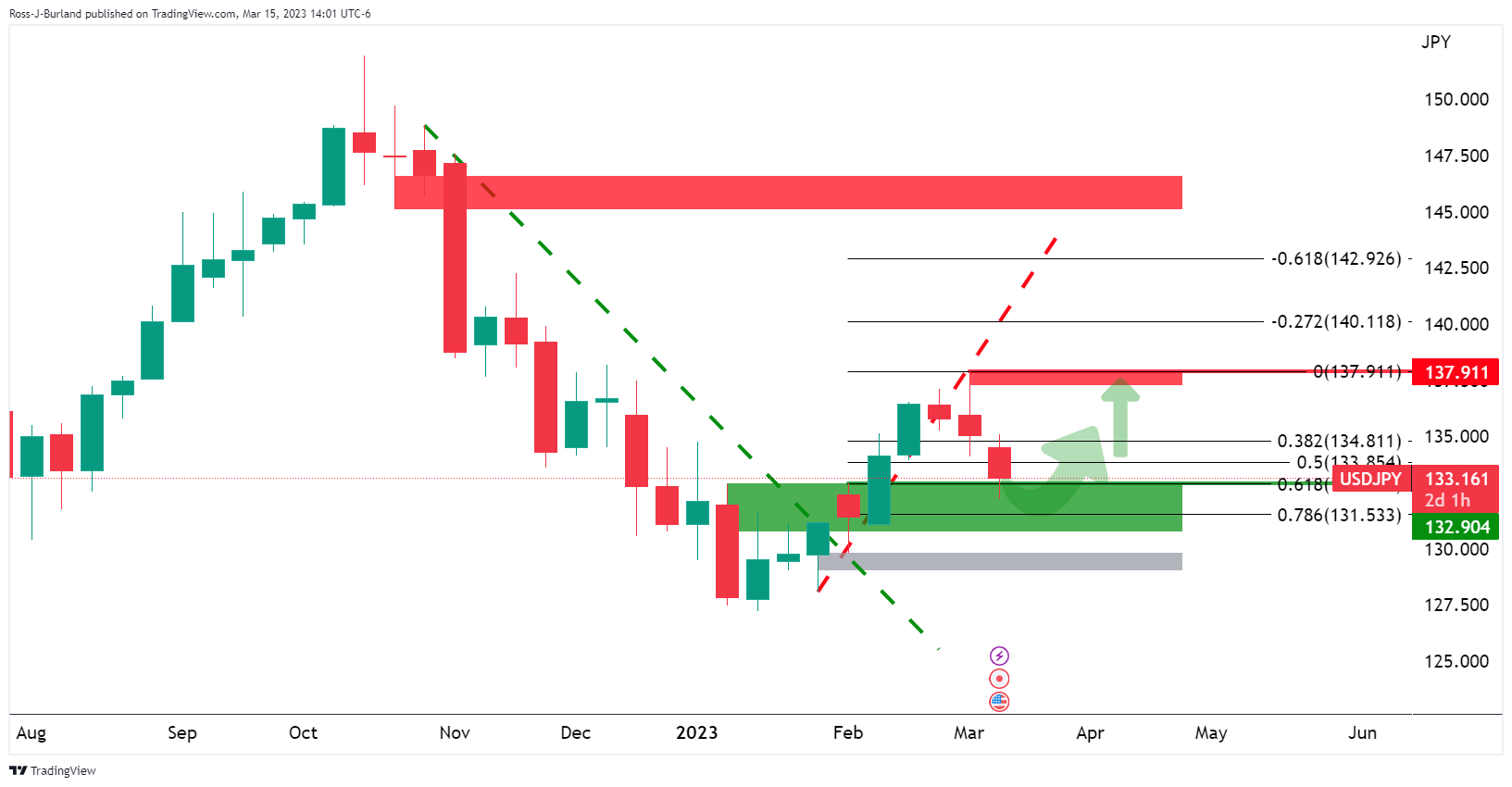
The price is meeting a potential support zone in this correction into the 61.8% Fibonacci retracement of the price´s bullish impulse. A bullish could be started to be built if a bullish structure should emerge on the lower time frame over the course of the next few sessions and/or days.

Author

Ross J Burland

Ross J Burland, born in England, UK, is a sportsman at heart. He played Rugby and Judo for his county, Kent and the South East of England Rugby team.


More from Ross J Burland
Share:

Editor's Picks

AUD/USD holds the bounce near 0.7050 after China trade data

AUD/USD is holding the bounce from two-month lows, retesting 0.7050 in the Asian session on Tuesday. Easing tensions in the Middle East keep the US Dollar on the defensive, supporting the pair amid China's trade surplus expansion in May.

USD/JPY consolidates above 160.00 amid intervention fears, Israel-Iran ceasefire

USD/JPY holds steady above 160.00 during the Asian session on Tuesday as expectations that authorities will step in again to prop up the Japanese Yen hold back bulls from placing fresh bets. Moreover, a de-escalation of tensions between Israel and Iran undermines the safe-haven US Dollar, capping the currency pair. Traders also seem hesitant and opt to wait for the release of the latest US inflation figures on Wednesday and Thursday.

Gold rebounds but not out of the woods yet

Gold holds the rebound above $4,300 early Tuesday after hitting three-month lows at $4,269. The US Dollar eases amid doubts over the Mideast truce situation, traders cash in ahead of Wednesday’s US CPI. Downside risks remain intact for Gold whilst below the 200-day SMA and amid bearish daily RSI.

XRP and XLM outlook: Fragile recovery as traders favor downside

Ripple and Stellar remain under pressure on Tuesday after a mild recovery following a massive correction in the previous week. Weakening derivatives positioning, alongside mixed on-chain data for both XRP and XLM, suggests that any recovery rallies are likely viewed as corrective within a broader bearish context. Derivatives data shows a bearish tilt.

The market dodged the Oil shock, but the rate trap is still set

Monday’s bounce was relief, not confirmation. Oil backed away from the geopolitical cliff, tech found a bid, and risk assets stabilized, but the late-day fade showed that conviction remains thin. The real threat is no longer just Middle East escalation.

The US economy defies the rules: 100 days into the Oil shock and the recession signal is still missing

More than three months after the start of the Iran war and the resulting disruption to global energy markets, the US economy continues to display remarkable resilience. The conflict has triggered a sharp rise in Oil prices, reignited inflationary pressures and fueled widespread concerns about a potential economic slowdown.