USD/CAD steps lower into 1.3580 as Greenback recedes from recent bullish momentum
- The USD/CAD is seeing a sell-off on possible profit-taking volumes.
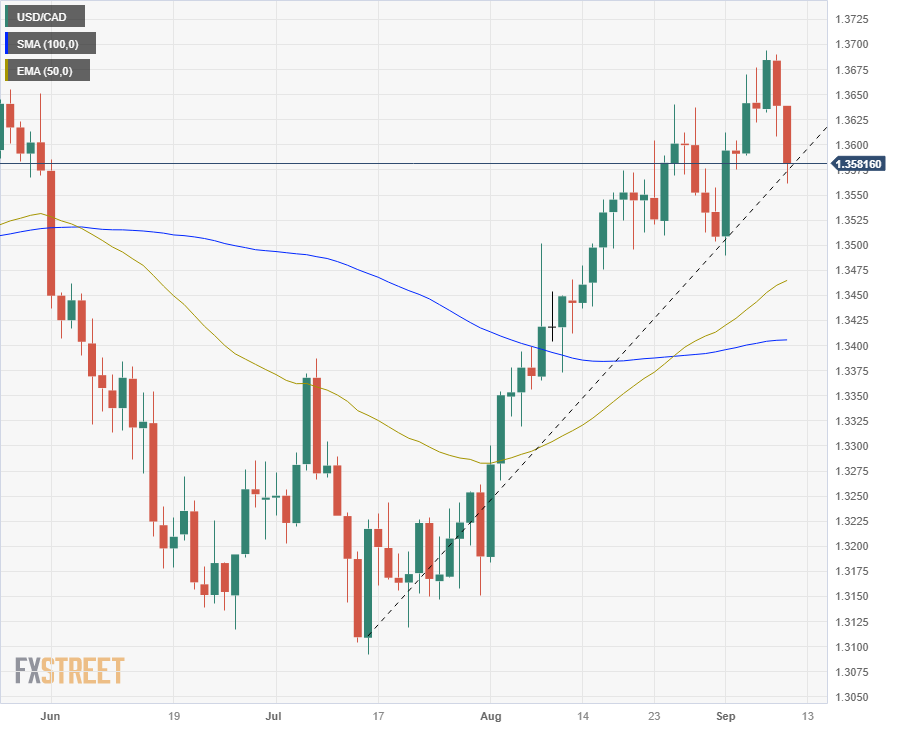
- Resistance is being provided by a rising trendline on daily candles.
- Rising oil prices on supply constraint worries providing a floor on extended Loonie losses.

The USD/CAD pair has taken a step lower for Monday, slipping from 1.3640 into the 1.3580 level, with the Greenback (USD) on the back foot as the USD gives up some of its recent gains across the broader market.
Monday has been a light day for major market catalysts on the US Dollar side, but recent bouts of risk-off market sentiment that sent investors scurrying into the Greenback on global economy concerns could be seeing some profit-taking.
The week is far from over, however, and Wednesday will see US Consumer Price Index (CPI) data dropping on mid-week markets. Headline CPI for the month of August is forecast to come in higher at 0.5% compared to the previous read of 0.2%, representing an uptick in inflationary pressures, while the core CPI figure for the same figure is forecast to hold steady at 0.2%.
Oil prices rise as supply concerns evolve, could support CAD as trading week continues
The Loonie (CAD) has been supported by bolstered crude oil prices of late, with extended oil production cuts from both Russia and Saudi Arabia extended into the end of the year, and continued oil supply constraint concerns are building a hard floor underneath the CAD.
Despite this, the USD/CAD pairing is holding on the upside for September, still well above the month’s opening prices near 1.3510. The Dollar-Loonie rate saw a firm lift into the 1.3690 region on soured risk appetite, but action is steadily declining into a comfortable zone near 1.3580.
USD/CAD technical outlook
Further upside will be capped by firm resistance from the 1.3600 major handle, while any extensions to the downside will see a bit of a support vacuum until facing a near-term floor at 1.3500.
USD/CAD 4-hour chart
Author

Joshua Gibson
FXStreet
Joshua joins the FXStreet team as an Economics and Finance double major from Vancouver Island University with twelve years' experience as an independent trader focusing on technical analysis.