|

USD/CAD Price Forecast: Still too early to say a reversal of the downtrend is unfolding

  • USD/CAD is showing bullish signs but lacks upside momentum and remains in a downtrend. 
  • It would have to rise more strongly and break above some key levels to indicate a reversal of the dominant bear trend. 

USD/CAD is showing some bullish reversal insignia but it is still too soon to be confident that bulls are back in the driving seat. 

The risks, therefore, continue to be to the downside as the bear trend remains intact. A break below the 1.3440 lows would extend the downtrend, possibly to the next target at 1.3380. 

USD/CAD Daily Chart
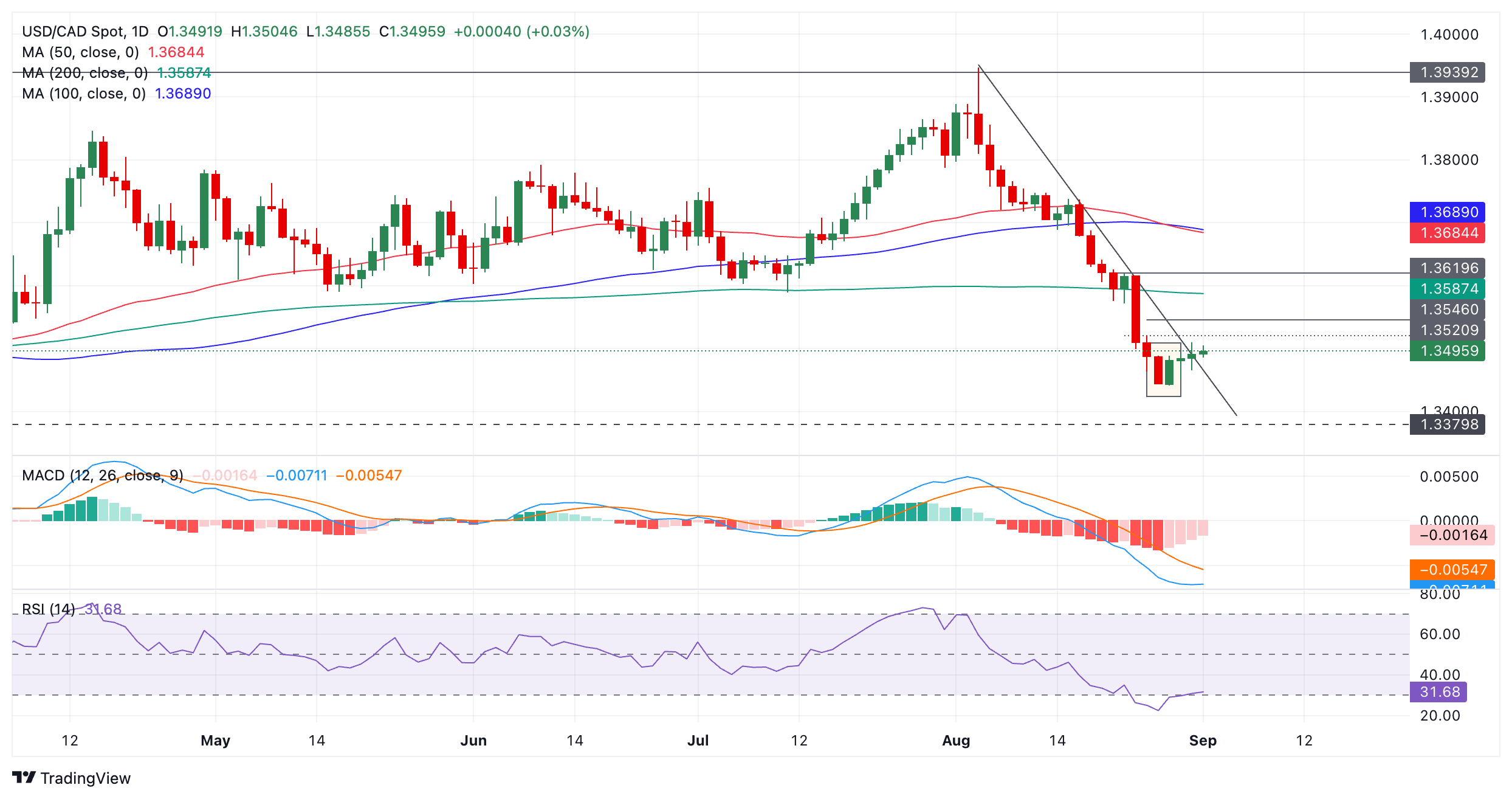
USD/CAD formed a Two-Bar reversal pattern at the August 27 and 28 lows (rectangle on chart). This pattern indicates a short-term reversal higher. The pattern occurs at the end of a down move when a long red candle is followed by a green candle of a similar shape and size. It was followed by two small up days. 

USD/CAD also broke above the trendline for the move down and this was accompanied by the Relative Strength Index (RSI) momentum indicator rising out of its oversold zone, and providing a buy signal. This adds further evidence to the possibility of a reversal evolving. 

A close above 1.3520-25 would help confirm a bullish reversal and bring into doubt the validity of the bear trend. Such a break might see the pair move up to 1.3593. A move above the latter would give a surer sign of a reversal of the trend.  

The recovery has been sluggish and weak so far, however, and there is every possibility the bear trend could resume. A break back down below the trendline would indicate renewed weakness. The next bearish target is situated at 1.3380 – the swing lows of October 2023 and January 2024. This is followed by the bottom of the range at 1.3222. 

Author

Joaquin Monfort

Joaquin Monfort is a financial writer and analyst with over 10 years experience writing about financial markets and alt data. He holds a degree in Anthropology from London University and a Diploma in Technical analysis.


More from Joaquin Monfort
Share:

Editor's Picks

AUD/USD hits nine-week lows below 0.7000 on RBA Bullock's remarks

AUD/USD reverses a brief uptick and turns lower to hit nine-week lows below 0.7000 in the European morning on Tuesday, as traders digest cautious remarks from Reserve Bank of Australia (RBA) Governor Michele Bullock during the press conference. Earlier on, the RBA raised the cash rate to 4.60%, as widely expected, leaving the door open to further rate hikes if needed.

USD/JPY consolidates near 157.50 as a bullish USD counters intervention risks

USD/JPY struggles to capitalize on the overnight bounce from a one-week low, consolidating around 157.50 in the Asian session on Tuesday. Trump's concerns about the Japanese Yen's weakness fueled speculation about another US-Japan joint intervention. This, along with the hawkish BoJ, underpins the JPY and caps the currency pair. Meanwhile, rising Fed rate-hike bets and oil-driven inflation fears continue to push US bond yields to multi-year highs, keeping the US Dollar pinned near a two-month high and supporting the pair.

Gold seems vulnerable near eight-week low amid Fed hike bets

Gold struggles to capitalize on a modest Asian session uptick, trading near its lowest level since August 4, around the $4,100 neighborhood, touched the previous day. Moreover, the bearish fundamental backdrop suggests that the path of least resistance for the precious metal remains to the downside.

Chainlink trims gains after CCIP 2.0 launch, Swift ledger integration

Chainlink (LINK) edges below $15.00 on Tuesday, trimming its 10% gains from the previous day, driven by the launch of its new Cross-Chain Interoperability Protocol 2.0 and Swift ledger integration for tokenized deposits and 24/7 cross-border payments.

Focus turns to US job openings
In the euro area, focus turns to the September flash inflation print for Spain which will give the first indication of where the euro area data on Friday lands. We expect a modest rise in headline due to higher energy costs and a small increase in core inflation. We also receive the European Commission's business survey for September.
Fed vs BoJ: Both hiked. The market only believes one of them – and the chart shows which

The Fed and the BoJ have just done something remarkably similar. Both central banks raised interest rates by 25 bps last week, both are confronting inflation risks, and both signal that future decisions will depend on incoming economic data.