|

USD/CAD Price Analysis: Multiple upside barriers to challenge the bulls

  • USD/CAD extends declines from the monthly top.
  • The mid-month tops, the immediate ascending trend line on sellers’ radar.
  • 50-day SMA, 61.8% Fibonacci retracement hold the key to 200-day SMA.

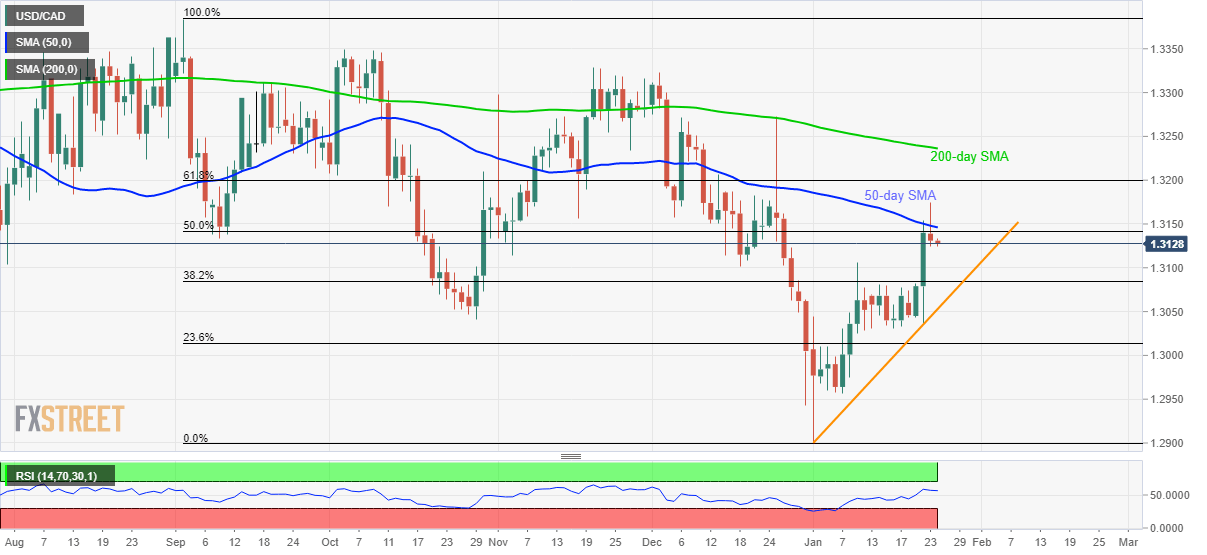
Following its pullback from the monthly top, USD/CAD drops to sub-1.3130 area during the pre-Europe session on Friday. The pair recently failed to cross 50-day SMA, not to forget 50% Fibonacci retracement level of September 2019 to January 2020 fall.

Sellers now target multiple highs marked during the middle of the month around 1.3080. However, an upward sloping trend line since January 01, at 1.3050, could question further declines.

On the upside, 50% Fibonacci retracement and 50-day SMA will guard the near-term recovery around 1.3140/50, a break of which could escalate the run-up towards 61.8% Fibonacci retracement level of 1.3200.

If at all the bulls manage to keep the sentiment intact beyond 1.3200, a 200-day SMA level of 1.3240 could return to the charts.

USD/CAD daily chart
Trend: Pullback expected

additional important levels

Overview
Today last price1.3128
Today Daily Change-3 pips
Today Daily Change %-0.02%
Today daily open1.3131
 
Trends
Daily SMA201.3045
Daily SMA501.3149
Daily SMA1001.3179
Daily SMA2001.3235
 
Levels
Previous Daily High1.3174
Previous Daily Low1.3124
Previous Weekly High1.3081
Previous Weekly Low1.3031
Previous Monthly High1.3322
Previous Monthly Low1.2951
Daily Fibonacci 38.2%1.3143
Daily Fibonacci 61.8%1.3155
Daily Pivot Point S11.3112
Daily Pivot Point S21.3093
Daily Pivot Point S31.3062
Daily Pivot Point R11.3162
Daily Pivot Point R21.3193
Daily Pivot Point R31.3212

Author

Anil Panchal

Anil Panchal

FXStreet

Anil Panchal has nearly 15 years of experience in tracking financial markets. With a keen interest in macroeconomics, Anil aptly tracks global news/updates and stays well-informed about the global financial moves and their implications.


More from Anil Panchal
Share:

Editor's Picks

AUD/USD weakens to two-week lows near 0.6960

AUD/USD clinches its second consecutive daily pullback as market participants continue to assess the RBA’s rate hike earlier in the day. Indeed, the pair slipped back toward the 0.6960 zone, or multi-day troughs, following the less-hawkish-than-expected message from the RBA after it hiked the OCR by 25 bps, as widely anticipated.

USD/JPY fails near 159.00 amid weak USD, intervention risks

USD/JPY edges lower during Tuesday’s Asian session, reversing part of the previous day's gains to 158.00 as the US Dollar remains depressed amid hopes for Iran diplomacy and ahead of US midterm elections. Meanwhile, intervention risks support the Japanese Yen, though the uncertainty over the timing of the next BoJ rate hike caps gains. This keeps the pair confined within a familiar range and warrants caution before placing directional bets.


Gold struggles near $3,900 as traders assess Middle East developments,US election risks

Gold (XAU/USD) loses momentum on Tuesday as Oil prices rebound after the Wall Street Journal (WSJ) reported a US strike on Iran’s Qeshm Island. At the time of writing, XAU/USD trades around $3,909, down 0.93% on the day.

Crypto Today: Bitcoin, Ethereum, XRP under pressure as investors pull capital

Bitcoin trades downward at $76,566 on Tuesday, testing six-week lows. Ethereum, like Bitcoin, trades under pressure as it consolidates within a narrow support range. Meanwhile, Ripple hovers marginally above $1.25.

US Dollar Index edges up within range with midterm elections front and centre

The US Dollar Index is picking up from session lows but remains within previous ranges, below 102.00. The Greenback is drawing support from hostilities in Iran and higher Oil prices, but US political uncertainty is capping gains.

The 2% inflation target came from a throwaway remark. It now moves trillions
The Federal Reserve's 2% inflation goal grew out of an off-the-cuff remark by a New Zealand politician in 1988. Bond investors still price long-term US debt as if 2% holds, so a change in how the Fed measures inflation would move markets.