USD/CAD dwindles around 1.3550s, awaiting US inflation
- USD/CAD trades nearly flat at 1.3552, as high oil prices offset minor gains in the US Dollar Index (DXY).
- US CPI data due Wednesday could be pivotal; expected at 3.6% YoY, up from July’s 3.2%, with core CPI at 4.3%.”
- Bank of Canada remains cautious; October meeting could see rates held at 5% as mixed economic data looms.

The Canadian Dollar (CAD) dropped on Tuesday’s session against the US Dollar (USD), underpinned by high oil prices, amid the lack of catalyst in the financial markets. With traders bracing for the August US inflation report, we could expect the USD/CAD to trade within a choppy trading range. The USD/CAD is trading at 1.3552, almost unchanged.
Loonie holds steady vs. the US Dollar, ahead of US CPI report for August
On Wednesday, the US Bureau of Labor Statistics (BLS) will reveal the US Consumer Price Index (CPI) report, which is expected to climb above the prior month’s figure. The CPI is estimated at 3.6% YoY, above July’s 3.2%. Excluding volatile items, the so-called core CPI is foreseen at 4.3% YoY, down from July 4.7%.
Even though the Greenback recovered some ground against a basket of six currencies, the US Dollar Index (DXY) finished with minuscule gains of 0.01%, at 104.54. In addition, it failed to bolster the USD/CAD pair, as oil prices finished with gains of more than 1.70%.
Up north across the US border, Canada’s economy has shown mixed data. Although the second quarter Gross Domestic Product (GDP) sounded the alarms of a recession, the latest employment report suggests the economy remains robust.
That triggered a reaction by the Bank of Canada (BoC), who decided to sit on their hands, awaiting more data, before committing to keep rates on hold or opening the door for additional tightening. Interest rate probabilities show the BoC is expected to hold rates at 5% for the upcoming meeting in October 25.
Nevertheless, Tiff Macklem, the BoC’s Governor, stressed that interest rates may not be high enough to tame inflation. He added, “Going forward, we will look for further evidence that price pressures are easing.”
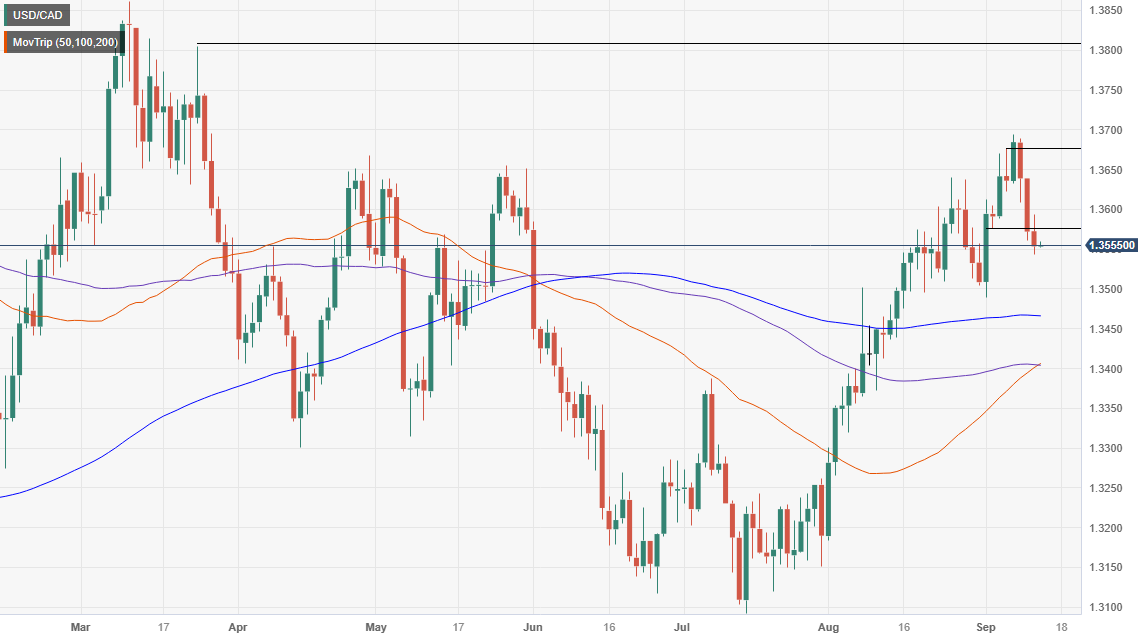
Given the backdrop, if US inflation decelerates in both readings, USD/CAD traders could expect further downside, with sellers eyeing a test of the 200-DMA. Otherwise, speculations the US Federal Reserve would continue to tighten monetary conditions could pave the way for buyers to reclaim 1.3600.
USD/CAD Price Analysis: Technical outlook
After extending its losses for three straight days, the USD/CAD has fallen from around 1.3600 towards the 1.3550s area, closing near the day’s lows. Therefore, the USD/CAD path of least resistance is downwards and will face first support at the current week’s low of 1.3543. Once cleared, the pair could dive to the 1.3500 figure, followed by the 200-day Moving Average (DMA( at 1.3464. On the flip side, the USD/CAD could shift upwards if the pair stages a comeback toward the September 11 high at 1.3593.
Author

Christian Borjon Valencia
FXStreet
Markets analyst, news editor, and trading instructor with over 14 years of experience across FX, commodities, US equity indices, and global macro markets.

















