US dollar moves to the top spot on the CSI on Fed Powell's hawkish pivot
- US dollar and yields have shot higher, extending the post-Fed statement gains during Chair Powell's hawkish pivot.
- Bulls have got behind a faster pace of tightening than what had been priced in.

The Federal Reserve did what was expected from them in the main and there had been low volatility in the currency space as a consequence, until Powell's pivot.
As a consequence of a hawkish turn by the Fed's chairman, Jerome Powell, during the presser, the US dollar has picked up a bid and moves to the first position on the Currency Strength Indicators.
Markets were expecting to be "prepared for liftoff" from the meeting which both the statement and the Fed's chair, Jerome Powell, has done. However, guidance on the likely pace of tightening, via QT (quantitative tightening), as well as the funds rate for the year/years ahead, would have been greater catalysts for markets. This did not come. Instead, there were no definitive signals.
However, Powell has stated in the presser that they could move faster and sooner than they did the last time which has helped the US dollar to extend on pre- presser gains:
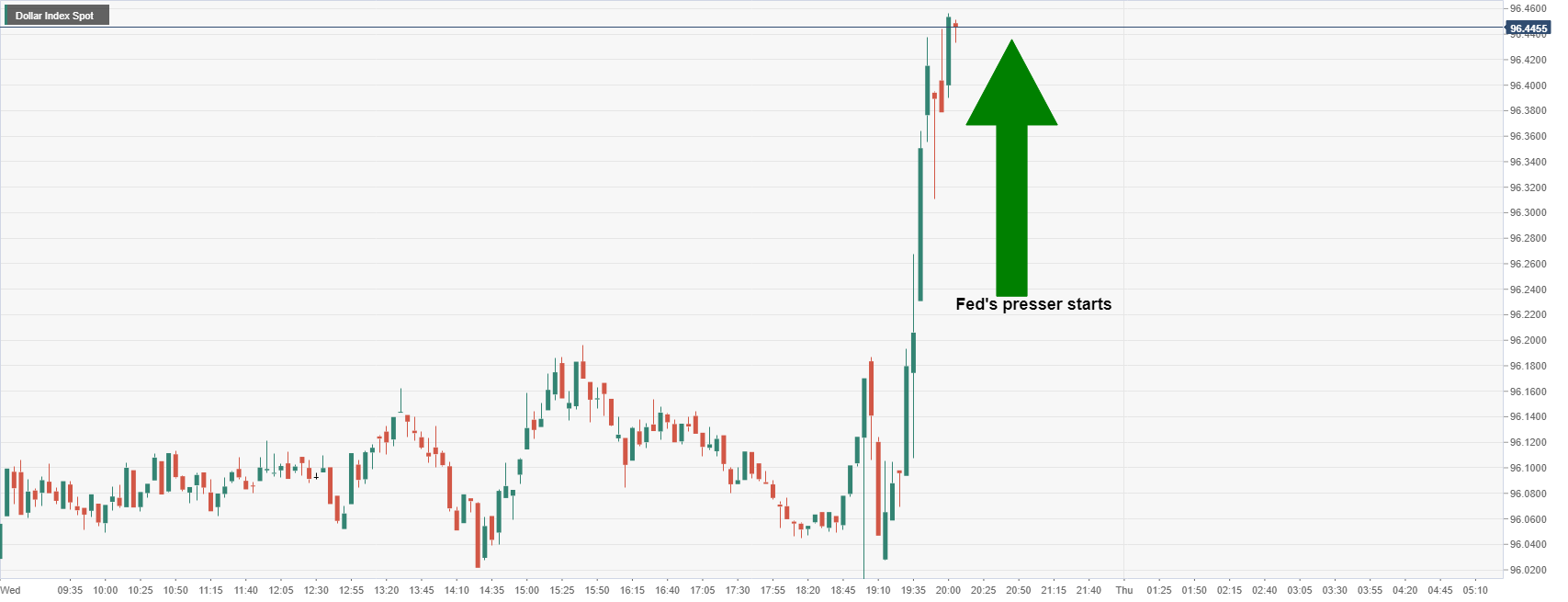
Fed's Powell's key comments, so far
- We are of the mind to raise rates at the March meeting.
- The current economy means we can move sooner, perhaps faster than we did last time.
- The next meeting will be coming to more of the details on the Balance Sheet.
- Other forces this year should also bring down inflation.
- Quite a bit of room to raise rates without dampening employment.
- No decision made on policy path, path to be led by incoming data.
Fed's statement, key takeaways
- A rather mixed and fairly dovish statement ticked some of the boxes as follows:
- As expected, the benchmark interest rate was unchanged; The Target Range stands at 0.00% - 0.25% - Interest Rate on Excess Reserves is also unchanged at 0.15%.
- There were no mentions of early rate hikes, let alone a 50bp hike (which some analysts have been expecting).
- QE is not indicated to end early either and that the balance sheet shrinking would start after rate hikes commence.
- The Fed has warned that soon it will be appropriate to raise rates.
- The Fed has stated that both the economy/employment have strengthened and that jobs gains are solid.
- "Overall financial conditions remain accommodative, in part reflecting policy measures to support the economy and the flow of credit to US households and businesses," is an unchanged statement that indicates we are no closer to lift off than of the prior meeting.
- Subsequent to this statement, Fed's funds futures are looking for four rate hikes for this year.
US yields are up on Fed rate hike expectations
US Treasury yields across the curve shot higher on Wednesday after the Federal Reserve chairman added colour to the statement that said US interest rates would rise "soon", adding that it will end its asset purchase program in early March.
The Fed, however, did not set a specific date for raising interest rates. With that being said, federal funds futures have fully priced in a quarter-point tightening for the Fed's March meeting, and another three hikes for 2022.
However, Fed's chairman Powell was uber hawkish in his comments around raising rates at every meeting. "Quite a bit of room to raise rates without hurting jobs'', he added.
As a consequence, the benchmark US 10-year yield rose to 1.855%. The US 30-year yields were moved to 2.172% and on the front end of the curve, US 2-year yields shot up to 1.095%.
Author

Ross J Burland
FXStreet
Ross J Burland, born in England, UK, is a sportsman at heart. He played Rugby and Judo for his county, Kent and the South East of England Rugby team.

















