Uber Stock Earnings: UBER spike dissipates after beating Q4 consensus
- Uber stock rose nearly 8% at the Wednesdary open before selling down to near flat.
- UBER stock has rallied 38% YTD.
- NASDAQ has declined 0.5% on the back of Powell's hawkish comments.
- Uber issued $482 million worth of stock-based compensation in the quarter.

After opening as high as $37.55, up 7.6%, from Tuesday's close, Uber (UBER) stock quickly shed most of its gains stemming from a consensus beat in its fourth quarter. At the time of writing, UBER stock is trading less than 1% higher. Uber was able to conquer consensus on both the top and bottom lines, but much of the positives had to do with its investment portfolio rather than its core business. Additionally, the company known for its typical heavy losses once again distributed a king's ransom worth of stock-based compensation.
The NASDAQ is at least partially to blame for the sell-off. The index is down 0.5% on Wednesday morning after Federal Reserve Chair Jerome Powell issued less than dovish comments in a speech.
Uber earnings news: $482 million of dilution
On the primary figures, Uber won the day. The eMobility king reported GAAP earnings per share of $0.29. This was a surprising 45 cents ahead of Wall Street's expectations. Revenue too was good at $8.6 billion, which was about $90 million ahead of estimates. Also this revenue figure rose 49% YoY, showing how Uber's international expansion has begun to bear fruit.
The problem comes in how CEO Dara Khosrowshahi made his meat. Adjusted EBITDA (wink, wink) was just 2.2% of gross bookings. Uber fielded losses of $142 million in its core business and $303 million in negative free cash flow. Of course, this was better than the $550 million loss in the same quarter in 2021. Uber made up the difference and achieved GAAP profits by having other income of $767 million, most of which stemmed from investment gains.
Then like most tech companies, Uber does not count its stock-based compensation against its earnings. There was a lot this quarter –$482 million worth. This fortifies the belief among many critics that Uber simply exists to line the pockets of its executives, shareholders be damned.
$UBER has hilarious earnings. 142m in operating loses, disguised by income from equity investments and a nice 482m SBC to boot.
— Mat Roiss (@InvestRoiss) February 8, 2023
Company at over 70b market cap (higher than $PBR or $GLEN).
Don't have a position, but how are you ever going to get a good return from them?
One part of the market was still excited by the outlook though. For the first calendar quarter, Uber expects adjusted EBITDA between $660 to $700 million. Additionally, Uber management expects between $31 and $32 billion in gross bookings in Q1, which would be 19% YoY growth when FX headwinds are taken into account.
Uber stock forecast
There are three important price levels to look at for UBER stock. First, the earnings release pushed Uber stock briefly above the $37 price level. This price held fairly stongly back in March and April of last year, so we will see how bulls attempt a close above this level for the rest of the month. Next, we see the $42.56 high from February of last year. That price is the longer shot expectation of bulls, at least those who have decided to not take profits with UBER stock up 38% year to date. Last is the $32.50 level that has become the face of resistance for the latter half of 2022. Though the level has been broken, expect it to have renewed importance as a support level should Uber stock consolidate after its January rally.
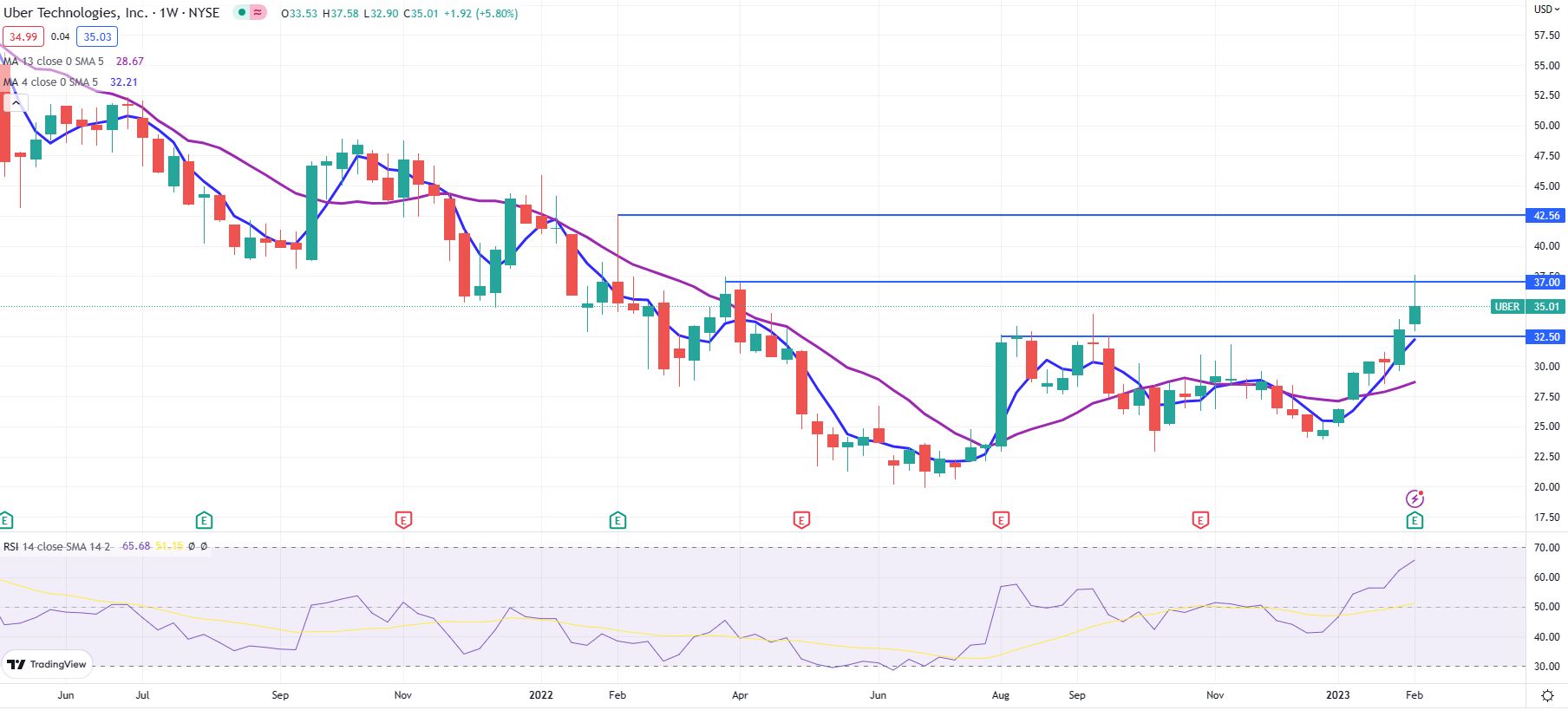
UBER weekly stock chart
Author

Clay Webster
FXStreet
Clay Webster grew up in the US outside Buffalo, New York and Lancaster, Pennsylvania. He began investing after college following the 2008 financial crisis.