Tilray (TLRY) Stock Analysis: Is the cannabis sector in reversal mode?
- Tilray trends higher on Thursday after Tuesday rally.
- Cannabis sector has been in a downtrend since February.
- TLRY stock was buoyed by the hiring of a new executive.


Is the cannabis drought finally over? Tuesday certainly looked the part of a turnaround day for the sector as many of the biggest names in cannabis posted high single-digit returns. Canopy Growth Corporation (CGC) scored an 8.6% stock gain, while Cronos Group (CRON) rose 8.4% and the ETFMG Alternative Harvest ETF (MJ) clocked in at 5.1%.
By far the biggest winner in the sector on Tuesday, however, was Tilray (TLRY). The Canadian conglomerate posted a 15.8% gain after announcing a new president in charge of sales, marketing and operations for its Canadian cannabis units.
Wednesday saw the sector consolidate overall, but most names held onto the vast majority of Tuesday’s rally. With the sector opening slightly higher on Thursday, could this be the start of a rally for the entire sector, as well as TLRY? The latter is trading up 3.2% on Thursday at the time of writing.
Cannabis News: A sector in the dumps
Five years into cannabis being a stock market sector in its own right, investors can be forgiven for giving up. The MJ ETF is down by about half from its price five years ago. Similarly, the AdvisorShares Pure Cannabis ETF (YOLO) is down 36% since its debut in April 2019.
A brief 2020 rally in the sector died around February of this year. Since then, there have been few bright spots for the industry, and most sector-related ETFs have spent the year selling off. While legal marijuana sales continue to climb in both Canada and the US, sector-wide revenue growth has not been translating to profits overall. Few if any companies appear to have competitive brands that confer pricing power.
Tilray Stock News: New executive spurs breakout
Tilray's new executive, Blair MacNeil, comes by way of Bacardi, where he managed alcohol sales for the whole of Canada. His experience in the consumer goods industry is broad with stints at Stoli, Pepsi and River Bend. The news was enough to help TLRY stock break out of a descending price channel it had been locked in since late June.
Earlier this month, the company reported a loss of $34.6 million for Q1 of fiscal 2022, a slight miss based on expectations from FactSet. Revenue also came in below forecasts but still resulted in 43% growth YoY.
The merger with Aphria completed earlier this year is expected to return $81 million in pre-tax cost synergies, and give TLRY a solid foothold in the US and European markets.
Tilray Technical Analysis: TLRY breaks out of trend and above moving average
Tilray is well off its 52-week high of $67 from February, at the time of writing sitting just around $12 per share. On Tuesday, however, TLRY stock broke above the 20-day moving average, which has acted as resistance for much of the year, and the overhead descending trendline that has kept TLRY under wraps since June 29. The next barrier to break for bulls is the nearby 50-day moving average at $12.10.
Beyond that, September showed there is tough resistance at $14. If TLRY shares break the 50-day average, then $14 will be the next target to test. Above here, only the start of the recent descending trend line at $18.67 offers any serious resistance, though the 78.6% Fibonacci level at $15.46 may also be a point for buyers to take profit.
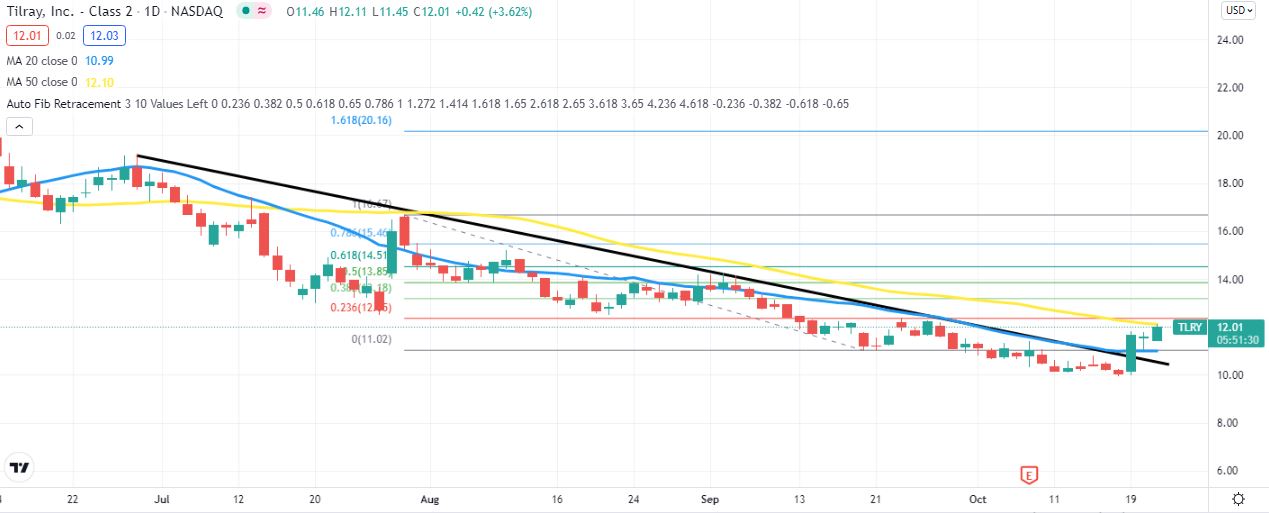
TLRY daily chart
Premium
You have reached your limit of 3 free articles for this month.
Start your subscription and get access to all our original articles.
Author
Clay Webster
FXStreet
Clay Webster grew up in the US outside Buffalo, New York and Lancaster, Pennsylvania. He began investing after college following the 2008 financial crisis.